

The Role of Furniture Prototype in Design
A furniture prototype is a physical or interactive model built during the design process to test and validate concepts before full-scale production begins. Prototypes are the standard tool designers, architects, and product developers use to catch structural flaws, confirm ergonomics, and align stakeholders around a shared vision. Teams that prioritize the role of furniture prototype in design reduce development costs by up to 33% and reach market 50% faster than teams that skip prototyping phases. The furniture design process without prototypes is not faster. It is riskier.
What are the main benefits of using furniture prototypes in design?
Prototyping delivers four concrete advantages: lower costs, faster development, better stakeholder communication, and higher product quality. Each one compounds the others.
Cost savings are the most measurable benefit. Skipping prototypes does not eliminate rework. It delays it. Teams that skip prototyping spend 3–5 times more on post-development fixes than teams that prototype early. Catching a structural flaw in a foam mock-up costs almost nothing. Catching it after production tooling is complete costs a great deal.
Faster time-to-market follows directly from early problem detection. When design flaws surface at the prototype stage, teams resolve them in days rather than weeks. The 50% reduction in time-to-market is not theoretical. It reflects the compounding effect of fewer late-stage surprises.
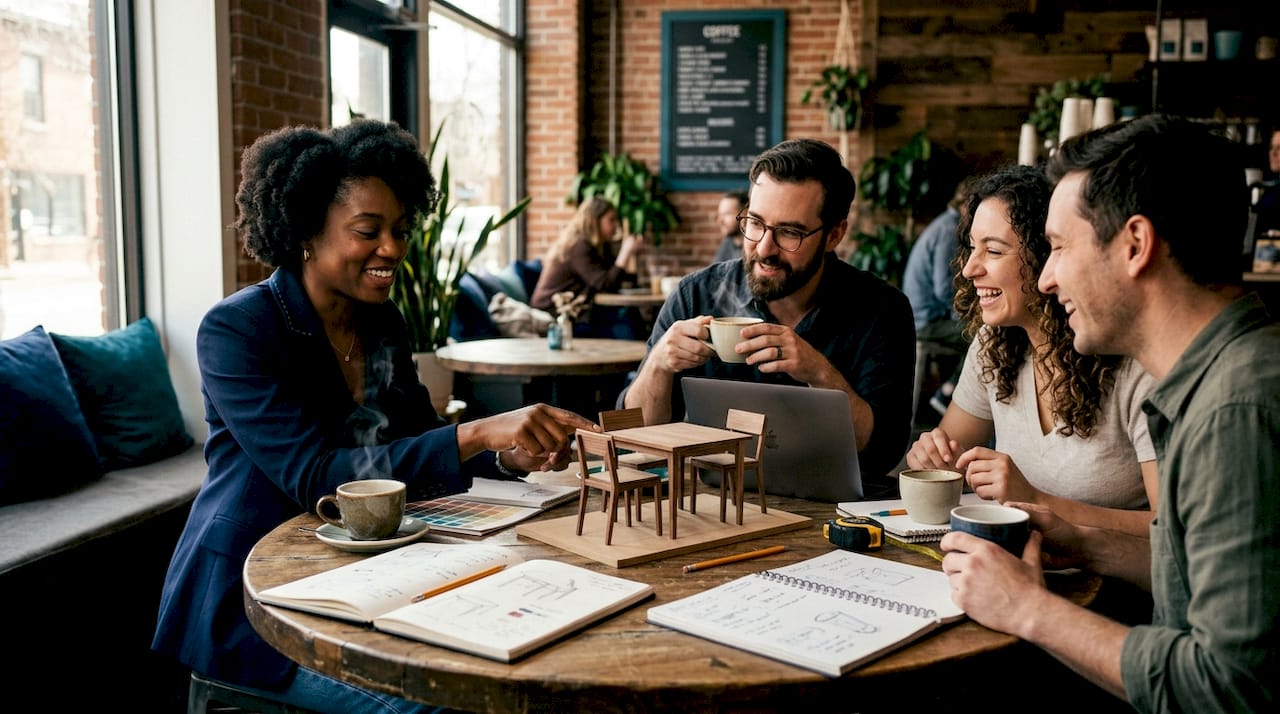
Stakeholder alignment is where prototypes do their quietest work. Tangible prototypes eliminate ambiguity among product managers, clients, and engineers in ways that design files alone cannot. A 3D rendering can be misread. A physical model cannot.
“Prototypes act as a universal language allowing diverse teams, including designers, engineers, and marketers, to share a unified vision before costly production begins.”
Quality assurance improves because prototypes surface issues that drawings hide. Proportion errors, uncomfortable seat depths, and weak joint connections all become obvious the moment someone sits in or handles a prototype. No amount of digital review catches these as reliably as a physical test.
- Reduced rework spending through early flaw detection
- Faster iteration cycles compared to post-production corrections
- Clearer communication between designers, clients, and production teams
- Improved ergonomics and structural integrity before final materials are committed
- Higher confidence in aesthetic decisions when stakeholders can see and touch the piece
Pro Tip: Never skip prototyping to save time on a tight deadline. The rework you avoid at the prototype stage will cost far more in time and money if it surfaces after production starts.
How is the furniture prototyping process structured from concept to final product?
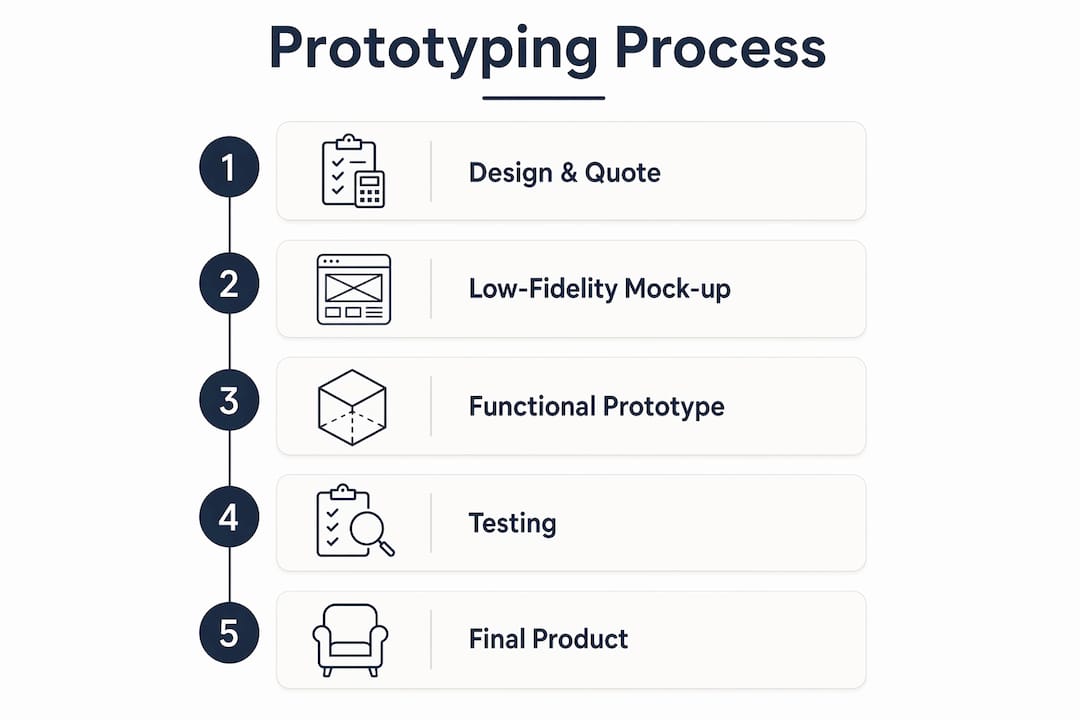
The furniture prototyping process follows a defined sequence of stages, each with a specific purpose and typical timeframe. Understanding this structure helps designers plan resources and set realistic client expectations.
The standard professional prototyping workflow moves through five phases:
- Project brief and NDA. The designer and manufacturer align on scope, confidentiality, and objectives before any design work begins.
- Technical design and quotation (3–10 days). CAD drawings are produced, materials are specified, and costs are estimated. Regulatory requirements such as CARB, TSCA, ASTM, and BIFMA standards are identified at this stage.
- Mock-up (1–2 weeks). A low-fidelity model built from scrap materials verifies proportions, scale, and basic fit. No finish work is applied.
- Functional alpha prototype (2–6 weeks). A near-production model built with final or near-final materials tests structural integrity, joinery, and surface finish.
- Prototype testing and revisions (1–2 weeks). The prototype is evaluated against ergonomic, structural, and aesthetic criteria. Revisions are made before production approval.
| Phase | Typical Duration | Key Activity |
|---|---|---|
| Technical design and quotation | 3–10 days | CAD drawings, material specs, compliance review |
| Mock-up | 1–2 weeks | Proportion and scale verification with scrap materials |
| Functional alpha prototype | 2–6 weeks | Structural and finish testing with near-final materials |
| Prototype testing and revisions | 1–2 weeks | Ergonomic evaluation, stakeholder review, design refinement |
Iterative prototyping cycles are normal and expected. Most furniture pieces go through at least two prototype rounds before production approval. Each cycle narrows the gap between design intent and physical reality. Iterative low-fidelity to high-fidelity cycles are the industry standard for managing risk across the furniture development stages.
Pro Tip: Build compliance review into the technical design phase, not the testing phase. Catching a BIFMA or ASTM issue after the alpha prototype is built adds weeks and cost to the timeline.
What prototyping methods and materials are commonly used in furniture design?
Prototyping methods fall into two broad categories: low-fidelity mock-ups and high-fidelity functional prototypes. Choosing the right method for each stage of the furniture design process saves time and avoids wasted material.
Low-fidelity mock-ups use cheap, readily available materials to test form and proportion. Mock-ups built from scrap wood or foam do not need to look like finished products to be effective. Their only job is to confirm that the piece fits the space and reads correctly at scale. Simplified joinery is acceptable. Surface finish is irrelevant.
High-fidelity functional prototypes use final or near-final materials to test structural performance, finish quality, and ergonomics. These prototypes are built to be evaluated by clients and tested under real-world conditions. They are the last checkpoint before production tooling is committed.
Rapid prototyping and 3D printing have changed how designers validate complex geometry and modular connections. 3D printed modular furniture demonstrates negligible material deformation under load, with structural validation achievable at 0.094 mm precision. That level of accuracy was previously only possible after expensive tooling was produced. Rapid prototyping also eliminates the need to remake costly molds for each design iteration, which reduces upfront investment significantly.
Common prototyping materials by stage:
- Mock-up stage: scrap wood, foam board, cardboard, basic fasteners
- Alpha prototype stage: production-grade timber, metal frames, fabric samples, actual hardware
- Digital validation: CAD software, 3D printing filament, finite element analysis tools
Pro Tip: Use the cheapest material that answers the question you are testing. If you are testing proportion, cardboard works. If you are testing joint strength, use the actual production material.
How do furniture prototypes improve design functionality and aesthetic outcomes?
Prototypes reveal what drawings cannot. A flat elevation drawing communicates dimensions accurately but tells you nothing about how a piece feels to sit in, how it reads from across a room, or whether the proportions work in three dimensions.
Three-quarter view testing of prototypes reveals structural and aesthetic flaws invisible in flat elevation drawings. Experienced designers evaluate prototypes from multiple angles before approving production. A chair leg that looks correct in a front elevation can appear visually heavy from a 45-degree angle. That correction costs nothing at the prototype stage and a great deal after production.
Functional testing under real-world conditions catches ergonomic problems early. Seat depth, armrest height, cushion firmness, and back angle all affect comfort in ways that only become clear when a person actually uses the piece. Sending a functional prototype for user feedback early uncovers hidden usability issues that stakeholders routinely overlook when reviewing design files.
The benefits of prototypes for aesthetic outcomes are equally concrete:
- Surface finish decisions, including color, texture, and sheen, read differently on a physical sample than on a screen
- Fabric drape and leather grain become visible only on a three-dimensional form
- Hardware placement, such as pulls, legs, and brackets, can be adjusted without cost at the prototype stage
- Lighting interaction with surfaces is only assessable on a physical model in the actual space
Rejected sketches and discarded prototypes are a normal and valuable part of refining design and engineering. The goal is not to get it right on the first prototype. The goal is to get it right before production. Every discarded prototype represents a costly industrial error that was caught early. That is the importance of prototypes in practice, not in theory.
Designers working on pieces for specific living environments benefit from choosing furniture that fits the way people actually live. Prototyping is the method that makes that fit possible before a single production unit is built.
Key Takeaways
Furniture prototypes are the most cost-effective tool in the design process, reducing development costs by up to 33% and preventing the 3–5x rework spending that follows when prototyping is skipped.
| Point | Details |
|---|---|
| Prototypes reduce costs | Teams that prototype early spend up to 33% less on overall development. |
| Five-stage workflow | The standard process runs from technical design through mock-up, alpha prototype, and testing. |
| Method matches stage | Use cheap materials for proportion testing; use final materials for structural and finish validation. |
| 3D evaluation is non-negotiable | Three-quarter view testing catches aesthetic and structural flaws invisible in flat drawings. |
| Stakeholder alignment improves | Physical prototypes eliminate ambiguity among designers, clients, and engineers far better than design files. |
Why I think skipping prototypes is the most expensive decision in furniture design
After years of watching furniture projects succeed and fail, the pattern is consistent. The projects that run over budget and miss deadlines almost always share one root cause: the team treated prototyping as optional. They believed that better software, more detailed drawings, or more experienced engineers could substitute for a physical model. They were wrong every time.
The real value of prototyping is not the prototype itself. It is the culture of building early and often that it creates. Teams that prototype regularly get better at identifying which assumptions need testing and which can be trusted. That judgment is worth more than any single prototype.
The uncomfortable truth is that most designers who skip prototyping do so because they are confident in their design. Confidence is not the problem. The problem is that confidence does not reveal how a piece feels to sit in, how it reads from across a room, or whether the joinery holds under daily use. Only a physical model does that.
My advice to designers and architects is direct: build the mock-up, even when it feels unnecessary. The furniture design process rewards the discipline of testing assumptions early. The cost of a foam mock-up is trivial. The cost of a production error is not.
— Pecan
cozyhome furniture and the value of prototype-informed design
At cozyhome furniture, we believe the quality you see in a finished piece reflects the rigor that went into developing it. Every sofa, sectional, and chair in our Plano showroom represents a design that has been tested, refined, and built to perform in real living spaces.
We work with designers and homeowners who want furniture that fits the way they actually live, not furniture pulled from a warehouse floor. Our Excelsior Sofa is a strong example of what prototype-informed production looks like in practice: clean proportions, durable construction, and a finish that holds up over time. If you are a designer or architect working on a project in the DFW area, visit our Plano showroom and see how we approach quality from the ground up.
FAQ
What is a furniture prototype?
A furniture prototype is a physical or interactive model built during the design process to test and validate design concepts before full production begins. It can range from a rough foam mock-up to a near-production functional sample.
How does prototyping reduce furniture development costs?
Teams that prototype early reduce development costs by up to 33% and avoid the 3–5x rework spending that results from catching design flaws after production starts.
What are the main stages of the furniture prototyping process?
The standard process includes technical design and quotation (3–10 days), a low-fidelity mock-up (1–2 weeks), a functional alpha prototype (2–6 weeks), and prototype testing with revisions (1–2 weeks).
When should 3D printing be used in furniture prototyping?
3D printing is most useful for validating complex geometry, modular connections, and structural load points. It allows multiple iterative tweaks without the cost of remaking production molds.
Why do experienced designers evaluate prototypes from multiple angles?
Three-quarter view testing reveals structural and aesthetic flaws that flat elevation drawings cannot show. Evaluating a prototype from multiple angles is the standard practice for furniture designed for real living environments.