

Furniture Showroom vs Warehouse Store: DFW Buyer's Guide
A furniture showroom is a curated retail space where fully assembled pieces are displayed in styled room settings, giving you the chance to test comfort, check scale, and work with design staff before you buy. A warehouse store, by contrast, is a large inventory outlet built around volume and low prices, with minimal displays and limited service. The furniture showroom vs warehouse store debate comes down to one core question: do you want to pay for experience and service, or for speed and savings? For DFW homeowners in Plano, Frisco, Allen, and McKinney, the answer depends on what you are actually furnishing and how long you plan to keep it.
How do pricing and cost structures differ between showrooms and warehouse stores?
Traditional furniture showrooms mark up wholesale costs by 200–300%, driven by high overhead including expensive urban rent and commissioned sales staff. That markup is not pure profit. It funds the styled displays, the design consultants, and the local delivery teams that make the experience work. Premium showroom commercial rent can exceed $1,500 per square meter annually, while warehouse locations typically run $200–$400. That gap in real estate cost flows directly into the price tag on the floor.
Warehouse stores close that gap by buying in volume and operating in lower-cost locations. They pass a portion of those savings to shoppers, which is why the sticker price on a warehouse sofa often looks significantly better than a comparable showroom piece. The catch is that the sticker price rarely tells the full story.

Furniture pricing includes hidden costs such as delivery, assembly, and returns that often cancel out the initial warehouse discount. A sofa that costs $400 less at a warehouse outlet can end up costing more once you add a third-party delivery fee, an assembly service, and a return shipping charge if something arrives damaged.
| Cost factor | Showroom | Warehouse store |
|---|---|---|
| Sticker price | Higher (200–300% markup) | Lower (volume-based margins) |
| Delivery fee | Often included or local flat rate | Third-party, variable cost |
| Assembly | Typically included | Usually self-service or paid add-on |
| Return process | Handled by store team | Third-party logistics, slower |
| Design consultation | Included | Rarely available |
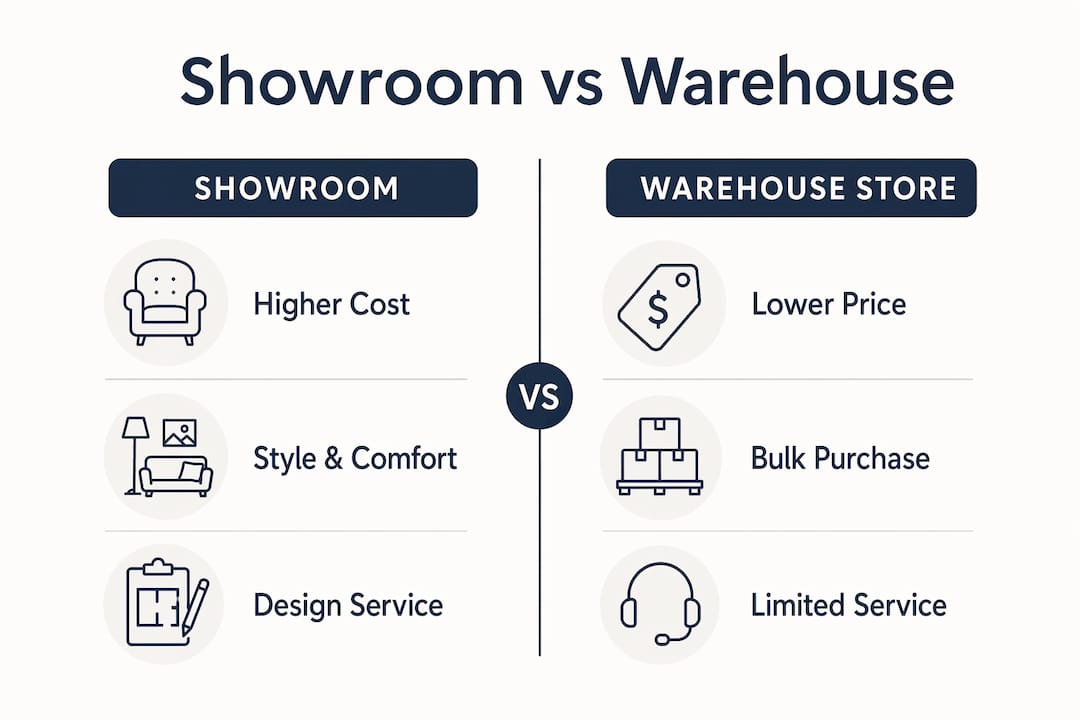
Pro Tip: A hybrid buying strategy can save 20–30% by purchasing basics at volume retailers and investing in custom or high-end pieces at a showroom. Use warehouse pricing for side tables and shelving, and put your budget toward a sofa or bed you can actually test and customize.
What are the differences in delivery, assembly, and after-sale service?
Showrooms typically offer faster, more reliable local delivery and professional assembly, while warehouse and online platforms rely on third-party logistics with longer wait times and separate assembly services. That distinction matters more than most shoppers expect. A showroom delivery team knows the local streets, the building access points, and how to handle packaging disposal. A third-party crew dispatched from a regional hub does not.
Here is what the service difference looks like in practice:
-
Damage resolution: Showroom delivery teams resolve transit damage within days because accountability stays local. Third-party logistics complicate returns and push resolution timelines out by weeks.
-
Assembly: Showroom staff typically assemble and place furniture in the room of your choice. Warehouse delivery often stops at the front door or curb.
-
After-sale support: Showroom staff know the product line and can answer questions after the sale. Warehouse customer service is usually a call center with no product-specific knowledge.
-
Returns: Showroom returns are handled by the same team that delivered the piece. Warehouse returns often require you to repackage and ship at your own expense.
-
Local accountability: Showroom-based delivery teams maintain direct accountability for customer satisfaction in a way third-party services cannot replicate.
Pro Tip: Before buying from a warehouse or outlet, calculate the full cost of delivery, assembly, and a potential return. Add those numbers to the sticker price before comparing it to a showroom quote. The gap often shrinks or disappears entirely.
For DFW shoppers, local delivery reliability is especially relevant. Traffic patterns across the Metroplex mean that a third-party crew running multiple stops can arrive hours late or reschedule entirely. A local showroom team with a defined service area handles that far more predictably. cozyhome furniture, for example, offers free local delivery to Plano and surrounding communities, which removes one of the most common hidden costs from the equation.
How do product quality, customization, and selection compare?
Showrooms help consumers visualize furniture in a styled setting and test comfort and functionality, which warehouse stores rarely facilitate. That hands-on experience is not just a nice feature. It is the most reliable way to know whether a sofa will actually work in your living room before you commit. Sitting on a cushion, checking the seat depth, and feeling the fabric under store lighting tells you things that a product photo cannot.
Warehouse and outlet stores present a different picture on product origin. Approximately 80–85% of outlet mall furniture is manufactured specifically for that channel using lower-cost materials, distinct from showroom inventory. This is a detail most shoppers do not know. Outlet furniture is not clearance stock or manufacturer seconds. It is a separate product line built to a lower specification and priced accordingly.
| Product attribute | Showroom | Warehouse/outlet store |
|---|---|---|
| Material quality | Higher-grade fabrics, frames, and finishes | Cost-efficient materials, made for channel |
| Customization | Fabric, configuration, and size options | Fixed SKUs, no customization |
| Comfort testing | Full in-store testing | Limited or no display models |
| Warranty | Typically included, store-backed | Varies, often manufacturer only |
| Condition disclosure | Full, with staff explanation | Variable, limited staff knowledge |
Showrooms that specialize in made-to-order furniture go further. cozyhome furniture offers more than 700 fabric and leather options, with American-made craftsmanship on sofas, sectionals, beds, and dining furniture. That level of handcrafted furniture durability is simply not available in a warehouse model, where the product is fixed and the only variable is price.
What should DFW consumers consider when choosing between these store types?
The right choice depends on four practical factors: budget priority, customization need, delivery timeline, and how long you plan to keep the piece.
-
Budget priority: If upfront cost is the main concern, warehouse stores offer lower sticker prices on standard pieces. If total lifecycle cost matters more, showrooms often deliver better value through durability and included services.
-
Customization need: Shoppers who want a specific fabric, a non-standard size, or a configuration that fits an unusual room layout need a showroom. Warehouse stores sell fixed products with no adjustment options.
-
Delivery timeline: Warehouse stores typically carry in-stock inventory for faster pickup or delivery. Made-to-order showroom pieces take longer to produce but arrive built to your specification.
-
Local service and accountability: DFW homeowners who want a local point of contact for questions, repairs, or returns get that from a showroom. Warehouse models route service through centralized call centers.
-
Urgency vs. investment: For a guest room or a short-term rental, a warehouse piece at a lower price point makes sense. For a primary living room sofa or a master bedroom bed, the investment in a showroom piece pays off over years of daily use.
The best place to buy furniture in the DFW area is not a single answer. It is a decision based on what you are buying and what you need from the process. A hybrid approach works well for many DFW households: warehouse pricing for accent pieces and accessories, showroom quality for the furniture that gets used every day. Good space planning tips can also help you decide which pieces deserve the most investment before you shop.
Key Takeaways
The most reliable way to evaluate a furniture purchase is total lifecycle cost, not sticker price, because delivery, assembly, and durability gaps between showrooms and warehouse stores consistently close the initial price difference.
| Point | Details |
|---|---|
| Showroom markup reflects service | The 200–300% markup funds design staff, local delivery, and assembly, not just display costs. |
| Warehouse pricing has hidden costs | Delivery, assembly, and return fees often cancel out the lower sticker price. |
| Outlet furniture is made for that channel | 80–85% of outlet furniture uses lower-cost materials distinct from showroom inventory. |
| Customization requires a showroom | Fabric, size, and configuration options are only available through showroom retailers. |
| Hybrid buying saves money | Purchasing basics at volume retailers and investing in key pieces at showrooms can save 20–30%. |
What I have learned from watching DFW shoppers choose
The regret pattern I see most often is straightforward. A shopper buys a sofa at a warehouse outlet to save money, and within two years the cushions have flattened, the frame has shifted, and the piece looks tired. They then spend close to the same amount replacing it. The math on that decision never works out.
What I have also noticed is that the shoppers who feel best about their purchases are not always the ones who spent the most. They are the ones who matched the store type to the purchase type. They bought their everyday sofa at a showroom, tested it, customized the fabric, and had it delivered by people who knew what they were doing. They bought their home office shelving at a volume retailer and assembled it themselves on a Saturday afternoon. That combination is genuinely smart buying.
Warehouse stores are not bad. They fill a real need for budget-conscious buyers, renters, and people furnishing spaces that will change soon. But for a piece that will sit in your living room for a decade, the showroom model wins on almost every measure that matters: comfort, durability, service, and the simple confidence of knowing exactly what you bought before it arrived.
The DFW market has enough options in both categories that you do not have to choose one model for everything. Use each format for what it does best.
— Pecan
cozyhome furniture: showroom quality with local DFW service
cozyhome furniture brings the full showroom experience to Plano, with a hands-on space where you can test comfort, choose from 700+ fabric and leather options, and work with staff who know the product inside and out.
We offer free local delivery to Plano, Frisco, Allen, McKinney, and surrounding DFW communities, with flexible financing to fit a range of budgets. Every piece is American-made and built to your specifications, not pulled from a warehouse floor. If you are ready to see the difference that customization and craftsmanship make, the Excelsior sofa is a strong place to start. You can also browse the Koba sofa in black for a bold, well-constructed option that pairs showroom quality with a competitive price point.
FAQ
What is the main difference between a furniture showroom and a warehouse store?
A furniture showroom is a curated retail space focused on styled displays, design consultation, and custom ordering. A warehouse store prioritizes volume inventory and lower prices with minimal service or display.
Are warehouse furniture stores worth it for DFW buyers?
Warehouse stores work well for accent pieces, guest room furniture, and budget-focused purchases. For primary living room or bedroom furniture, the total cost of delivery, assembly, and shorter product lifespan often offsets the savings.
Why is showroom furniture more expensive?
Showroom pricing reflects a service package that includes expert design advice, local delivery, professional assembly, and local accountability. The markup of 200–300% over wholesale covers those costs, not just the display floor.
Is outlet furniture the same quality as showroom furniture?
No. Approximately 80–85% of outlet furniture is manufactured specifically for the outlet channel using lower-cost materials. It is not clearance or manufacturer-second stock from showroom lines.
How can DFW shoppers get the best value when buying furniture?
A hybrid approach works best: use volume retailers for basics and accent pieces, and invest in a showroom for sofas, beds, and dining furniture that will see daily use. This strategy can save 20–30% while protecting quality where it matters most.