

Choose Table Edge Types Confidently: A 5 Step Showroom Checklist
Table edge types fall into a handful of families: rounded (bullnose and roundover), chamfer and bevel, eased or square, ornamental (ogee, cove, thumbnail), structural waterfall edges, and natural live edge. The right pick comes down to three things: the style you’re building toward, how the edge feels against your arm every single day, and how well it holds up over years of use.
TL;DR:
- Rounded edges like bullnose and roundover are safest for households with children, as they eliminate sharp corners that could cause injuries.
- Ornate profiles such as ogee and cove require harder woods to maintain their detail and are more prone to chipping with frequent use.
- Waterfall and live edge tables depend on strong joinery and reinforcement underneath to maintain stability due to their shapes removing structural mass.
- Smooth bevels and eased edges visually make a tabletop appear lighter or heavier based on their cut angle, affecting perceived thickness.
- Testing sample profiles by hand before purchase ensures comfort, durability, and that the profile matches the feel and style needed for long-term use.
Table of Contents
- What Are the Common Types of Table Edges?
- How Edge Profile Changes Perceived Thickness and Comfort
- Checklist for Choosing a Table Edge Before You Buy
- How Cozyhome Approaches Edge Selection In-Showroom
- Balancing Style and Function in Your Final Choice
- Bring Your Edge Profile to Life at Cozyhome
- Sources
- FAQ
What Are the Common Types of Table Edges?
Every table edge starts as a flat, square board until a router bit, hand plane, or sander changes its profile. That change does more than dress up the silhouette. It shapes how the table feels to touch, how much light it catches, and how forgiving it is with kids, pets, and daily wear. Here’s what to look for, whether you’re scanning photos online or running your hand along a sample in a showroom.
Bullnose and roundover. A bullnose rounds the edge into a full half circle, while a roundover softens just the top corner and leaves the underside flatter. Both read as casual and friendly. They’re the default choice for family dining tables and kitchen islands because there’s no sharp corner to catch a hip or a toddler’s forehead. Softening a tabletop edge with a roundover measurably improves comfort for arms and hands and cuts down on chipping in busy households.
Chamfer. A chamfer cuts a flat angled face across the corner instead of a curve, usually at 45 degrees. It’s a quick way to add a crisp, architectural line without softening the whole look. Chamfers show up often on modern and industrial dining sets, and they resist chipping better than a true square edge.
Bevel. Similar to a chamfer but often steeper or wider, a bevel can run the full thickness of the top or just a portion of it. A steep, narrow bevel tends to make a tabletop look thicker and more substantial. A wide, sweeping bevel does the opposite, visually thinning out a heavy slab.
Eased or square. This is the simplest option: a nearly flat edge with just enough sanding to knock off the razor corner. It’s the go-to for minimalist and Scandinavian-style pieces, and it’s inexpensive to produce consistently across a large run of furniture.
Ogee. An ogee carves an S-curve into the edge, alternating concave and convex. It’s ornate, traditional, and most at home on formal dining tables or antique-style reproductions. Ogee profiles need harder woods to hold their fine detail without crumbling at the tips.
Cove. A cove is a single concave curve, essentially the inverse of a bullnose. It reads as understated and traditional, often paired with a small bead or lip for definition.
Thumbnail and partial thumbnail. Named for its resemblance to a rounded fingernail, this profile combines a curve with a small flat shoulder. It splits the difference between a full roundover and a formal ogee, making it a popular middle ground for traditional dining sets.
Waterfall. Instead of shaping the edge itself, a waterfall edge continues the tabletop’s grain and finish down the vertical face of the legs or base in one unbroken line. It’s a modern, sculptural look that depends heavily on precise miter joints.
Live edge. This keeps the tree’s natural, unshaped contour, bark line and all, usually on one or both long sides of a slab. It’s the most organic option on this list and the one that varies the most from piece to piece, since no two slabs are identical.
Laminated and applied edges. Commercial and budget-friendly tables sometimes use a separate edge treatment, like vinyl T-molding or a back-beveled strip, applied to a laminated core for durability and easy repair. Manufacturers commonly reference profiles like silhouette, eased, bullnose, slope, square, traditional, live, and bevel as a standard field vocabulary.
A few practical notes worth flagging before you fall in love with a photo:
- Rounded profiles are the safest bet for households with young kids.
- Ornate profiles like ogee and cove chip more easily and need harder woods to hold detail.
- Waterfall and live edges depend on strong joinery, since the shape often removes structural mass.
- Laminated edges with applied trim are easiest to repair in high-traffic commercial settings.
Pro Tip: Bring a photo of your room to the showroom, but don’t decide on an edge from a photo alone. Run your palm along a physical sample first. A profile that looks elegant in a picture can feel surprisingly sharp or clumsy in person.
How Edge Profile Changes Perceived Thickness and Comfort
The edge you choose can make an identical slab of wood look heavier or lighter depending on the angle and depth of the cut. Steep, narrow bevels tend to accentuate a tabletop’s perceived thickness, while wider, sweeping bevels or underbevels make the same top look leaner. If your dining table already feels bulky in the room, a gentle underbevel can visually trim it down without shaving a single inch of material.
Comfort and chip resistance follow a similar logic, and the differences show up fast in daily use:
- Rounded edges (bullnose, roundover) feel best against forearms during long meals.
- Sharp or square edges show wear and small chips faster in busy kitchens.
- Ornate profiles like ogee need hardwoods such as oak or maple to hold their detail; softer woods blur the lines over time.
Simple profiles are often the smarter choice for softer woods because they’re easier to cut consistently and don’t rely on crisp detail to look finished. Reserve the elaborate router work for dense, tight-grained species.
Pro Tip: Ask your maker about “kissing” the edge with a hand plane. This light hand-finishing technique adds a subtle, light-catching facet that no stock router bit replicates, and it’s a hallmark of genuinely custom furniture.
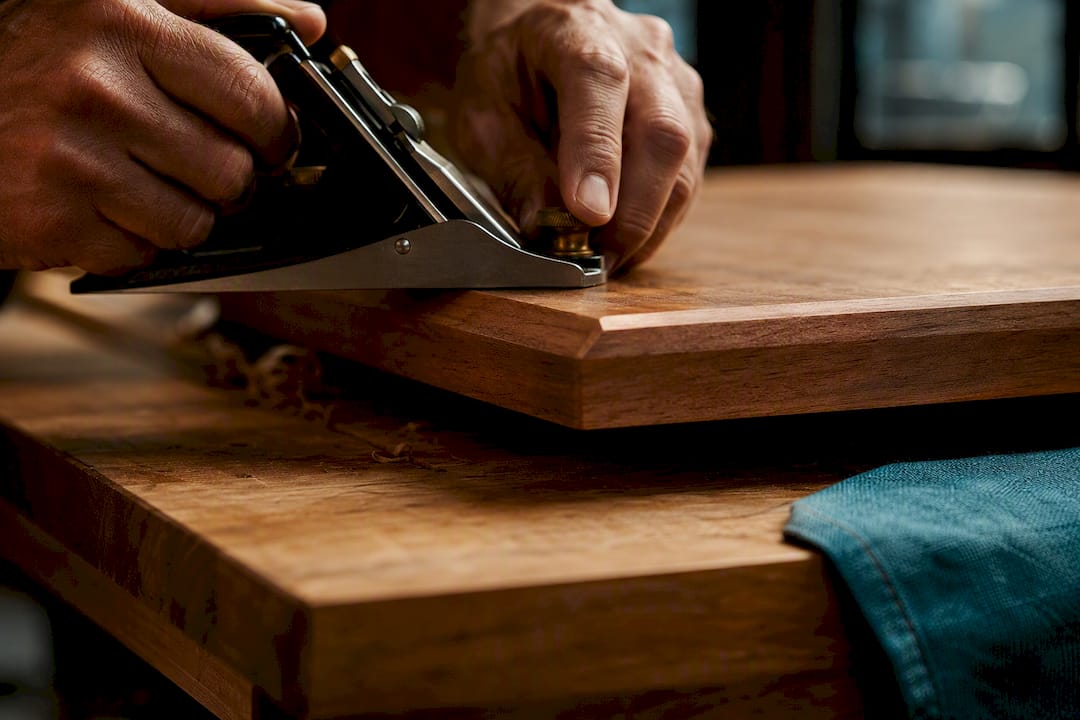
For restaurants or heavy-use spaces, skip the delicate ogee entirely. Roundovers and eased edges shrug off daily bumps and are far cheaper to touch up when they do get dinged.
Checklist for Choosing a Table Edge Before You Buy
Walking into a showroom without a plan usually ends in decision fatigue. Work through these steps in order:
- Pick your style family first. Decide broadly between rounded, angular, ornamental, or live edge before you compare individual profiles.
- Test a physical sample. Run your hand and forearm along the actual edge, not a photo or rendering.
- Confirm the wood species can hold the detail. Ask whether the profile you like has been cut in that exact species before.
- Check overhang and seating clearance. Make sure knees and chair arms clear the edge comfortably at your intended table height.
- Ask about reinforcement for live edges and waterfalls. These profiles often remove structural material and need extra bracing underneath.
A few questions are worth asking any maker directly: what bit or hand technique produces this edge, how will joints and laminates be finished, and can you see the profile cut into the actual species you’re ordering?
Watch for red flags too. Long, unsupported overhangs on heavy tops can create real tipping risk once you calculate the lever-arm force pressing down at the far edge, especially on pedestal bases. Unclear stabilization plans for live-edge slabs and a mismatch between a delicate profile and a soft wood species are two more signs to keep shopping.
How Cozyhome Approaches Edge Selection In-Showroom
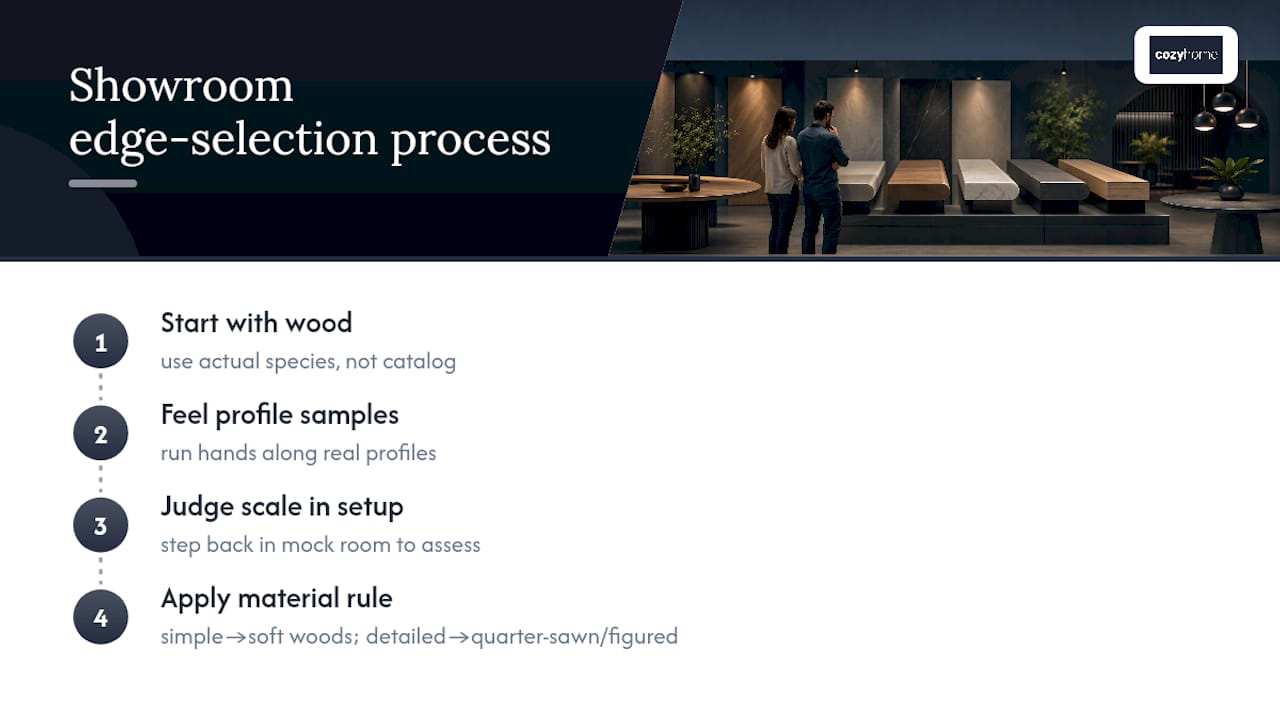
Cozyhome furniture starts every edge conversation with the actual wood, not a catalog page. Customers run their hands along real profile samples cut into the species they’re considering, then step back to judge scale in a mock room setup. Our general rule: simpler profiles suit softer, more casual woods, while detailed edges belong on quarter-sawn or figured hardwoods that can hold a crisp line for decades.
Balancing Style and Function in Your Final Choice
Families do best with a forgiving roundover. Formal hosts often lean toward an ogee or thumbnail edge. Rustic lovers gravitate to live edge every time. Whichever direction you’re leaning, test a real sample before you commit, and save the fully custom edge for a piece you plan to keep a long time.
— Dean P.
Bring Your Edge Profile to Life at Cozyhome
Photos and charts only get you so far when you’re picking a table edge. A showroom letting you handle real profile samples across fabric, leather, and wood options before you commit to anything helps ensure the roundover or waterfall edge you’re picturing actually feels right under your hand. Staff can guide you through which profiles hold detail best in your chosen wood and how overhang affects seating comfort at your table height.
If a custom dining table with a specific edge profile is what you’re after, a maker can spec it around your room and your routine. Not ready for a full custom build? Browse pieces like the Excelsior sofa or explore wood species options that pair well with different edge treatments, then stop by the showroom or request a quote to get the process started.
Sources
- The Right Edge for Your Tabletop — FineWoodworking
- Selecting table edge profiles — Woodsmith
- Dining Table Stability — Woodweb
- Table Edge Profiles — Meyer Wells
FAQ
What Is the Edge of a Table Called?
The shaped border running around a tabletop’s perimeter is called the edge profile, and common names include bullnose, bevel, ogee, and live edge depending on how it’s cut.
What Type of Countertop Edge Is Best?
There’s no single best edge. Rounded profiles like bullnose suit busy family kitchens for comfort and chip resistance, while a beveled or ogee edge suits a more formal look in a lower-traffic space.
What Are the Different Types of Wood Edges?
The main categories are rounded (bullnose, roundover), angular (chamfer, bevel), simple (eased, square), ornamental (ogee, cove, thumbnail), and natural (live edge), plus structural styles like the waterfall edge.
Is a Live Edge Table More Fragile Than a Standard Table?
Live edge slabs need proper stabilization at the base since they often carry more mass unevenly across the span; a maker like cozyhome furniture can confirm reinforcement before you order. Ask specifically how the piece is braced underneath before buying.
Are Rounded Edges Safer for Homes With Kids?
Yes. Bullnose and roundover profiles remove the sharp corner entirely, which cuts down on injuries and is why they’re the standard recommendation for family dining tables.