

Get a Sofa That Fits: Measure Buttock to Knee for Sofa Seat Depth
The most comfortable seat depth for most people falls within a range typical for standard to deep sofas, with shallower sofas and lounge-style seating available outside that range. The quickest way to find your number: sit fully back, measure from your tailbone to the crease behind your knee, then subtract a small amount for clearance. Or use the two-finger test at the showroom, sliding your fingers between the seat edge and the back of your knee once you’re settled in. Cushion fill and seat height shift how deep a sofa actually feels, so treat these ranges as a starting point, not a finish line.
TL;DR:
- The most comfortable seat depth typically ranges from 20 to 24 inches for standard sofas, but personal measurements and lifestyle preferences can shift this ideal.
- Measuring your buttock-to-knee length and using the two-finger rule behind your knee can help identify a seat depth that provides proper support and comfort.
- Cushion fill and construction significantly affect perceived depth, so firmer cushions and added support can help maintain the intended dimensions.
- For shared sofas, 22 to 23 inches of seat depth balance well across different body types and usage patterns, especially in smaller rooms.
- Custom sofas allow precise depth specification based on accurate measurements, reducing the risk of discomfort caused by typical specification inaccuracies.
Table of Contents
- What Sofa Seat Depth Actually Means
- Standard Sofa Seat Depth Ranges (and Why Seat Height Matters Too)
- How to Measure Your Body for the Right Seat Depth
- Why Cushions Change the Seat Depth You Actually Feel
- Matching Seat Depth to How You Actually Live
- Showroom-Tested Tips From cozyhome Furniture
- Why Three Inches Makes a Real Difference
- Let Us Help You Get the Depth Right the First Time
- Sources
- FAQ
What Sofa Seat Depth Actually Means
Seat depth gets confused with two other measurements constantly, and that mix-up is why so many people end up with a sofa that looks right on paper and feels wrong in the living room. Inside seat depth (sometimes called usable depth) runs from the front edge of the seat cushion to the point where your back meets the backrest. Overall depth measures the entire frame, arm to arm, front to back, which tells you almost nothing about how a seated person will feel.
Spec sheets rarely make this distinction clear, and that’s the trap. A sofa listed at “36 inches deep” might mean the frame footprint, while the usable seat depth, once cushions are in place, is closer to 22 inches. According to Rove Lab’s measurement guide, the accurate way to measure is front cushion edge to backrest contact point, accounting for how cushions sit once you’re actually seated.
When you’re shopping, ask one direct question: “Is this the inside usable seat depth, or the frame depth?” A retailer or salesperson who can answer immediately usually knows their product well. One who can’t is guessing right along with you.
Standard Sofa Seat Depth Ranges (and Why Seat Height Matters Too)
Seat depth falls into four rough bands, and knowing where you land in each one narrows your search fast. RoomSketch3D’s dimension reference puts shallow seating at 18 to 20 inches, standard at 20 to 24 inches, and deep at 24 to 28 inches, with anything beyond that qualifying as extra deep.
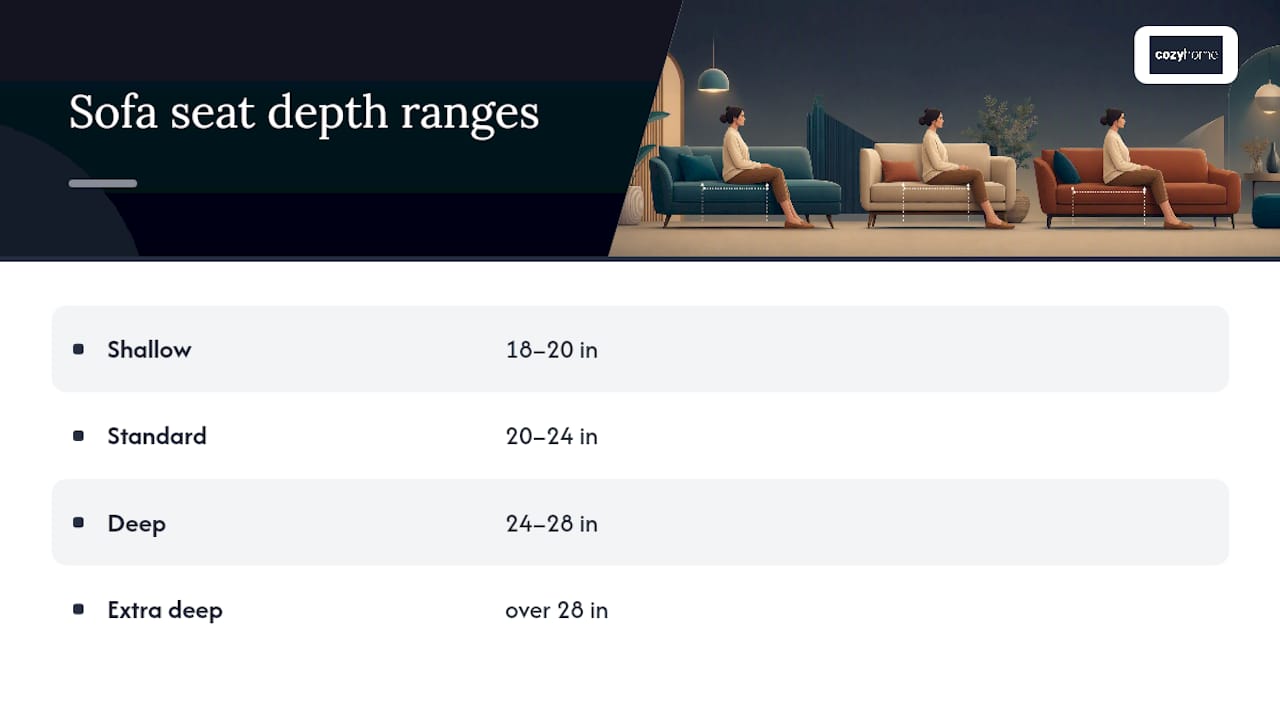
Seat depth categories are generally described as shallow, standard, deep, and extra deep, each suited to different user needs and preferences. Seat heights are often paired appropriately, but specific inch values vary across sources.
Seat depth doesn’t work alone. Seat height changes how easy it is to stand up, and how a given depth actually feels under you. Standard sofas run 17 to 19 inches high, and cozyhome furniture’s own seat height testing shows that pairing a deeper seat with a slightly higher seat height, closer to 19 inches, makes it noticeably easier to stand without scooting forward first. A deep, low seat can feel like sinking into a hole rather than sitting down.
If more than one person with different builds shares the sofa, 22 to 23 inches is the compromise zone that satisfies the widest range of bodies without frustrating anyone.
How to Measure Your Body for the Right Seat Depth
Skip the guesswork and measure your buttock-to-knee length, also called popliteal length in ergonomics research. Sit in a straight chair with your back against the wall and feet flat on the floor, then measure from your tailbone to the crease behind your knee. Whatever number you get, your ideal seat depth sits at roughly 80 to 95% of it, per the ergonomic guidance from PostureSolved. If your buttock-to-knee measurement is 24 inches, look for a seat depth between 19 and 23 inches.
Here’s the showroom version of the same test, and it takes less than a minute:
- Sit all the way back until your spine touches the backrest.
- Keep your feet flat on the floor, knees at a natural bend.
- Slide two or three fingers between the seat edge and the back of your knee.
- Check whether your lower back actually rests against the cushion, or floats in front of it.
- Try standing up without scooting forward first.
That finger gap matters more than it sounds. Ergonomics research on seating standards notes that a small clearance behind the knee prevents pressure on the soft tissue and blood vessels there, which is exactly why the two-to-three-finger rule keeps showing up in furniture guides.
Pro Tip: If you love lounging with your legs up, add an inch or two beyond your measured number. If you sit upright to work or eat, subtract an inch instead. Your measurement is a target, not a rulebook.
Why Cushions Change the Seat Depth You Actually Feel
The number on the tag and the seat you experience aren’t always the same thing, and cushion construction is usually the reason why. A firm, tightly attached back cushion holds the listed depth close to accurate. A loose, overstuffed back cushion can eat 1 to 4 inches of usable space, since it compresses forward under your weight, according to Houzz’s sofa buying guide.
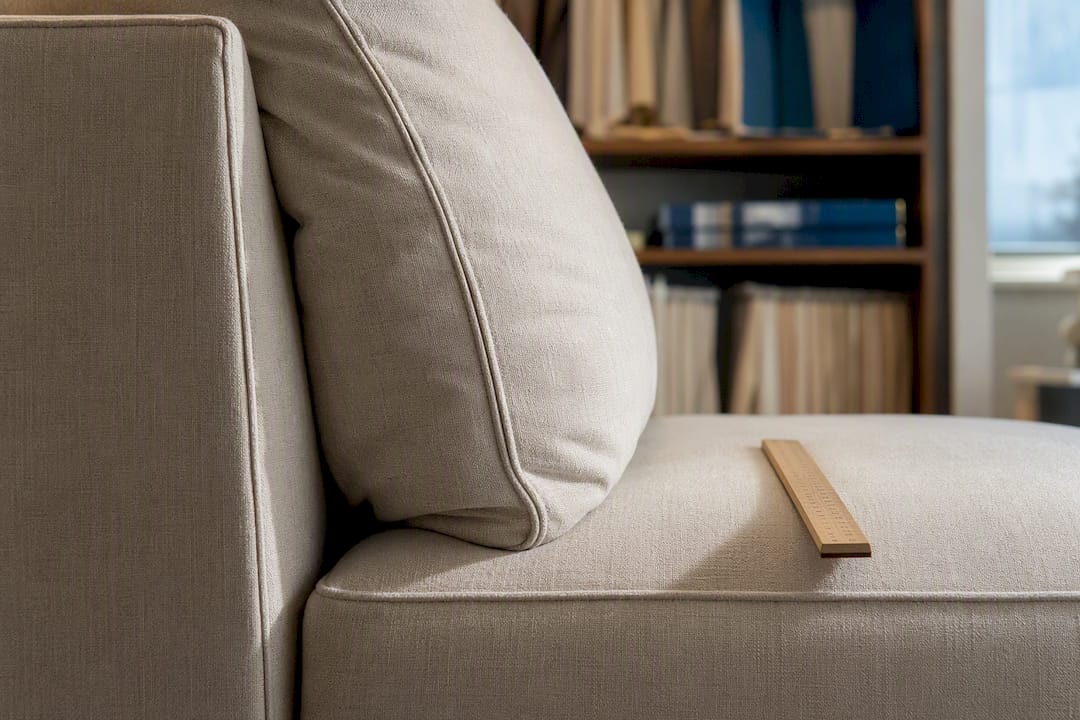
Soft, sinky seat cushions play a similar trick in the opposite direction: they make a seat feel deeper than it measures, because your body settles lower and further back than a firm cushion would allow.
A few fixes handle most of these surprises:
- Choose a firmer seat cushion if you want the listed depth to hold true.
- Add a lumbar pillow to close the gap on an oversized seat without buying new furniture.
- Use a seat wedge for extra upright support on soft cushions.
- Pair a deep sofa with an ottoman so shorter sitters can still plant their feet.
- Order a slightly shallower frame if you know you prefer plush, overstuffed backs.
Matching Seat Depth to How You Actually Live
The best seat depth depends less on your living room’s square footage and more on what you do on that sofa most often.
- Loungers and nappers do best with 24 to 28 inches, deep enough to pull your legs up and settle in sideways.
- Formal sitters, people who use the sofa for entertaining or upright conversation, are more comfortable at 20 to 22 inches.
- Media room seating leans deep, 24 inches or beyond, since most people recline for hours at a stretch.
- Mixed households land safest at 22 to 23 inches, the range that flatters the most body types.
Room size plays its own role. A deep sofa in a tight room can visually swallow the space, so pairing it with low arms or a piece that shows some leg beneath the frame keeps the room from feeling boxed in, a trick worth remembering if you’re furnishing a smaller apartment-size living room. If you can’t settle on one depth for the whole household, a modular sectional with a chaise lets people choose their own zone instead of forcing a single compromise on everyone.
Showroom-Tested Tips From cozyhome Furniture
Dean P. walks customers through the same checklist on every showroom visit, because seat depth is the single dimension buyers get wrong most often. Ask for the usable seat depth, not just the frame measurement. Ask what the cushion fill is made of, since foam density and fiber wrap change how a seat feels within the first year of ownership. Bring a lumbar pillow from home and test it against the actual piece. Confirm the seat height pairs with the depth in a way that lets you stand up without effort.
When cozyhome furniture builds a custom sofa, usable depth and frame depth get reported separately, precisely because customers deserve to know which number they’re buying. If you’re ordering sight unseen, request photos of the frame with cushions installed, or ask to sit on a similar floor model so you can feel the depth before committing. Our order-ready dimension checklist walks through exactly what to confirm before signing off on a custom build.
Why Three Inches Makes a Real Difference
A three-inch swing between seat depth options sounds trivial until you’ve sat wrong on a sofa for six months. That gap is enough to move your knees from a supported bend to an awkward float, or to leave your lower back unsupported the entire time you’re seated. Cushion softness magnifies the effect further, since a plush seat can turn a technically correct depth into a poor fit.
If you have to compromise, prioritize your buttock-to-knee measurement first and your lifestyle preference second. Lounging habits and room size are real considerations, but a sofa that fits your body wrong will never feel right no matter how you use it. When one depth can’t satisfy everyone in the house, adjustable fixes, an ottoman, a lumbar pillow, a modular piece, close the gap better than picking a number and hoping.
— Dean P.
Let Us Help You Get the Depth Right the First Time
Reading dimensions off a spec sheet only gets you so far. cozyhome furniture builds sofas around your actual measurements instead of asking you to adjust your body to fit a warehouse floor model.
When you visit our Plano showroom, we walk through the same checklist Dean P. uses with every customer: your usable seat depth, cushion-fill preference, and seat-height pairing, all before a single yard of fabric gets cut. With 700+ fabric and leather options and American-made construction, you’re not choosing between “close enough” sizes off a floor. You’re specifying the depth that actually matches your buttock-to-knee measurement and how you plan to use the piece. Browse the made-to-order custom sofas and sectionals to see configuration options, or stop by the showroom and bring your measurements. We’ll help you turn a number into a sofa that fits the way you actually sit.
Sources
- Standard sofa and loveseat sizes: complete reference | RoomSketch3D
- Seat depth for tall and short people — PostureSolved
- Sofa Secrets: How to Choose the Right Seat Depth and Cushions — Houzz
- Updated chair standards overview — EWI Works (ergonomics PDF)
FAQ
What Is the Seat Depth on a Sofa?
Seat depth is the distance from the front edge of the seat cushion to the backrest, measured with cushions in place rather than across the whole frame. It’s the single most important number for figuring out whether a sofa will actually feel comfortable once you sit down.
What Is the 2/3 Rule for Sofas?
There’s no single universal “2/3 rule” in furniture standards, but the common version buyers reference means your seat depth should equal roughly two-thirds to three-quarters of your buttock-to-knee length, leaving a small gap behind the knee. The more precise ergonomic target is 80 to 95% of that measurement, with two to three fingers of clearance behind the knee.
Is 27 Seat Depth Good?
A deep seat depth falls within the range better suited to taller people or anyone who prefers lounging with their legs pulled up. For shorter individuals, a deep seat often leaves the knees floating without back support, so it’s worth testing with the two-finger method before buying.
How Do I Know if a Sofa Is Too Deep for Me?
If your feet can’t rest flat on the floor while your back touches the cushion, or if you have to scoot forward to stand up, the seat depth is too deep for your body. Cushion firmness can shift this slightly, so always test with your preferred seating posture.
Can I Get a Custom Seat Depth Instead of a Standard Size?
Yes. Some custom furniture makers build sofas to order, specifying seat depth to your measurements rather than from a handful of preset sizes.