

How Tall Should a Headboard Be? A Height Guide That Works
For most beds, the headboard should rise a modest distance above the mattress, with twin beds having the shortest headboards and king or California king frames the tallest. A common rule is to leave a visible gap of wall space between the top of the headboard and the ceiling to keep a bedroom feeling balanced instead of cramped.
Here’s the fast version before we get into specifics:
- Twin/Twin XL: a lower headboard height above the mattress
- Full/Queen: a moderate height above the mattress
- King/California King: a taller headboard height that can be quite substantial for statement styles
These figures track closely with what Casper’s headboard sizing guide recommends as standard reference points, and they match what we see order after order at cozyhome furniture. Ceiling height, mattress thickness, and how many pillows you stack up all nudge these numbers up or down, which is exactly what the rest of this guide walks through.
Key Takeaways
Headboard height depends on mattress size, ceiling height, and pillow volume, with 14 to 29 inches above the mattress covering most standard beds.
| Point | Details |
|---|---|
| Match height to mattress size | Twin runs about 14 inches above the mattress; queen runs 24 to 28 inches; king can reach up to 58 inches. |
| Leave ceiling breathing room | Keep 24 to 36 inches of wall between the headboard top and the ceiling for visual balance. |
| Measure both floor-to-top and mattress-top | Floor-to-top checks ceiling proportion; mattress-top checks pillow clearance and comfort. |
| Test before you buy | Mark the proposed height with painter’s tape and view it from the doorway before ordering. |
| Consider custom sizing for odd rooms | Vaulted ceilings, built-ins, or tight rooms often call for made-to-order headboard heights. |
Table of Contents
- Headboard Height Guide: Sizes and Widths by Mattress
- How to Measure Your Room for the Right Headboard Height
- Matching Headboard Height to Your Ceiling
- Materials and Styles That Change How Tall a Headboard Feels
- Your Headboard Height Checklist Before You Buy
- When Standard Sizes Don’t Fit Your Room
- How cozyhome furniture Solves Awkward Headboard Proportions
- What Most Headboard Advice Gets Backwards
- Sources
- FAQ
Headboard Height Guide: Sizes and Widths by Mattress
Picking a headboard height starts with matching it to your mattress size, then adjusting for the room around it. Width matters just as much as height. A headboard that’s narrower than the mattress looks like a mistake, while one that’s a few inches wider on each side reads as intentional.
| Mattress Size | Recommended Headboard Width | Typical Height Above Mattress | Floor-to-Top Range |
|---|---|---|---|
| Twin/Twin XL | 42 inches | ~14 inches | 48 inches |
| Full | 58 inches | 24 inches | 54 inches |
| Queen | 62 inches | 24–28 inches | 48–58 inches |
| King | 84 inches | 28 inches | 50 inches |
| California King | 74 inches | 28–58 inches | 50–72 inches |
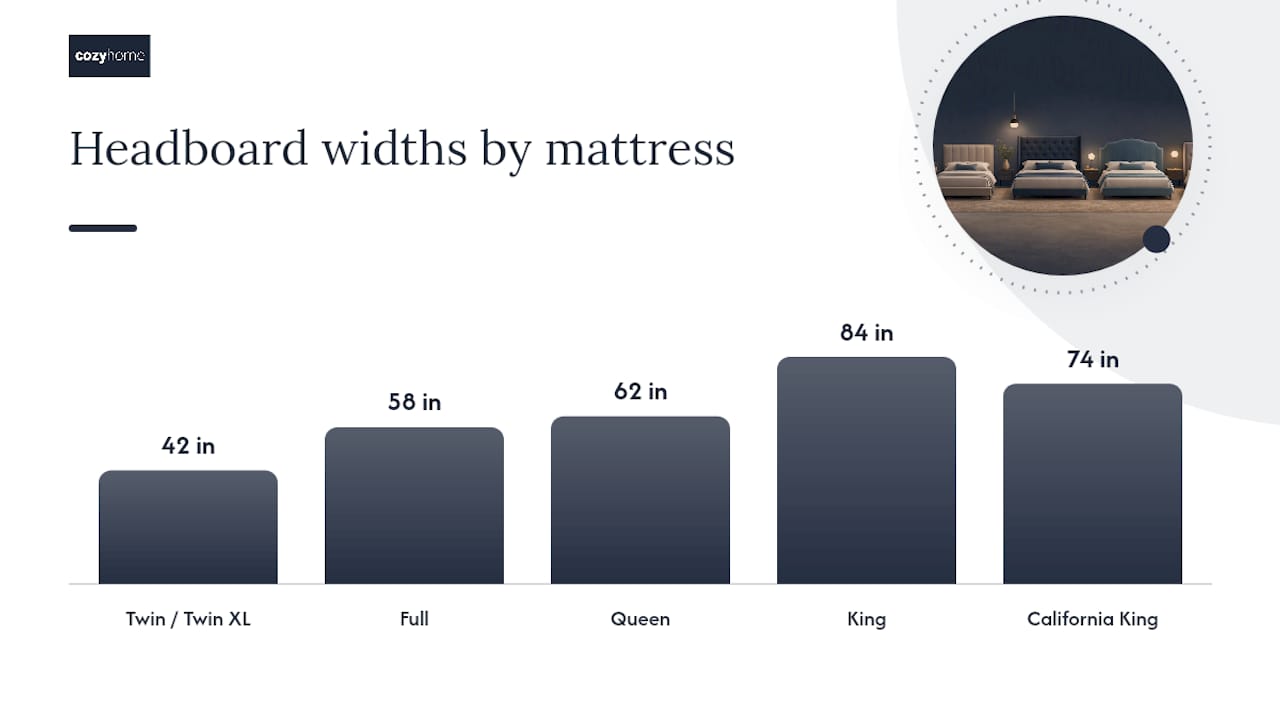
These width-to-mattress pairings show up consistently across retailer guides because they’re based on the same basic logic: a queen mattress measures 60 inches wide, so a 62-inch headboard leaves a clean inch of overhang on each side rather than a stark, boxed-in edge.
A few adjustments matter once you’re standing in front of your own bed frame:
- Thick mattresses need extra height. A 14 to 16 inch mattress on a platform frame sits noticeably higher than a standard 10 inch mattress, so add 2 to 4 inches to your headboard height target so it doesn’t disappear behind the pillows.
- Pillow stacks eat into visible headboard. If you sleep with four or more pillows piled up, budget another 2 to 6 inches of height so the headboard still peeks out above the pile.
- Box springs and bed risers change the floor-to-top math. Measure with your actual setup in place, not the mattress alone.
Room footprint matters too. A queen bed with a proportionally sized headboard needs roughly 10 by 10 feet of usable floor space to avoid feeling like the furniture is wearing the room. King beds push that closer to 12 by 12 feet, especially once nightstands and a dresser enter the picture.
How to Measure Your Room for the Right Headboard Height
Skipping the tape measure is the single most common reason headboards get returned. Here’s the sequence that actually prevents that.
- Measure your ceiling height first, floor to ceiling, in the exact spot where the bed will sit. Ceilings vary by an inch or two even within the same house, so measure the real wall, not the listing sheet.
- Measure floor to the top of your mattress, including any platform, frame, or box spring already in place. This is your baseline for figuring out how tall a headboard can go before it competes with the ceiling.
- Measure your typical pillow stack height while pillows are fluffed and in normal use, not flattened. This tells you how much headboard needs to show above the pillows to still look intentional.
- Mark the proposed headboard height with painter’s tape directly on the wall, then step back and view it from the bedroom doorway. Design guidance from TheFineBed recommends this exact mockup step because it’s the cheapest way to catch a sizing mistake before it’s a $1,200 mistake.
The mix-up we see most often: confusing total headboard height (floor to top) with height above the mattress. They’re not the same number, and using the wrong one throws off your entire proportion calculation. Floor-to-top tells you how the headboard relates to your ceiling. Mattress-top-to-headboard tells you how comfortable it’ll feel when you sit up to read or scroll your phone before bed.
Pro Tip: Measure from the mattress top, not the floor, when your main concern is pillow clearance and back support. Measure from the floor when your main concern is how the headboard reads against the ceiling. Do both, write both numbers down, and you’ll never confuse them mid-shop.
Matching Headboard Height to Your Ceiling
Ceiling height is the variable that changes everything else. A headboard that looks perfectly scaled in a 10-foot loft can swallow a room with 8-foot ceilings.
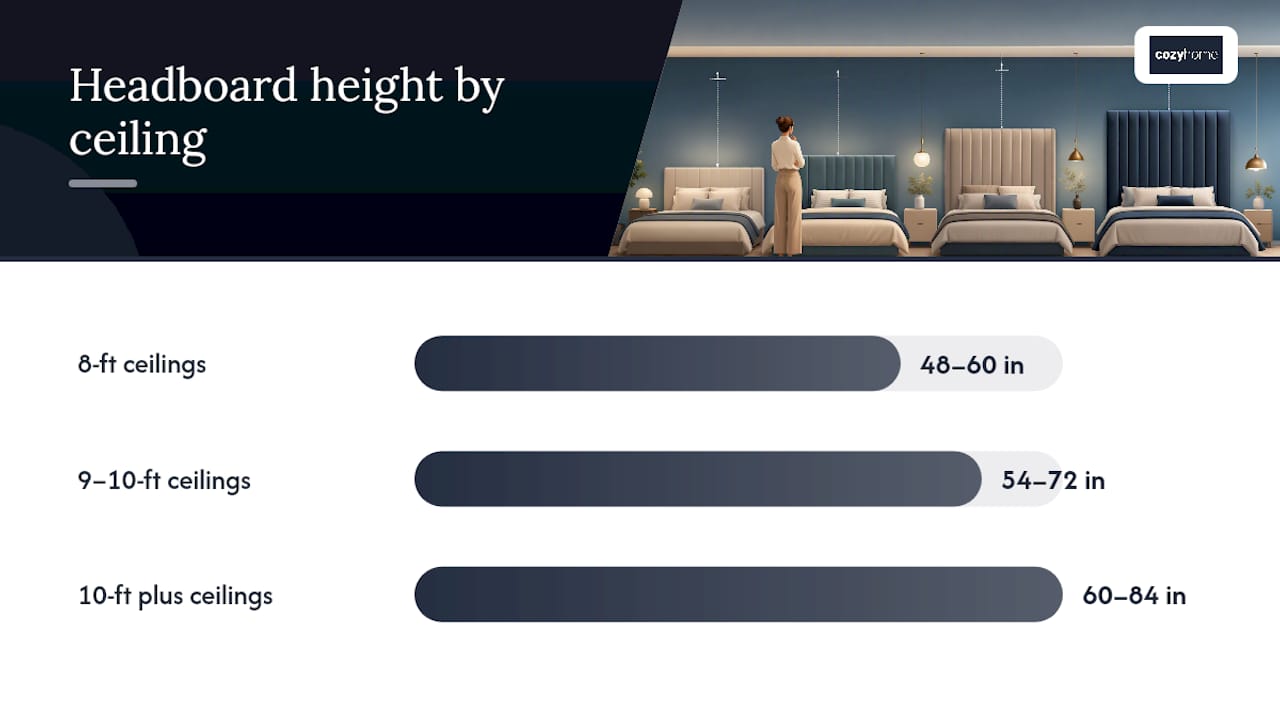
- 8-foot ceilings: aim for a floor-to-top range of 48 to 60 inches. Anything taller starts to crowd the ceiling line and makes the room feel shorter than it is, according to ceiling-specific guidance from Miami Furniture.
- 9 to 10-foot ceilings: you’ve got room to go taller, generally 54 to 72 inches floor-to-top, without the headboard reading as oversized.
- 10-foot-plus ceilings: tall, statement headboards in the 60 to 84 inch range (and sometimes beyond) actually help fill vertical space that would otherwise feel empty and cold.
The breathing-room rule holds across all three: leave 24 to 36 inches of open wall between the top of the headboard and the ceiling. Go tighter than that and the headboard starts to look like it’s trying to escape the room.
If you’d rather run a quick math check instead of eyeballing it, the one-third proportion rule works as a starting point: the headboard should account for roughly a third of the total visual height of the bed setup, from floor to the top of the frame. Designers treat it as a baseline, not gospel, and adjust it based on mattress thickness and how much pillow volume sits at the head of the bed. Related reading on furniture scale in bedroom design covers this same proportional thinking for larger pieces like dressers and armoires.
Choose taller when you have the ceiling height to support it and you want the bed to function as the room’s focal point. Choose lower and more minimal when ceilings run under 8 feet, or when your style leans toward a clean, low-profile look that doesn’t compete with other furniture.
Materials and Styles That Change How Tall a Headboard Feels
The actual inches on a tape measure only tell part of the story. Material and style change how tall a headboard feels, sometimes dramatically.
- Upholstered headboards carry the most visual weight per inch. A thickly padded, tufted headboard in a dark fabric can look taller than its measured height because the eye reads density as size, so a 50-inch upholstered piece can visually rival a 58-inch wood one.
- Wood and panel headboards tend to look sleeker at the same height, especially in lighter finishes, which makes them a strong choice for lower ceilings where you want height without visual bulk.
- Metal headboards, particularly slatted or open designs, read as the lightest option of the group. They let wall color and art show through, which works well when you want tall without heavy.
- Storage headboards (built-in shelving or cubbies) add functional height but also add mass, so they usually need slightly more breathing room above them than a plain panel of the same height.
Tufting, nailhead trim, and channel details also nudge perceived height upward, since texture draws the eye vertically. Pair headboard height with nightstand scale too. Nightstands set noticeably lower than the mattress top can make even a well-proportioned headboard look disconnected from the rest of the furniture grouping. For a deeper look at how these pieces work together, our guide to furniture proportion breaks down how visual weight interacts across a full room.
Your Headboard Height Checklist Before You Buy
Run through this before you order anything, whether you’re shopping online or standing in a showroom.
- Measure first, always. Ceiling height, mattress-top height, and pillow stack height, in that order.
- Tape it out. Mark the proposed height on the wall and check it from the doorway and from lying in bed.
- Decide the headboard’s job. Is it there for back support while you read, or is it purely a design statement? That answer changes whether you prioritize height above the mattress or overall visual scale.
- Confirm nightstand clearance. The headboard shouldn’t tower so far above the nightstands that the grouping looks disjointed.
- Check the mounting method before you fall in love with a style that won’t work with your frame.
When you’re talking to any furniture vendor, ask about return policies on sizing, whether custom heights are available, what the mounting hardware requires, and what lead times look like for made-to-order pieces.
Watch for these red flags: a headboard that comes within 12 inches of the ceiling, a headboard narrower than the mattress itself, or a height that leaves less than a few inches of clearance above your pillow stack.
Pro Tip: If a headboard’s listed height is only given as “overall height” with no floor-to-top or mattress-top breakdown, ask for both numbers before you buy. Vague spec sheets are how sizing mistakes get through checkout.
When Standard Sizes Don’t Fit Your Room
Wall-mounted headboards free up floor space and work well in rooms with tricky bed placement, but they require secure anchors and are harder to reposition later. Frame-attached headboards move with the bed frame and are the simplest option for most bedrooms. Freestanding headboards, which lean against the wall without hardware, offer the most flexibility for renters but can shift over time.
Adjustable-leg headboards solve the “what if I measured wrong” problem. Most allow a few inches of height adjustment without new hardware or drilling, which Casper’s sizing guide notes as a practical option for buyers who aren’t fully confident in their measurements yet. They’re worth considering for rented apartments or rooms where ceiling height feels borderline. For heavier upholstered or wood pieces, professional installation is worth the cost, since mounting into studs correctly is what keeps a tall headboard from becoming a safety issue down the line.
How cozyhome furniture Solves Awkward Headboard Proportions
Standard sizing charts get most homeowners most of the way there, but plenty of bedrooms don’t play by standard rules: a slanted ceiling, a headboard that needs to match built-in shelving, or a king bed crammed into a room sized for a queen. That’s where made-to-order sizing earns its keep.
At our Plano showroom, we walk customers through the exact measuring process covered above, then match it against 700+ fabric and leather options so the headboard height, width, and finish all fit the room instead of a factory default. Common custom requests we see include taller headboards for rooms with vaulted ceilings, shorter profiles for low-clearance apartments, and matching a headboard to existing storage furniture. A piece like our Luzon king bed with a tall headboard shows how a taller silhouette can anchor a room with generous ceiling height, while the queen version works for standard bedrooms wanting that same statement look at a more common scale.
Use our process as your own checklist with any vendor: bring your measurements, ask if custom heights are possible, and confirm someone will help you check proportion before the order is final. Explore made-to-order bed and furniture options at cozyhome furniture, or stop by the Plano showroom for hands-on measuring help and free local delivery across the DFW area.
What Most Headboard Advice Gets Backwards
Most sizing guides treat headboard height as a single number to look up. It isn’t. The right height is a relationship between four things: your mattress, your ceiling, your pillow habits, and how much visual weight your chosen material carries. A 50-inch upholstered headboard and a 50-inch metal one do not occupy the same room the same way.
The advice that gets skipped most often isn’t a number at all. It’s the painter’s-tape test. Homeowners will spend an hour comparing spec sheets and five seconds actually visualizing the piece on their own wall. That’s backwards. A $30 roll of tape catches more sizing mistakes than any chart.
If there’s one place to push back on convention, it’s this: when a measurement falls between two reasonable options, size up rather than down. An undersized headboard reads as an afterthought no matter how well the fabric matches your bedding. A slightly larger one, chosen deliberately, tends to become the room’s anchor instead of an apology for it.
Sources
- Headboard Size Chart + Dimensions: Your Complete Guide | Casper Blog
- Headboard Buying Guide: Types, Materials, Sizing & Installation 2026 | TheFineBed
- Headboard Height Proportion Guide: 5 Ways to Get the Right Fit
FAQ
What is the perfect headboard height?
There’s no single perfect number, but most homeowners land well by keeping the headboard 14 to 29 inches above the mattress, depending on bed size, while leaving 24 to 36 inches of wall space below the ceiling.
What is the standard height of a headboard?
Standard heights run about 14 inches above the mattress for twin beds, 24 to 28 inches for full and queen, and up to 58 inches for king and California king headboards in taller, statement styles.
Should I get a low or high headboard?
Choose a lower headboard for rooms with 8-foot or lower ceilings or a minimalist style, and choose a taller headboard when ceilings run 9 feet or higher and you want the bed to serve as the room’s focal point.
How tall should your headboard be if you have 10-foot ceilings?
With 10-foot ceilings, a floor-to-top headboard height of 60 to 84 inches usually looks proportional, as long as you keep at least 24 to 36 inches of open wall above it.