

Sofa TV Distance: Quick Cheat Sheet & How to Calculate
The right sofa TV distance for most rooms is about 1.5 to 2.5 times your screen’s diagonal size, and for 4K sets, 1.5x is the tightest comfortable measurement worth remembering. Sit a 65-inch 4K TV around 8 to 10 feet away, and you’re in the sweet spot recommended by SMPTE’s field-of-view guidance, which calls for the screen to fill roughly a 30-degree horizontal viewing angle.
Here’s the quick check: measure from your usual seat to the screen, divide that number by the TV’s diagonal in the same unit, and see where you land.
| TV Size | 4K Sweet Spot | 1080p Sweet Spot |
|---|---|---|
| 55" | a moderate comfortable range for 4K TVs | a moderate comfortable range for 1080p TVs |
| 65" | a moderate comfortable range for 4K TVs | a moderate comfortable range for 1080p TVs | | — | a moderate comfortable range for 4K TVs | a moderate comfortable range for 1080p TVs |
A few things push you off this baseline fast:
- Small rooms where the sofa has nowhere else to go often force closer seating than ideal.
- Recliners shift your eye point back several inches when reclined, effectively adding distance.
- Low vision or older viewers sometimes prefer sitting closer regardless of what the math says.
Field-of-view fact: SMPTE’s 30-degree horizontal angle is the industry standard behind nearly every “how far should couch be from TV” calculator on the market, including RTINGS’ own tool.
Key Takeaways
Sofa TV distance comes down to one core formula: multiply your screen’s diagonal by 1.5 for 4K or 2 for 1080p, then adjust for room layout and personal vision.
| Point | Details |
|---|---|
| Use the multiplier rule | Multiply screen diagonal by 1.5 for 4K or 2 for 1080p to get your target distance in inches. |
| Measure from the seat, not the wall | Eye point at the cushion, not the sofa’s back edge, gives the true effective viewing distance. |
| Plan clearances first | Budget 14 to 18 inches to the coffee table and 36 inches for walkways before finalizing sofa placement. |
| Match distance to content | Sit closer for movies and gaming, farther back for sports, within your calculated range. |
| Consider custom sizing | A shallower-depth or modular sofa can recover several inches of usable distance in tight rooms. |
Table of Contents
- What’s the Ideal Sofa TV Distance for Common Screen Sizes?
- How Do You Calculate Your Own Ideal Viewing Distance?
- How Much Closer Can You Sit With a 4K TV?
- How Does Sofa and Room Layout Change Your Real Distance?
- How Do You Measure and Mount for the Right Distance?
- When Does a Custom Sofa Solve a Viewing Distance Problem?
- Impact of Room Lighting on Optimal Viewing Distance
- How Does Personal Vision Affect Ideal Viewing Distance?
- What Most Guides Get Wrong About Sofa Placement
- Sources
- FAQ
What’s the Ideal Sofa TV Distance for Common Screen Sizes?
Print this table, tape it to your fridge, or just remember the ranges for whatever size you’re shopping for.
| TV Size | 4K Range | 1080p Range |
|---|---|---|
| — | a recommended range for 4K TVs | a recommended range for 1080p TVs |
| 42" | a recommended range for 4K TVs | a recommended range for 1080p TVs | | — | a recommended range for 4K TVs | a recommended range for 1080p TVs |
| 55" | a recommended range for 4K TVs | a recommended range for 1080p TVs | | 65" | a recommended range for 4K TVs | a recommended range for 1080p TVs | | — | a recommended range for 4K TVs | a recommended range for 1080p TVs |
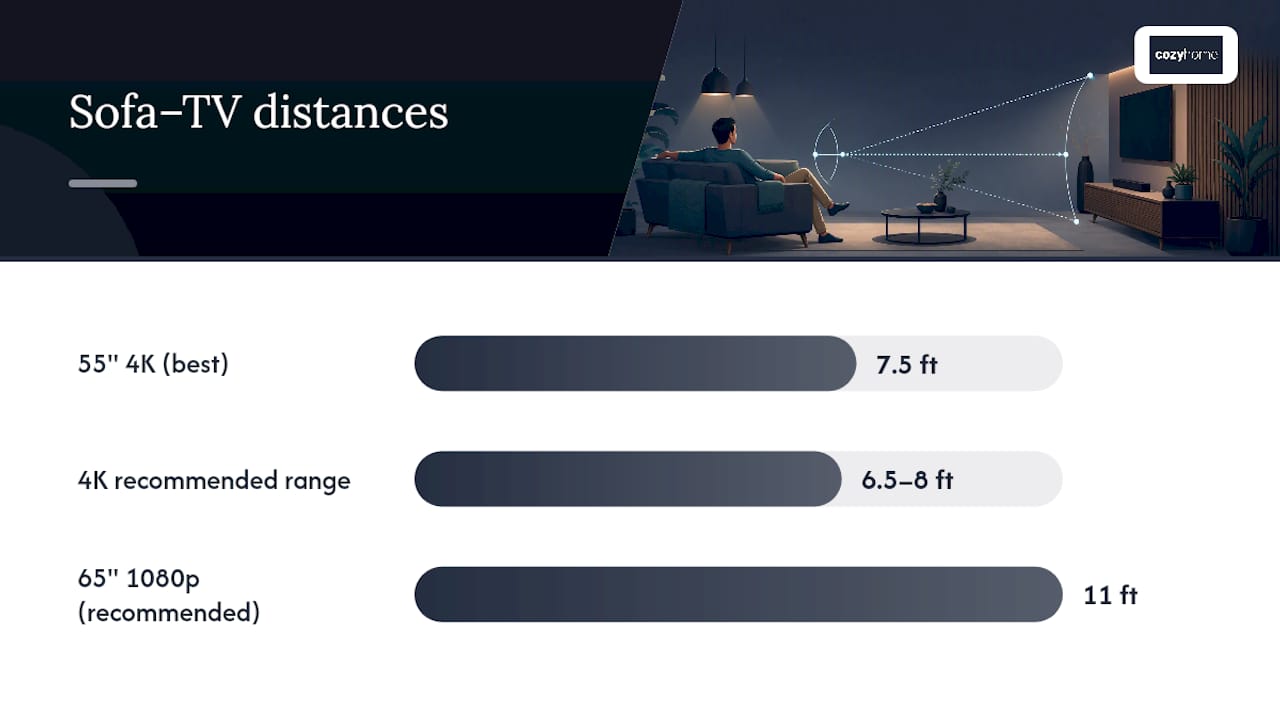
A 55-inch 4K TV plays best around 7.5 feet from the couch, according to Popular Science’s rundown of SMPTE guidance — right in the middle of that 6.5 to 8-foot range. A 65-inch 1080p set, by contrast, wants more breathing room, closer to 11 feet, because lower resolution shows pixelation sooner as you close the gap.
To use this cheat sheet correctly, measure from eye level at your main seat, not from the wall or the TV stand’s edge. And don’t forget the coffee table: if it eats up 18 inches of your available floor space, your “measured” distance and your actual comfortable distance aren’t the same number.
How Do You Calculate Your Own Ideal Viewing Distance?
The cheat sheet works for typical rooms, but if your seating is unusual, you’ll want the actual math behind it. It’s simpler than it sounds.
SMPTE’s recommendation is that a screen should occupy about 30 degrees of your horizontal field of view. RTINGS built its size-to-distance calculator directly from that angle, translating it into distance multipliers for different resolutions.
Here’s the formula breakdown most guides (including RTINGS) rely on:
- For 4K/UHD: distance in feet ≈ screen diagonal (inches) × 1.5, divided by 12.
- For 1080p/HD: distance in feet ≈ screen diagonal (inches) × 2, divided by 12.
- For exact geometry: distance = (screen height / 2) ÷ tan(15°), which gives you the precise 30-degree angle rather than a rounded multiplier.
Worked example: a 55-inch 4K TV. Multiply 55 by 1.5, then divide by 12. That lands you at roughly 6.9 feet, comfortably inside the 6.5 to 8-foot range from the cheat sheet above. A 65-inch 1080p TV, using the 2x multiplier, comes out near 10.8 feet.
Pro Tip: Keep a tape measure in the living room drawer. Measuring from your actual seat cushion, not the wall, is the single biggest source of error people make when checking their own setup.
How Much Closer Can You Sit With a 4K TV?
Resolution changes everything about how close is “too close.” Because 4K packs roughly four times the pixels of 1080p into the same screen size, RTINGS’ testing shows you can typically sit 20 to 30% closer to a 4K set before individual pixels become visible.
That’s the gap between the two columns in the cheat sheet above: a 1.5x multiplier for 4K versus a 2x multiplier for 1080p on the same screen.
Content type matters too, and it’s worth adjusting for what you actually watch most:
- Movies: sit toward the closer end of your range for a more immersive, theater-like feel.
- Sports: many viewers prefer the farther end, since a wider field of view helps track fast-moving action across a full field or court.
- Gaming: competitive players often sit closer for reaction speed, though this trades off some peripheral comfort during long sessions.
Panel type plays a smaller but real role. OLED screens tend to hold sharpness and contrast better at close range than standard LED panels, while QLED sits somewhere in between depending on the model.
How Does Sofa and Room Layout Change Your Real Distance?
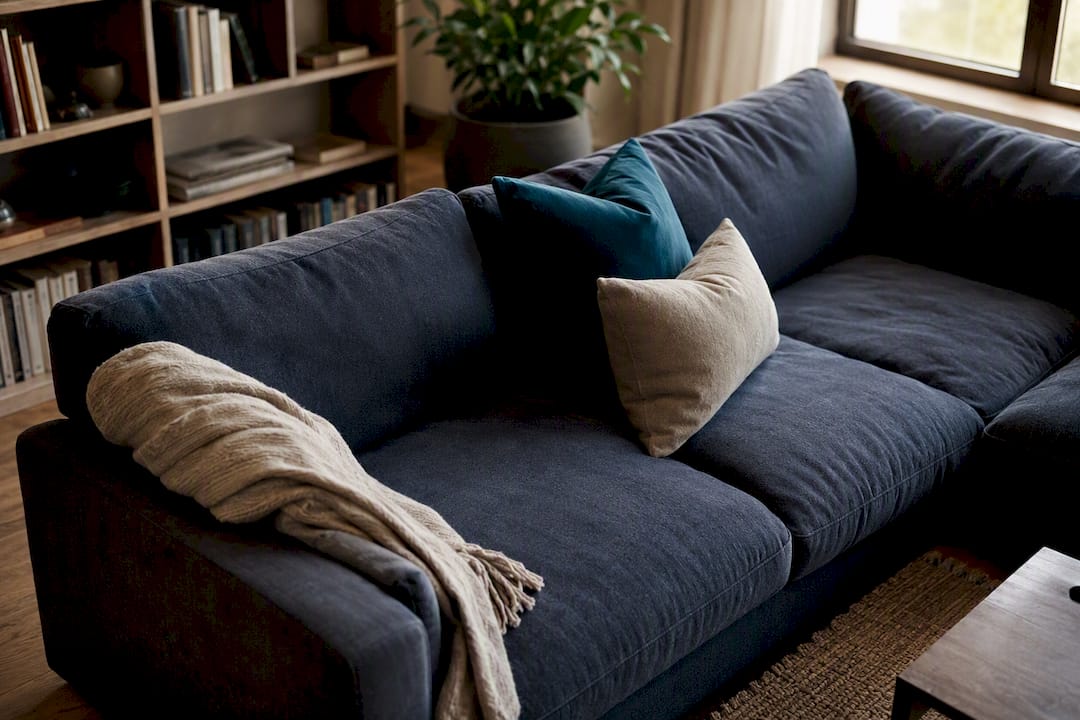
The math above assumes you’re measuring from the middle of your seat cushion, at eye level, to the center of the screen. Most people measure from the wall or the sofa’s back edge instead, and that single habit throws off every calculation that follows. A deep-seat sofa can shift your actual eye point 6 to 10 inches closer to the TV than the sofa’s overall footprint suggests.
Room clearances eat into your available distance fast. Plan for at least 14 to 18 inches between the sofa and coffee table, a minimum 36-inch walkway for main traffic, and 12-plus inches of clearance behind any sofa with recliner mechanisms. Furniture retailers who specialize in this exact problem point out that a room’s width often decides your TV size before your budget does.
For sectionals or multi-seat arrangements, put your primary viewing seat directly on-axis with the screen and treat corner or side seats as secondary. If space is tight, consider these adjustments:
- Choose a shallower seat depth to gain a few extra inches of usable floor.
- Swap a bulky coffee table for a lower-profile option.
- Reposition recliners along the room’s longer wall rather than facing the shortest one.
Pro Tip: A shallower-depth sectional can add 4 to 6 inches of real viewing distance in a small living room without moving a single wall.
How Do You Measure and Mount for the Right Distance?
Getting this right on the wall matters as much as getting the math right on paper. Here’s the short version.
- Measure from your primary seat’s eye point (sitting upright, cushion compressed) to where you plan to mount the TV.
- Calculate your target range using the multipliers above.
- Test before you drill: tape a cardboard cutout to the wall at the planned size and height, then sit in your usual spot for a few minutes.
- Check for glare from windows or lamps at that height and time of day.
Mounting height matters too. The center of the screen should land around 42 inches from the floor for a standard-height sofa, adjusted slightly lower for sofas with deep, low seating.
Pro Tip: A $5 roll of painter’s tape outlining the TV’s exact dimensions on the wall beats guessing every time. Live with it for a day before committing to the drill.
When Does a Custom Sofa Solve a Viewing Distance Problem?
Sometimes the room simply won’t cooperate with the math. A standard 38-inch-deep sofa in a narrow living room can push your seating a foot closer to the screen than any calculator recommends, and no amount of remeasuring fixes that if the sofa itself is the wrong shape for the space.
That’s where custom sizing earns its keep. At our Plano showroom, we walk homeowners through seat depth and configuration options built around the actual room, not a warehouse standard. Odd-shaped rooms, oversized screens, and multi-use spaces all benefit from a modular sectional that can be reconfigured as needs change.
When a room’s dimensions and your ideal viewing distance don’t line up, the fix usually isn’t the TV. It’s the sofa. Measure your space, calculate your target distance, then talk to a showroom that can build around both.
Impact of Room Lighting on Optimal Viewing Distance
Bright, glare-heavy rooms push people to sit farther back than the math suggests, because glare and reflection are more noticeable up close on a large panel. Rooms with south-facing windows or overhead can lights aimed at the screen are the worst offenders, since reflected light off a glossy panel breaks the illusion of depth and makes text and dark scenes harder to read at short range.
Dimmer, more controlled lighting lets you comfortably sit closer within your calculated range, since contrast holds up better when ambient light isn’t washing out the screen’s blacks. This is part of why home theater rooms with blackout curtains tend to favor the tighter end of the 4K distance range, while sunny family rooms often land closer to the 1080p-style, farther-back distances even with a 4K set installed.
Practical adjustments matter more than moving furniture. Position the TV perpendicular to windows rather than facing them, use curtains or blinds during peak daylight hours, and consider a matte-finish or anti-glare panel if your living room gets strong afternoon sun. None of this changes the underlying formula, but it does change how close you can comfortably sit within that formula’s range. A screen that measures perfectly on paper can still feel too close if glare forces you to squint.
How Does Personal Vision Affect Ideal Viewing Distance?
The formulas above assume roughly average, corrected vision. Real eyesight varies a lot, and that changes where the “ideal” distance actually sits for any given household.
Nearsighted viewers without corrective lenses often prefer sitting closer than the calculated range, simply because distant detail is harder to resolve. Farsighted viewers or those with presbyopia (the common age-related loss of near-focus) sometimes prefer more distance, since it reduces the eye strain that comes from focusing on fine detail up close for hours.
Sitting close to a TV does not cause permanent eye damage in people with otherwise healthy vision, according to UT Health Science Center San Antonio, which debunks a myth that’s followed television since the 1950s. That said, sitting closer for long sessions can still bring on temporary digital eye strain, the kind the American Optometric Association describes as dry eyes, headaches, and blurred vision after extended close-range screen time. If your household mixes ages and vision needs, aim for the middle of the recommended range rather than either extreme, and take breaks during long viewing sessions regardless of how far back you’re sitting.
What Most Guides Get Wrong About Sofa Placement
Most viewing-distance guides treat the TV as fixed and the sofa as an afterthought. That’s backwards for anyone who doesn’t live in a builder-grade rectangle. The math behind SMPTE’s 30-degree rule is solid, and the multipliers RTINGS publishes are worth trusting. But the real failure point in most living rooms isn’t the formula, it’s the assumption that a standard 38-inch-deep sofa will simply fit wherever the calculator says it should.
Room shape decides the ceiling on what’s possible before screen size or resolution ever enter the conversation. A narrow room with a 65-inch 4K TV mounted on the short wall might mathematically want 9 feet of distance, but if the room is only 11 feet deep, something has to give: the TV size, the sofa depth, or the walkway clearance most people don’t want to sacrifice.
Prioritize measuring the room before shopping for either piece. If the numbers don’t line up, a shallower or modular sofa solves more problems than a smaller TV usually does.
Sources
FAQ
How Far Should a TV Be From a Sofa?
For most rooms, place the sofa 1.5 to 2.5 times the TV’s diagonal size away, or roughly 6.5 to 8 feet for a 55-inch 4K TV.
What Is the 2/3 Rule for Sofa Placement?
The “2/3 rule” some furniture guides reference suggests a sofa should be roughly two-thirds the width of the wall it sits against, which affects how the TV and seating area balance visually, though it doesn’t directly set your viewing distance.
How Close Can You Put Your Couch to the TV?
You can sit as close as roughly 1.5 times the screen diagonal for 4K without noticing pixelation, and sitting closer doesn’t cause permanent eye damage in people with healthy vision, though it can bring on temporary eye strain during long sessions.
How Far Should a Sofa Be From a 55-Inch TV?
A 55-inch 4K TV works best around 6.5 to 8 feet from the sofa, while a 55-inch 1080p set needs more room, closer to 8 to 11 feet.