

4 Headboard Fabric Ideas That Balance Style, Durability and DIY
The most reliable headboard fabric ideas come down to a short list: velvet and bouclé for drama and texture, linen and cotton blends for a relaxed, breathable look, and faux leather or microfiber for easy wipe-down durability. If kids, pets, or heavy daily use are part of the picture, lean toward performance fabric or faux leather. If you’re building a hotel-style focal wall, velvet or a full-height upholstered panel wins every time. Fabric-wrapped plywood works for a weekend DIY project, but custom upholstery handles curves, oversized panels, and specialty fabrics far better.
TL;DR:
- Performance fabrics with high rub counts and colorfastness ratings are recommended for durability, especially in households with kids, pets, or high daily use.
- Large-scale patterns or solid textures are more effective on vertical surfaces, with oversized upholstered panels creating a intentional, room-softening statement.
- DIY headboards can range from simple fabric-wrapped plywood to tufted designs, but complex shapes or specialty fabrics often require professional upholstery.
- Fabric choice should consider household wear and lighting, as some textures like bouclé or velvet may look different at various times of day or under different lights.
- Custom upholstery provides better options for nonstandard sizes, specialty fabrics, or complex shapes, with a wide selection of American-made, durable materials.
Table of Contents
- Styling and Moodboard Approaches for Headboard Fabric Ideas
- Headboard Fabric Families: What to Know
- Performance and Maintenance: Choosing Fabric That Lasts
- DIY Headboard Fabric Ideas, From Simple to Ambitious
- How to Choose the Right Headboard Fabric: A Practical Checklist
- Why Custom Upholstery Solves What Off-the-Shelf Can’t
- What Actually Matters When You’re Choosing Headboard Fabric
- Get Your Headboard Custom-Built at cozyhome furniture
- Sources
- FAQ
Styling and Moodboard Approaches for Headboard Fabric Ideas
Before you fall for a swatch, decide what mood you’re building. We think of it in four lanes, and each one points to a different fabric family.
- Statement: deep velvet in jewel tones (emerald, sapphire, burgundy) for a headboard that anchors the whole room.
- Calm neutral: linen or soft cotton blends in oatmeal, ivory, or stone for a relaxed, hotel-suite feel.
- Textured sculptural: bouclé or wool blends for a modern, tactile look that hides everyday wear.
- Family-friendly: microfiber or faux leather for households juggling kids, pets, or frequent guests.
Scale matters more than most people expect. Small prints tend to disappear on a headboard, while large-scale patterns and solid textures read better on a vertical surface, especially under a full-height panel. Designers keep reaching for oversized, wall-to-wall upholstered panels because the bigger surface reads as intentional, not accidental, and it softens the room acoustically too.
Pro Tip: Pin or tape your fabric sample directly to the wall behind your bed and look at it morning, afternoon, and night. Fabric color shifts more than you’d think under lamp light versus daylight.
Headboard Fabric Families: What to Know
Every fabric family behaves differently once it’s stretched over foam and framed against your pillows. Here’s what actually matters with each one.
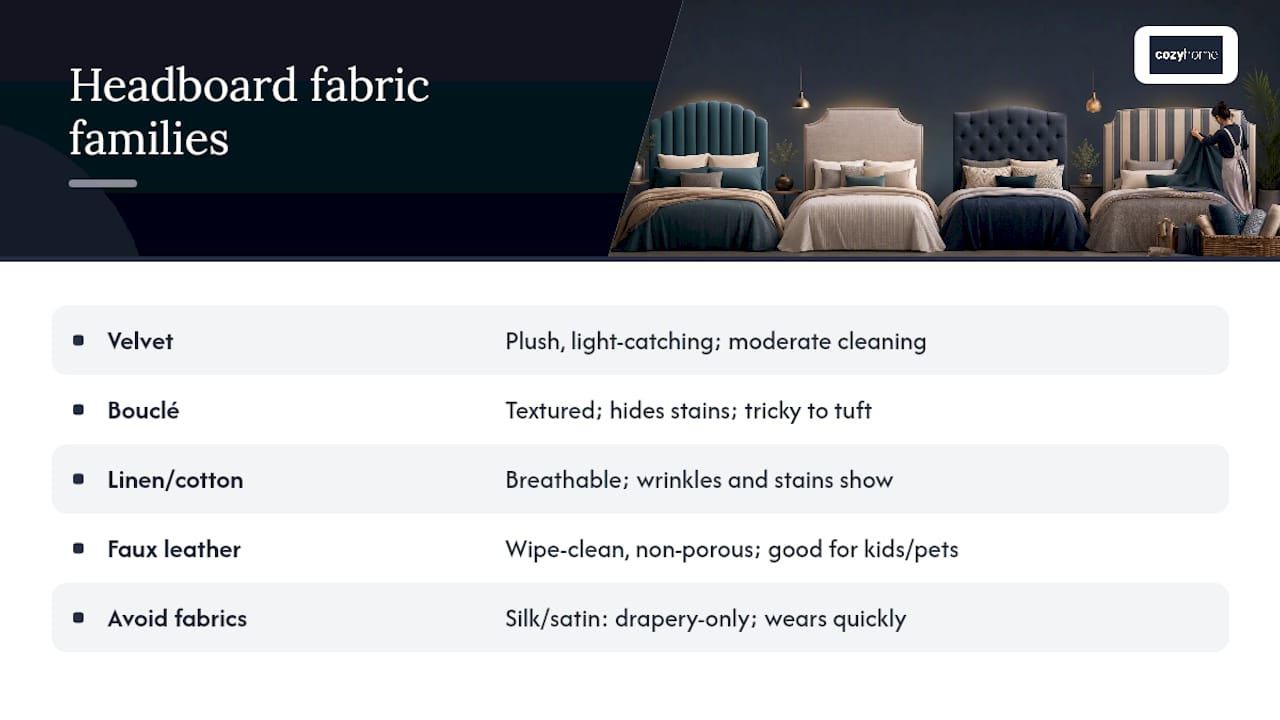
Velvet gives you that plush, light-catching look people associate with boutique hotels. It resists abrasion reasonably well on a vertical surface like a headboard, where it isn’t taking the daily friction a sofa cushion would. Cleaning needs are moderate: expect occasional professional attention, especially with lighter shades.
Bouclé brings texture and depth that photographs beautifully and hides small stains and everyday wear better than a flat weave. It’s trickier to upholster around curves or buttoning, so ask for a sample before committing to a tufted design.
Linen and cotton blends deliver a breathable, casual elegance that suits a low-traffic bedroom. They wrinkle easily and stain more visibly than tighter weaves, so they’re a better fit for adult-only or guest rooms than for a household with young kids climbing into bed.
Faux leather and microfiber are the practical workhorses. Both wipe clean quickly, and faux leather’s non-porous surface makes spills easy to remove before they set. These are the go-to choices for rental properties, pet owners, and families with small children.
One note worth flagging: skip drapery-only fabrics like silk or satin. They’re beautiful on a curtain rod but weren’t built to withstand the friction of shoulders, pillows, and blankets, and they’ll show wear within a season. Choose an upholstery-weight material instead, and check the Martindale rub count before you buy.
Performance and Maintenance: Choosing Fabric That Lasts
Performance fabrics solve the biggest tension in headboard shopping: the trade-off between how something looks and how long it stays looking that way. A fiber-level treatment like FibreGuard builds stain resistance into the fabric itself rather than relying on a topical spray that wears off after a few cleanings, which matters more on a headboard than almost anywhere else in the house since you can’t just throw a slipcover over it.
Two numbers are worth asking about before you buy:
- Martindale rub count: look for 20,000 or higher for typical domestic durability on a headboard.
- Colorfastness rating: ask specifically how the fabric holds up to sunlight if your bed sits near a window.
Care itself is straightforward. Blot spills immediately rather than rubbing, use a manufacturer-approved cleaning agent, and call a professional upholstery cleaner for anything that’s set for more than a day. With that kind of routine care, performance fabrics can hold up for 10 to 15 years or more, which changes the math on paying more upfront for a better weave. For a deeper look at abrasion ratings across fabric types, our sofa fabric guide breaks down what those numbers mean in daily use.
DIY Headboard Fabric Ideas, From Simple to Ambitious
Not every headboard project needs a workshop. Here’s how the effort scales.
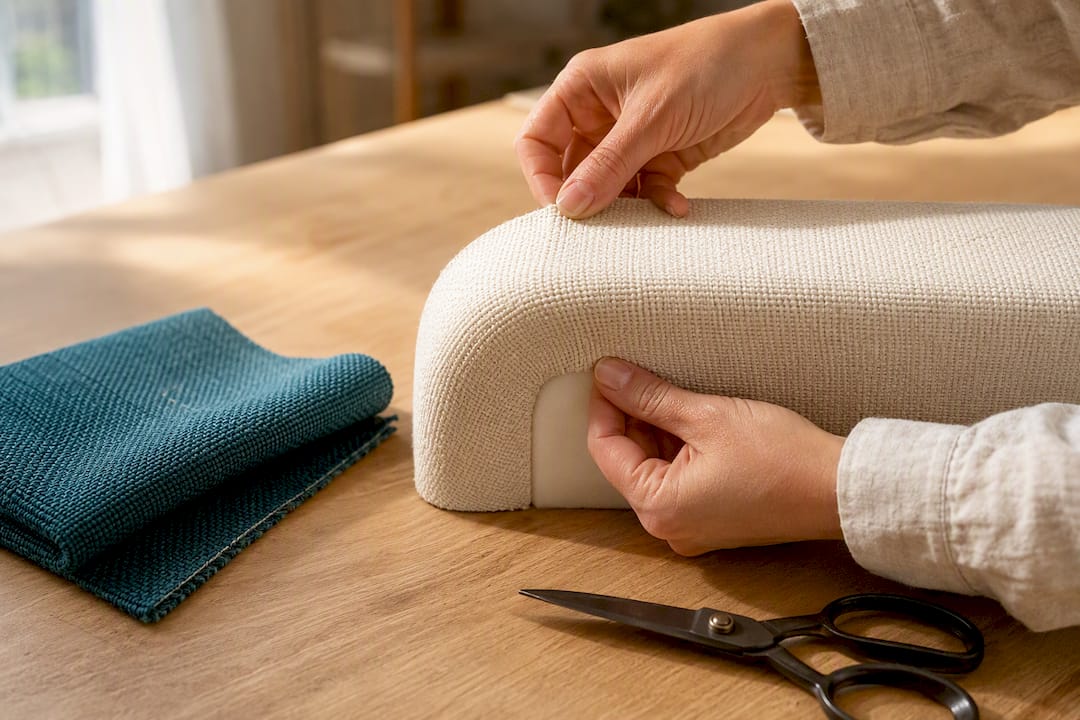
- Fabric-wrapped plywood panel. Cut plywood to size, layer on foam and batting, wrap with fabric, and staple it to the back. This is the fastest route to a custom look for under a weekend’s work.
- Staple-on foam padding. Skip the plywood base if you already have a frame; staple foam and fabric directly onto an existing headboard shape for an instant upgrade.
- Hanging fabric panel or tapestry. No stapling, no tools. Mount a curtain rod and drape a heavier fabric panel behind the bed for a low-commitment statement wall.
- Tufted foam with buttoning or nailhead trim. This step up needs a curved template, upholstery buttons, a long needle, and patience, but it delivers a genuinely custom-looking result.
Once you’re chasing scalloped edges, fluted channels, or a full-wall panel, that’s usually the point to call in custom upholstery. Complex curves and specialty fabrics like bouclé or leather are far less forgiving of a first attempt, and a professionally built piece typically carries a warranty a DIY project never will.
Pro Tip: Before you commit to a DIY cut, order the same fabric swatch you’d use for a custom build and test how it wraps around a curved corner. Some textured weaves crack or pucker on tight curves.
How to Choose the Right Headboard Fabric: A Practical Checklist
Walking into a showroom or scrolling swatches online goes faster with a short list of questions ready.
- How much daily wear will this headboard actually see (kids climbing on it, pets, daily lounging)?
- Does the fabric wipe clean, or does it need spot treatment or professional cleaning?
- What’s the weave density and pile direction, and does that affect how it looks in different light?
- For apartments or high-rises, does the fabric meet local fire-safety requirements?
- What’s the supplier’s sample return policy if the color looks different once it’s home?
Ask directly about rub count, warranty coverage, and the recommended cleaner for the fabric you’re considering. Order more than one swatch and compare them vertically, against your bedding, and under your actual bedroom lighting before you sign off on a yard of anything.
Why Custom Upholstery Solves What Off-the-Shelf Can’t
Standard headboards come in standard sizes and a handful of fabric choices, which is fine until your bed frame, ceiling height, or fabric wish list falls outside that range. Custom upholstery businesses work from over 700 fabric and leather options with American-made construction, which means an oversized panel, a nonstandard king-plus width, or a specialty bouclé weave can be requested. In-store guidance from our team helps you avoid the swatch-versus-reality mismatch that trips up a lot of online orders. For proportions, our headboard height guide is a useful starting point before you settle on a size.
What Actually Matters When You’re Choosing Headboard Fabric
Most headboard advice treats fabric choice like a design decision alone, and that’s where it falls short. The real decision is about tolerance: how much wear, mess, and daily contact this specific fabric is going to absorb in your specific household. A velvet headboard in a guest room with occasional use behaves completely differently than the same velvet in a bedroom shared with a dog that jumps on the bed every morning.
The overrated advice is chasing the “most popular” fabric of the year. Bouclé and oversized panels look fantastic in photos, but they’re not automatically right for every bedroom. The underrated move is ordering swatches early and living with them for a few days under your actual lighting, because a fabric that looks perfect on a screen can read completely differently at 9 p.m. under a warm bedside lamp.
If you’re weighing DIY against custom, be honest about the shape you’re building. A flat panel is forgiving. A curved, tufted, or full-wall design punishes a first attempt, and that’s exactly where professional upholstery earns its price.
— Dean P.
Get Your Headboard Custom-Built at cozyhome furniture
Some showrooms offer the alternative to ordering a headboard sight-unseen online: instead of guessing at a swatch on a screen, customers can handle real fabric samples in person and get sizing and configuration guidance from knowledgeable staff. With many fabric and leather options and American-made builds, they can match various fabric ideas, whether a wall-to-wall velvet panel or a wipe-clean performance weave for a busy household.
If you’re ready to move past inspiration boards, start with our made-to-order custom furniture page to see how the process works, or stop by the showroom to compare fabric swatches against your actual bedroom colors before you order. Bring a photo of your room and a rough size in mind, and we’ll walk you through the rest.
Sources
- Best performance upholstery fabrics for headboards — FibreGuard
- Designers are turning bed walls into statement features — Homedit
- Top upholstery fabrics for bed headboards: durability & style guide — Neveitalia
- Fabrics for headboards — The Headboard Workshop
FAQ
What is the best type of fabric for a headboard?
There’s no single best fabric. Velvet and bouclé lead for texture and visual impact, linen and cotton blends suit low-traffic rooms, and faux leather or microfiber wins for households with kids or pets needing easy cleanup. Match the fabric to how the bed actually gets used, not just how it looks in photos.
What are the trends for headboards in 2026?
Oversized and wall-to-wall upholstered panels remain the dominant trend, creating a boutique-hotel feel while also softening bedroom acoustics. Textured fabrics like bouclé and fluted upholstery are showing up frequently alongside these full-height designs.
What are some DIY fabric headboard ideas?
The simplest option is a fabric-wrapped plywood panel with foam and batting stapled to the back, which most people can finish in a weekend. Hanging a fabric panel from a curtain rod requires no tools at all, while tufted foam with buttoning or nailhead trim takes more skill but delivers a custom look.
What is the best material for a bed headboard?
For durability and low maintenance, performance fabrics and faux leather typically outperform natural fibers, with some performance fabrics lasting 10 to 15 years or more under normal care. For a softer, more decorative feel, velvet or bouclé offers more visual richness at the cost of slightly higher upkeep.
Should I choose a custom headboard instead of a ready-made one?
Custom makes the most sense for nonstandard bed sizes, full-wall panel installs, or specialty fabrics like bouclé and leather that are harder to execute well as a DIY project. cozyhome furniture builds these to order with over 700 fabric options, so sizing and fabric choice aren’t limited to what’s already on the shelf.