

Furniture Structural Integrity: What It Means for Your Home
TL;DR:
- Furniture’s structural integrity determines its ability to support loads and resist failure over time. Proper frame material and joinery methods are crucial for long-lasting, safe furniture that withstands daily stresses. Regular inspection, careful assembly, and understanding industry standards help ensure a piece remains durable for years.
Furniture structural integrity is a piece’s ability to support its intended loads and resist everyday stresses without permanent deformation or failure. Before you buy anything, run through this quick checklist:
- Frame material: Is it solid hardwood, engineered plywood, or metal? Avoid particleboard frames in load-bearing pieces.
- Joinery: Look for mortise-and-tenon, dovetail, or corner-block construction rather than staples or simple butt joints.
- Wobble test: Press down and rock the piece gently. Any flex or creak signals a weak joint or uneven leg.
- Weight rating: Confirm the stated capacity covers your household’s realistic use, not just a minimum.
- Visible damage: Check for cracks, splits, or finish separating at joints — these often reveal deeper frame stress.
- Hardware: Bolts and screws should be snug, not stripped or missing.
- Anchoring: Tall storage units and wall-mounted shelves need proper wall anchors, not just floor contact.
Pro Tip: When judging a piece for long-term safety, focus on the frame and joinery first. Surface finishes can be refreshed; a compromised frame cannot.
Table of Contents
- What does furniture structural integrity actually cover?
- What physical forces act on furniture, and how do pieces fail?
- How do materials and construction create or undermine strength?
- How do manufacturers test and validate structural integrity?
- What should you check before buying furniture?
- How does proper assembly protect structural integrity?
- How do you maintain structural integrity and know when to retire a piece?
- Why do U.S. standards and reputable manufacturing practices matter?
- Key Takeaways
- The part most buyers skip entirely
- cozyhome furniture helps you choose pieces built to last
- Useful sources
- FAQ
What does furniture structural integrity actually cover?
Structural integrity goes beyond whether a chair holds your weight today. It describes how well a piece maintains its load-bearing capacity, resists the forces applied to it daily, and retains its shape and safety over years of real use. Think of it as the furniture’s skeleton: everything else, cushions, fabric, finish, depends on it staying sound.

There is an important distinction between structural lifespan and comfort or visual lifespan. A sofa’s cushions may flatten after several years of use, and its fabric may show wear well before the frame shows any weakness. The frame’s structural life is what determines whether a piece remains safe to use. High-quality pieces with proper care last substantially longer than budget items, and that gap is almost always traceable to frame and joinery quality.
Real-world examples make this concrete. A dining chair faces concentrated compression on its legs and lateral racking forces every time someone sits down or pushes back from the table. A sofa distributes weight across a wider frame but endures cyclic loading thousands of times a year. A bookshelf carries sustained compression on its shelves and shear stress at the back panel. Each piece has a different structural profile, but all three share the same basic requirement: the frame and its connections must hold without shifting.
What physical forces act on furniture, and how do pieces fail?
Every piece of furniture faces a predictable set of forces. Understanding them helps you know exactly where to look when inspecting a piece.
Primary forces acting on furniture:
- Compression: Downward load on legs and shelf surfaces from weight.
- Tension: Pulling force at joints when a piece is lifted or racked.
- Bending: Flexing along a horizontal member, most common in table aprons and shelf boards.
- Shear: Sliding force at joint faces, especially where legs meet rails.
- Racking (lateral force): Side-to-side movement that stresses corner joints, the most common cause of wobble in chairs and tables.
- Impact: Sudden loads from dropping items or bumping furniture.
- Cyclic loading: Repetitive, lower-magnitude stress from everyday sitting, opening drawers, and leaning — the slow accumulation that fatigues joints over time.
Research on wooden furniture confirms that most failures originate at corner-type junctions, where through-bolts, dowels, and nut connections are the critical points under horizontal static loads. That finding matches what furniture repair professionals see in practice: a chair rarely fails in the middle of a leg; it fails where the leg meets the seat rail.
Common failure modes by furniture type:
- Chairs: Joint pull-out at leg-to-rail connections; cracked back rails from racking; fastener loosening at seat-to-leg bolts.
- Sofas: Sagging from broken or stretched webbing and spring systems; frame splitting at arm-to-base connections.
- Tables: Apron-to-leg joint failure from lateral force; split tabletop boards from humidity cycling.
- Storage units: Corner cracking at case joints; back-panel separation that removes racking resistance.
How do materials and construction create or undermine strength?
The frame material sets the ceiling for how strong a piece can be, and the joinery method determines whether that potential is actually realized.

Frame materials
Solid hardwood (oak, maple, ash, walnut) offers the best combination of strength, screw-holding ability, and repairability. Kiln-dried hardwood is particularly important: wood dried to a stable moisture content resists the swelling and shrinking that loosens joints over time, as explained in the guide on Are Solid Wood Interior Doors Worth It? — One Day Doors & Closets. Engineered plywood made from cross-laminated veneers is dimensionally stable and resists warping, making it a sound choice for case goods and platform beds. Softwood (pine, fir) is lighter and less expensive but dents more easily and holds fasteners less securely under repeated stress. Metal frames (steel, aluminum) offer high strength-to-weight ratios and are common in commercial seating, though weld quality and tube gauge vary widely.
Particleboard and MDF cores are common in budget furniture. They are acceptable for low-stress applications like drawer bottoms, but they hold screws poorly and swell when exposed to moisture, making them a poor choice for primary structural members.
Joinery that matters
Traditional joinery distributes load through interlocking geometry rather than relying solely on fasteners. A mortise-and-tenon joint, where a projecting tenon fits into a matching cavity, resists racking and pull-out forces far better than a screw alone because the wood itself carries the load. Dovetail joints in drawer construction resist the pulling force of an open drawer without any hardware. Corner blocks glued and screwed across the inside corners of chair and table frames add triangulation that dramatically reduces racking. Practical guidance from craftspeople consistently points to tight interlocking joinery combined with moisture-stable wood as the core factors that allow furniture to last across generations.
Simple butt joints held by staples or small screws are the weakest option. They rely entirely on the fastener’s grip in the wood, which loosens as the fastener hole enlarges under cyclic loading. When you see a piece advertised as “easy assembly” with only cam locks and dowels, that is not inherently bad, but the quality of the dowel fit and the wood’s density determine how long it holds.
Signs of construction worth choosing: kiln-dried hardwood frames, glued-plus-mechanical joinery (glue and a mechanical fastener together), corner blocks at leg junctions, and dovetail drawer construction. These details are visible if you look under cushions and inside drawers, and they are worth asking about directly. Our guide to signs of quality furniture construction walks through exactly what to look for.
How do manufacturers test and validate structural integrity?
Manufacturers and independent labs use two fundamentally different test types to validate furniture strength, and knowing the difference helps you read product claims accurately.
Static load tests apply a fixed force to a structural point, such as a seat, back, armrest, or tabletop, and confirm the piece supports that load without permanent deformation or failure. This tells you the piece can handle a worst-case single load. Cyclic (fatigue) tests apply a lower, repetitive force thousands of times to simulate years of daily use. A piece that passes a static test may still fail a cyclic test if its joints fatigue under repeated stress.
BIFMA (the Business and Institutional Furniture Manufacturers Association) is the primary U.S. benchmark for evaluating furniture structural integrity. BIFMA standards cover specific product categories: BIFMA X5.1 addresses general-purpose office chairs, X5.4 covers lounge seating, X5.5 applies to desk and table products, and X5.9 covers storage units. Each standard specifies the exact loads, cycles, and acceptance criteria a product must meet. Third-party labs such as UL Solutions conduct ANSI/BIFMA testing for manufacturers who want independent validation.
| Test Type | What It Measures | What It Tells You |
|---|---|---|
| Static load | Peak load capacity at a single point | Can the piece handle a worst-case weight? |
| Cyclic/fatigue | Repeated loading over thousands of cycles | Will joints hold up over years of daily use? |
| Impact | Resistance to sudden force (drops, bumps) | How does the piece respond to accidental stress? |
| Stability | Resistance to tipping under lateral force | Is the piece safe from tipping when loaded? |
ISO 7173:2023 is the international standard for chair and stool strength and durability, covering test methods for all seating types regardless of material or construction. For residential buyers, BIFMA certification is the most relevant U.S. trust signal, though residential furniture is not always required to carry it.
Pro Tip: When reviewing a product spec sheet, look for a stated weight capacity alongside a reference to the test standard used to establish it. A weight rating without a test reference is a marketing claim, not a validated figure.
What should you check before buying furniture?
A few minutes of hands-on inspection, or careful review of online listings, can reveal construction quality that no product description will volunteer.
Pre-purchase research steps
- Search for the frame material in the product description. “Solid hardwood frame” and “kiln-dried hardwood” are meaningful claims; “wood frame” or “engineered wood” are vague and warrant follow-up questions.
- Look for a stated weight capacity and, ideally, a reference to the test standard behind it.
- Request or search for photos of the underside, the joint areas, and the back of case goods. Reputable sellers provide these.
- Check whether the piece carries any BIFMA or third-party test certification, especially for seating.
In-store inspection checklist
- Lift one corner of a chair or table. A well-built piece feels dense and solid. Surprisingly light weight often signals thin frames or hollow components.
- Sit and rock gently side to side. Any lateral flex or creaking points to weak corner joints or missing corner blocks.
- Look under seat cushions. Check for corner blocks at leg junctions and confirm the webbing or spring system is intact and evenly tensioned.
- Open and close drawers. Smooth, even glide with no binding suggests quality drawer construction. Check the drawer corner joints: dovetail is the gold standard.
- Examine all visible fasteners. Bolts and screws should be flush and snug, with no stripped heads or missing hardware.
- Check for wobble on a flat surface. Place the piece on the showroom floor and press each corner. All four legs should contact the surface evenly.
- Inspect finish at joints. Cracks, gaps, or finish separation at joint lines often indicate stress the frame has already absorbed.
Buying online
Ask the seller for the frame material specification, the weight rating and its test basis, and photos of joinery details. A seller who cannot or will not provide these details is telling you something about the product. Our post on common furniture shopping mistakes covers the specific questions worth asking before you commit.
How does proper assembly protect structural integrity?
Assembly is where a well-built piece can be compromised before it ever gets used. The two most common mistakes are over-tightening fasteners (which strips threads and splits wood) and under-tightening them (which allows movement that enlarges fastener holes over time).
Follow this sequence for a safe, repeatable assembly:
- Unpack and inspect all components before assembly begins. Check for cracks, pre-split wood, or damaged hardware. Do not proceed with a compromised part.
- Read the manufacturer’s sequence before tightening anything. Many frames require legs or rails to be attached in a specific order to align correctly.
- Finger-tighten all fasteners first. Get every bolt and screw started before applying final torque. This prevents the frame from being pulled out of square by a fully tightened joint on one side.
- Apply final torque per the manufacturer’s specification. If no torque spec is given, snug plus a quarter turn is a reasonable rule for wood-to-wood bolted connections.
- Check for square and level before the piece bears any load. A frame assembled slightly out of square will rack under use.
- Recheck all fasteners after 24–72 hours. Wood compresses slightly under initial load, and fasteners often need a small additional turn after the first day of use.
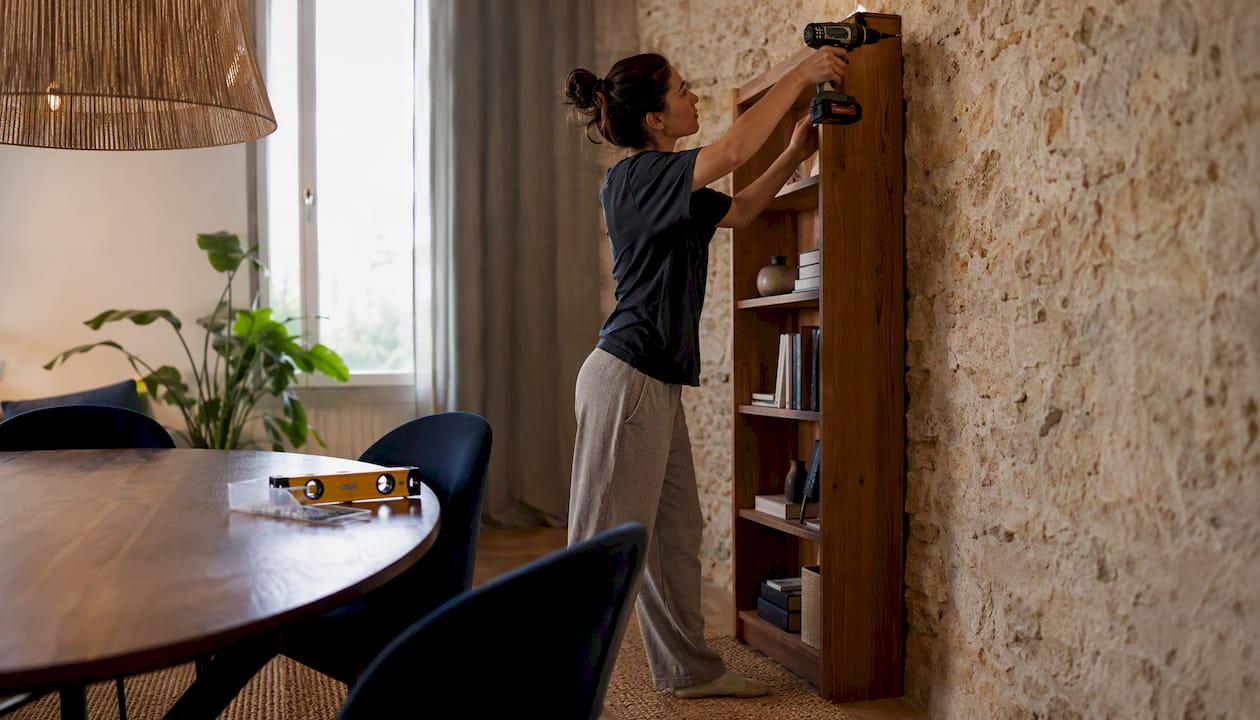
For tall storage units, bookcases, and wall-mounted shelves, anchoring to the wall is not optional. A unit that tips under load is a safety hazard. Use the appropriate anchor for your wall type: toggle anchors for drywall without a stud, through-bolts into studs for heavy units. The same principle applies to platform bed frames that attach to a headboard wall mount.
Pro Tip: Seasonal humidity shifts cause wood to expand and contract. Re-check all fasteners once in spring and once in fall, especially on solid hardwood pieces, to catch any loosening before it becomes a structural problem.
How do you maintain structural integrity and know when to retire a piece?
Maintenance is mostly about catching small problems before they become large ones. A loose bolt found during a monthly check takes thirty seconds to fix; the same bolt ignored for a year can enlarge its hole to the point where the joint cannot be re-tightened.
A simple maintenance schedule:
- Monthly: Walk around each piece and press lightly on corners and joints. Any new movement or creak warrants a closer look.
- Every 6–12 months: Tighten all accessible hardware. Check drawer slides, hinge screws, and leg bolts. Inspect joints for any new cracking or separation.
- Seasonally: Monitor indoor humidity. Wood furniture performs best between roughly 35% and 55% relative humidity. Significant swings outside that range accelerate joint loosening and wood movement.
Common repairs that genuinely restore structural integrity include re-gluing a loose joint (clean the old glue, apply fresh wood glue, clamp overnight), replacing stripped screws with a slightly larger diameter or a threaded insert, and adding corner blocks to a chair frame that has begun to rack. Professional repair is worth considering when a joint has failed completely, when a structural member has cracked through, or when the repair requires disassembling a glued frame. Well-made furniture with solid hardwood frames and traditional joinery is almost always worth repairing because the underlying structure can be restored.
Red flags that mean it is time to retire a piece:
- A cracked or fractured structural frame member, not just a surface scratch.
- A joint that has failed and cannot be re-glued because the wood around it has split or compressed.
- Major sagging in a sofa or bed frame that persists after spring or slat replacement.
- Repeated hardware failure at the same location, which signals the wood can no longer hold a fastener.
- Any piece that rocks or tips under normal use after repair attempts.
When repair costs approach or exceed the replacement cost of a comparable quality piece, replacement is the practical choice. Parts replacement, such as new legs, replacement slats, or a new spring system, extends life cost-effectively when the primary frame is still sound.
Why do U.S. standards and reputable manufacturing practices matter?
BIFMA certification and third-party laboratory validation are the clearest trust signals available to furniture buyers in the United States. When a manufacturer references BIFMA testing protocols in their product documentation, it means the piece has been subjected to cyclic fatigue, static load, and impact testing designed to simulate real-world use, not just a single weight test. That distinction matters for long-term safety.
Practical questions worth asking any seller before you buy:
- What is the frame material, and is it kiln-dried?
- What is the stated weight capacity, and which test standard was used to establish it?
- Does the piece carry any third-party test certification (BIFMA, ISO, or equivalent)?
- What does the warranty cover, and does it include structural defects?
- Can the manufacturer supply replacement parts (legs, rails, spring systems) after the warranty period?
Reputable makers differ from mass-market producers in three consistent ways: they use better raw materials (kiln-dried hardwood, quality plywood), they use joinery methods that distribute stress mechanically rather than relying solely on fasteners, and they stand behind the product after the sale. At cozyhome furniture, our in-store staff walk through frame and joinery details during every consultation, and we can match furniture configuration to your room’s actual use patterns so the piece you choose is built for how you will actually live in it.
Key Takeaways
Furniture structural integrity is the single most important factor in whether a piece remains safe and functional for years, and it is almost always determined by frame material and joinery quality before anything else.
| Point | Details |
|---|---|
| Frame and joinery first | Prioritize kiln-dried hardwood frames and interlocking joinery over surface finish when assessing long-term safety. |
| Know the failure points | Most wooden furniture failures originate at corner junctions; inspect these closely before and after purchase. |
| Understand test standards | BIFMA standards (X5.1, X5.4, X5.5, X5.9) are the primary U.S. benchmarks; ask for test references, not just weight ratings. |
| Maintain regularly | Re-check and tighten hardware every 6–12 months and monitor humidity seasonally to prevent joint loosening. |
| cozyhome furniture | cozyhome’s in-store consultations cover frame and joinery details so DFW homeowners choose pieces built for their actual use. |
The part most buyers skip entirely
Most furniture buyers spend their time choosing fabric colors and dimensions. Almost none of them lift a corner, look under a cushion, or ask what kind of joinery holds the frame together. That gap is where a lot of expensive disappointment originates.
The conventional advice is to “buy quality.” That is not wrong, but it is not useful either. What actually separates a piece that lasts fifteen years from one that wobbles after eighteen months is almost always one of two things: the joinery method or the moisture content of the wood at the time of manufacture. A chair built with mortise-and-tenon joints and kiln-dried oak will outlast a chair built with dowels and green pine regardless of how similar they look in a showroom photo.
There is also an underappreciated environmental factor. Furniture placed on slightly uneven floors develops a persistent rocking stress at one or two joints. Over months, that stress loosens the fasteners at those specific points, and the wobble grows. The fix is often as simple as a furniture pad under one leg, but most people never make the connection between their uneven floor and their failing chair.
The other thing worth saying plainly: BIFMA certification is not a guarantee of perfection, but its absence from a commercial or high-use piece is a meaningful gap. A manufacturer who has not subjected their product to cyclic fatigue testing does not actually know how it will perform after two years of daily use. For residential furniture, that testing is not always required, but the brands that do it voluntarily are telling you something about how seriously they take the product.
cozyhome furniture helps you choose pieces built to last
When you are shopping for a sofa, sectional, dining chair, or bed in the DFW area, the difference between a piece that holds up and one that does not usually comes down to what you can see and feel before you buy. That is exactly why the cozyhome furniture showroom in Plano exists: so you can sit in it, rock it, open the drawers, and talk to someone who knows what is inside the frame.
We carry American-made pieces with solid hardwood frames and traditional joinery, and our staff can walk you through the construction details on any piece in the showroom. Whether you are looking at a dining chair set or a configurable sectional, we will help you match the construction to your household’s actual use patterns. Free local delivery, flexible financing, and a no-pressure consultation make the process straightforward from first visit to final placement. Stop by the showroom or reach out online to request frame and joinery specs on any piece before you commit.
Useful sources
These are the most authoritative references for verifying furniture structural integrity standards, test methods, and practical longevity guidance.
-
BIFMA (Business and Institutional Furniture Manufacturers Association) — The primary U.S. standards body for furniture testing. Their site covers all current ANSI/BIFMA standards, including X5.1 (office chairs), X5.4 (lounge seating), X5.5 (tables), and X5.9 (storage units), with explanations of what each test protocol measures.
-
ISO 7173:2023 — Furniture: Chairs and Stools — Determination of Strength and Durability — The international standard for seating strength and durability testing. Useful for understanding how test methods apply across different markets and product types.
-
Ensuring Furniture Durability: Strength and Load-Bearing Tests Explained — Eurofins — A practical overview of static load, cyclic, and stability tests with clear explanations of what each test type reveals about a product’s real-world performance.
-
Furniture Testing Services for Performance and Durability — UL Solutions — Details on third-party ANSI/BIFMA testing services, including the specific standards covered and what independent lab validation means for product reliability.
-
A Multi-Model Approach for Wooden Furniture Failure Under Mechanical Load — Mechanics & Industry — Peer-reviewed research on where and how wooden furniture fails under load, with a focus on corner junctions and horizontal static forces. Useful background for understanding why joinery quality is so critical.
-
Furniture Lifespan by Type: What Lasts How Long? — NEPA Furniture — A consumer-focused breakdown of expected lifespans by furniture category, with practical context for setting realistic expectations about structural versus comfort lifespan.
FAQ
What is furniture structural integrity?
Furniture structural integrity is a piece’s ability to support its intended loads and resist deformation or failure over time without compromising safety. It is determined primarily by frame material, joinery method, and how well those elements hold up under both peak and repetitive everyday loads.
What is an example of structural integrity in furniture?
A dining chair that uses mortise-and-tenon joints at the leg-to-rail connections and kiln-dried hardwood throughout demonstrates strong structural integrity. It resists the racking forces of daily use without joint loosening or frame flex, even after years of regular sitting.
What are the requirements for structural integrity in furniture?
In the United States, BIFMA standards define the primary requirements for commercial furniture, specifying static load, cyclic fatigue, and impact tests by product category. Residential furniture is not always required to meet these standards, but pieces that do carry BIFMA certification have been independently validated against defined performance thresholds.
How do you test furniture structural integrity at home?
The most practical home tests are the wobble test (press each corner of the piece on a flat surface to check that all legs contact evenly), the rock test (sit and gently shift side to side to feel for joint flex), and a visual inspection of joints and fasteners for cracking, separation, or looseness. These checks take under two minutes and reveal the most common structural problems.
How does structural integrity affect furniture lifespan?
A piece with sound structural integrity, built from kiln-dried hardwood with interlocking joinery, will outlast a budget piece with staple-and-glue construction by many years, even with identical surface finishes. The frame’s structural life sets the ceiling for how long a piece can remain safe and functional, regardless of how well the upholstery or finish holds up.