

What Is Furniture Contrast Welt? A Homeowner's Guide
TL;DR:
- A contrast welt is a fabric-covered cord sewn into furniture seams to create a bold outline or a subtle definition, depending on the fabric choice. It reinforces seams and enhances the piece’s visual and structural quality, especially when selected with proportional cord diameter. Choosing the right contrast welt at the time of order ensures a tailored look, highlighting craftsmanship and design intent.
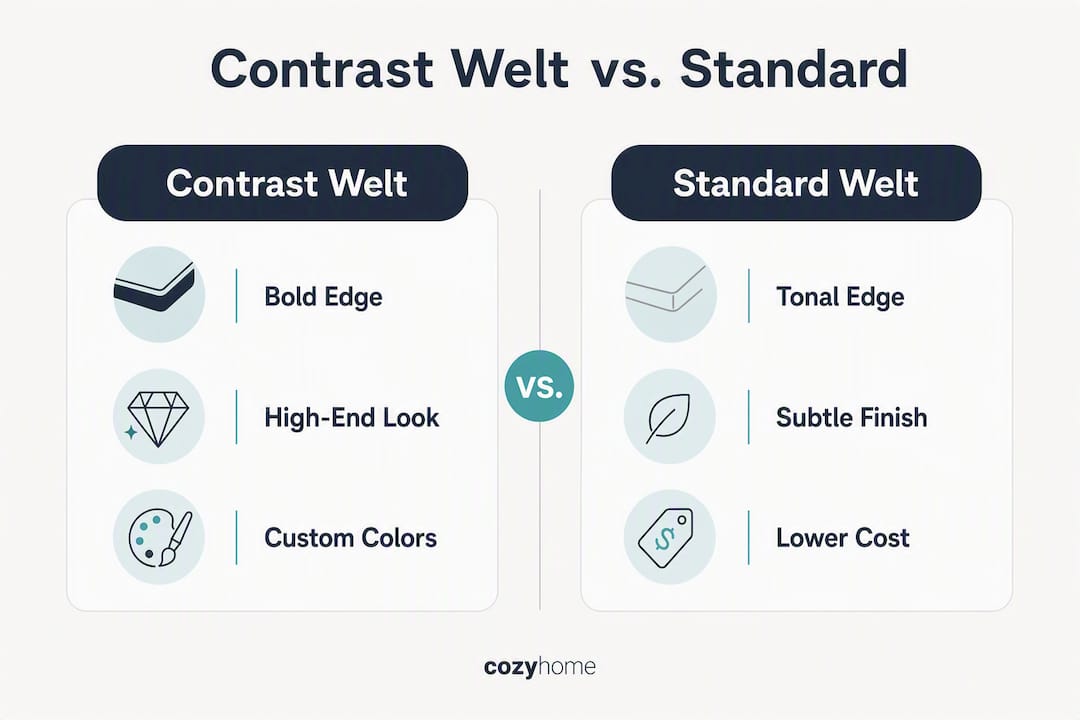
A contrast welt is a fabric-covered cord sewn into the seams or edges of upholstered furniture using a fabric that differs in color or texture from the main upholstery, creating a defined outline that frames the piece’s silhouette. Where a self-welt blends in, a contrast welt stands out, drawing the eye along cushion edges, arm profiles, and seat rails like a deliberate border.
- Visual effect: A bold contrast welt makes a sofa or chair’s silhouette graphic and intentional; a tonal version adds quiet definition without drama.
- Structural role: Welting reinforces seams and helps cushions hold their shape through regular use.
- When to choose it: Pick contrast welt when you want a custom, tailored look that highlights the furniture’s lines rather than letting them disappear into the fabric.
Table of Contents
- What is furniture contrast welt, and how does it differ from related terms?
- How is a welt actually constructed?
- What purpose does welting actually serve?
- How does contrast welt change a piece, and how do you choose?
- Where is contrast welting most commonly used?
- Welt vs. piping vs. flange: quick answers
- How to specify a contrast welt when ordering
- How cozyhome furniture handles contrast-welt orders
- Key Takeaways
- Why contrast welt deserves more attention than it gets
- Custom contrast-welt sofas and chairs at cozyhome furniture
- Useful sources
- FAQ
What is furniture contrast welt, and how does it differ from related terms?
Upholstery has its own vocabulary, and the terms overlap enough to cause real confusion. Here is a plain-language breakdown.
| Term | What it is | Typical placement | Visual impact |
|---|---|---|---|
| Welt | Fabric-covered cord sewn into a seam | Cushion edges, arms, seat rails | Defines the seam line |
| Piping / cording | Same construction as welt; terms are interchangeable in most U.S. shops | Cushions, pillows, skirts | Adds a raised edge detail |
| Self-welt | Welt covered in the same fabric as the main upholstery | All seam locations | Subtle, tonal, refined |
| Contrast welt | Welt covered in a contrasting fabric or color | Cushion borders, arms, seat fronts | Bold outline, graphic effect |
| Flange | A flat fabric tab sewn into a seam, no cord inside | Pillow edges, cushion borders | Flat, decorative border |
| Double welt | Two welts stitched side by side | Chair backs, panel edges | Heavier, more formal look |
Single welt is the standard choice for most sofas and cushions. Double welt, sometimes called double-cord trim, suits more formal or traditional pieces where a heavier edge detail reads as intentional rather than busy.
How is a welt actually constructed?
Every welt starts with two components: a core cord and a cover strip. The core is usually a twisted cotton or poly-cotton rope, chosen in a diameter that suits the furniture’s scale. The cover strip is cut from the chosen fabric and wrapped tightly around the cord, then stitched close to the cord with a zipper foot so the seam allowance can be tucked into the furniture’s seam.
Key construction details that separate a clean welt from a sloppy one:
- Bias cutting: Cutting the cover strip at a 45° angle gives it enough stretch to follow curves without puckering, which matters on rounded arms and cushion corners.
- Stitch distance: The stitching line must sit tight against the cord so no fabric gap shows at the finished edge.
- Join placement: Where the welt ends meet, the join should be hidden on a lower rear run, never at a corner or a visible front seam.
- Corner handling: Corners require notching the seam allowance so the welt turns cleanly without bunching.
Common cover materials include the main upholstery fabric (for self-welt), a contrasting solid, leather, velvet, or a complementary pattern. The cord itself can be cotton, polyester, or a foam-wrapped core for a softer profile.
What purpose does welting actually serve?
Welting does two jobs at once, and both matter. Structurally, it reinforces the seam where two fabric panels meet, distributing stress across the cord rather than concentrating it on a single stitch line. That means cushion edges stay crisp longer, and the cover holds its shape through years of use.
The decorative function is just as deliberate. Designers treat contrast welt as an intentional frame for furniture, tracing the silhouette the way a picture frame defines a canvas. When the welt fabric contrasts in texture, such as velvet trim on a linen sofa, it adds tactile depth that changes how the piece reads from across the room.
“Welting and piping are the unsung heroes of the custom upholstery world. They create the crisp, clean lines that define the silhouette of high-end furniture, meticulously tracing the seams of cushions, arms…” — A Designer’s Guide to Luxury Ribbon and Trim
Contrast welt is a reliable signal of custom, high-end work precisely because it exposes the quality of the tailoring. A neat welt line shows the upholsterer’s skill; a rolling or puckered one reveals poor fit underneath.
Pro Tip: Match cord diameter to furniture scale. A large-diameter cord suits a deep, substantial sofa but looks clumsy on a compact accent chair. For smaller-profile seating, a narrow cord keeps the detail proportional and professional.
How does contrast welt change a piece, and how do you choose?
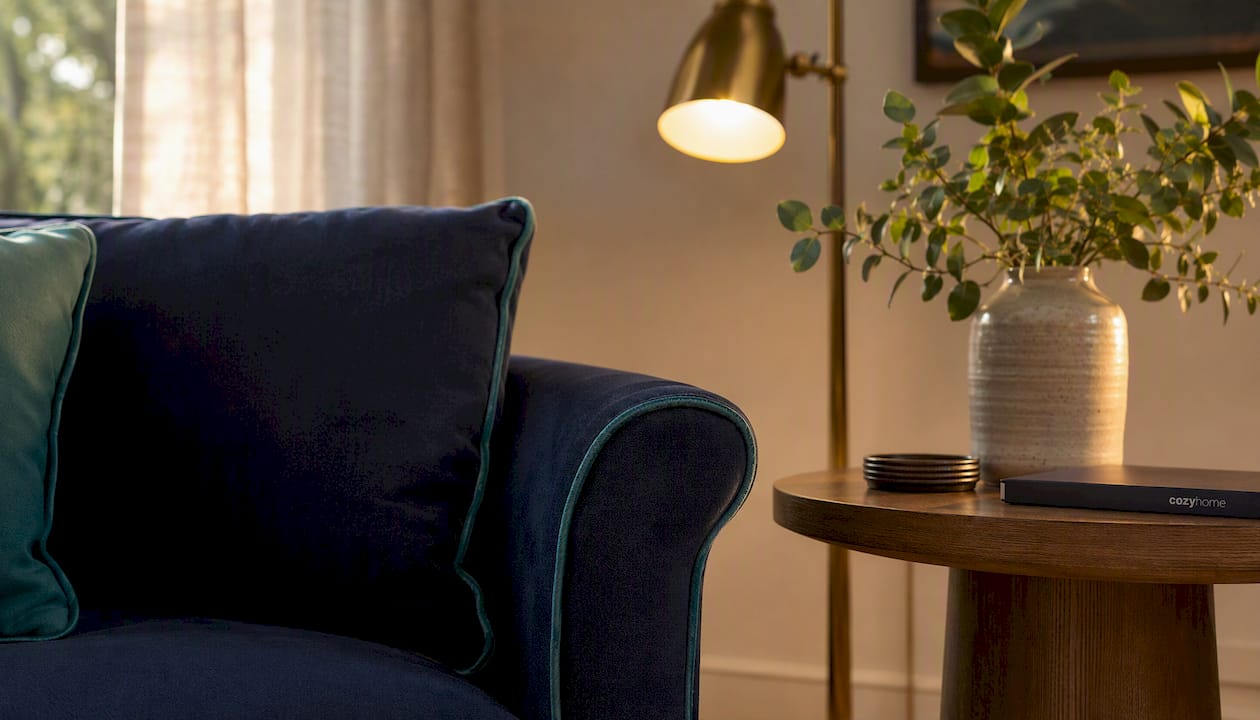
A bold, high-contrast welt makes the silhouette graphic, while a tonal contrast maintains a sophisticated, understated look. The choice comes down to what you want the furniture to do in the room.
Design scenarios to consider:
- Bold contrast for modern or sculptural pieces: A navy welt on a cream sofa or white piping on a charcoal chair creates a deliberate, graphic outline. This works best on clean-lined contemporary shapes where the silhouette is worth emphasizing.
- Tonal contrast for classic or refined looks: A warm taupe welt on a beige linen sofa adds definition without drama, suiting transitional and traditional rooms.
- Texture contrast for tactile depth: Velvet trim on a linen or cotton upholstery changes the perceived quality of the piece even when the color difference is subtle.
- Scale guidance: Choose cord diameter proportional to cushion thickness; large cords read as professional on deep seating, narrow cords suit light-profile chairs.
For fabric pairing ideas, the guide on how to combine fabric patterns covers visual balance in detail. If you want to go deeper on fabric behavior before choosing a welt material, the upholstery fabric types guide covers nap, bias, and stretch in practical terms.
Where is contrast welting most commonly used?
Contrast welt appears most often on cushion edges, arm profiles, seat rails, and the front face of ottomans. These are the lines the eye travels first, so a contrast detail there frames the whole piece. Pillows and bolsters also take contrast piping well, especially when they repeat the welt color from the main furniture.
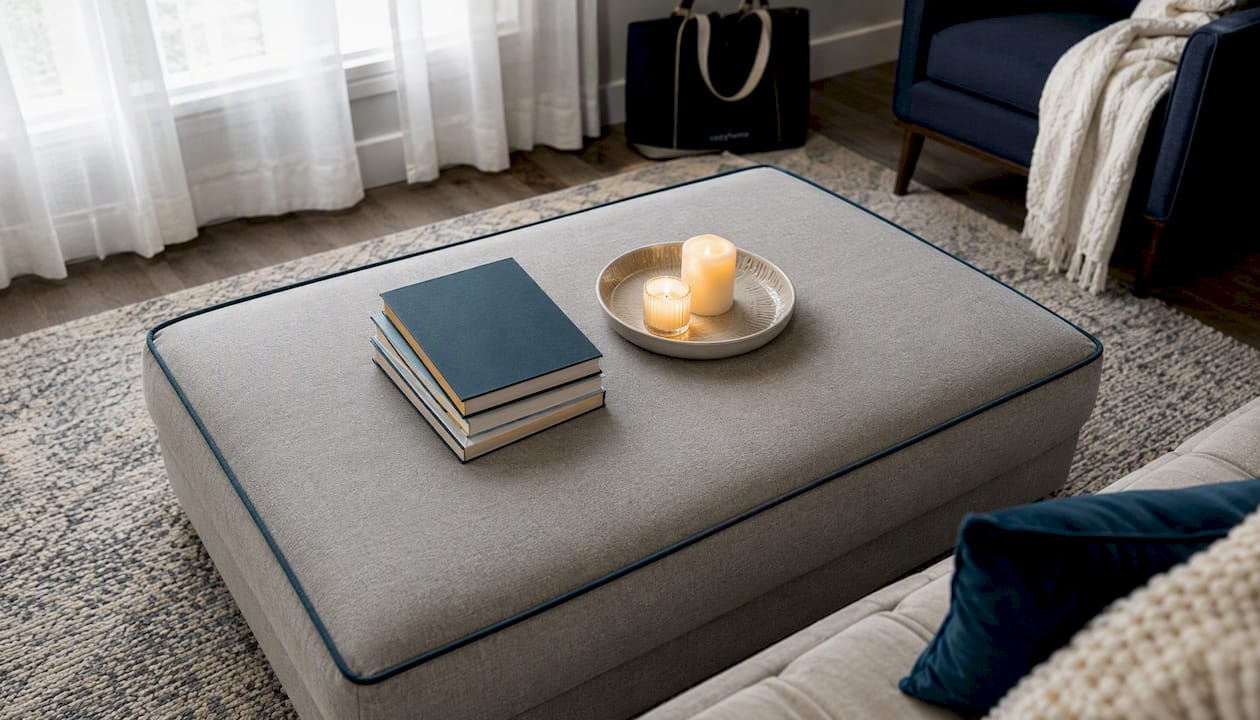
Style fit matters. Contemporary and transitional pieces carry contrast welt naturally because their clean lines give the detail room to read. Formal or classic upholstery, such as a tufted wingback, can use double welt for a heavier, more traditional edge. Heavily patterned fabrics are a harder case: when the main fabric is already busy, a contrast welt competes rather than complements.
Two situations where contrast welt tends to work against the piece: very small-scale seating like counter stools, where a heavy cord overwhelms the profile, and fabrics with large-scale prints, where the welt interrupts the pattern repeat in a way that reads as accidental rather than intentional.
Welt vs. piping vs. flange: quick answers
| Detail | Look | Cost level | Construction visibility |
|---|---|---|---|
| Self-welt | Tonal, subtle | Lower | Minimal |
| Contrast welt | Bold outline | Moderate | Intentional, exposes tailoring |
| Flange | Flat border, no cord | Lower | Flat, soft edge |
| Exposed piping | Raised cord, visible stitching | Moderate | High, deliberate |
Can welt be removed or added later? It can, but it requires reopening the seam, which means partial disassembly of the cover. It is far easier to specify it at the time of order.
Does welt hide poor fit? No. Welt cannot fix an oversized cushion insert or a cover cut too tight. A rolling or stressed welt line is usually a sign of fit problems underneath, not a trim issue.
What about cost and lead time? Made-to-order pieces with custom contrast welt typically carry longer lead times and higher costs than ready-to-ship items. Ask for a specific estimate and a sample before committing.
How to specify a contrast welt when ordering
Getting the result you want means giving your upholsterer or retailer clear, specific instructions. Work through this checklist before you finalize the order:
- Self-welt or contrast welt? Confirm which you want and name the contrast fabric explicitly.
- Cord diameter: State the size in millimeters or describe it relative to the cushion thickness.
- Welt fabric: Specify the exact fabric, colorway, and whether it should be cut on the bias.
- Bias-cut requirement: For any curved run or rounded arm, confirm the strip will be cut at 45°.
- Join placement: Ask that joins be hidden on a lower rear run, away from corners and front seams.
- Corner handling: Confirm whether corners will be mitered or notched, and ask to see a sample corner.
Sample phrases that work well with a retailer or upholsterer:
- “Contrast welt in [fabric name], [X] mm cord, bias-cut, join hidden on lower rear.”
- “Single welt, tonal, same fabric as seat cushion, no join on front face.”
- “Double welt on arm panels only, contrast color, mitered corners.”
Pro Tip: Before the upholsterer cuts the full run, ask for a short welt mockup on the actual fabric stack. A six-inch sample with a corner turn shows you exactly how the scale, color, and corner handling will read on the finished piece.
How cozyhome furniture handles contrast-welt orders
cozyhome furniture’s made-to-order process is built around exactly this kind of detail. With 700+ fabric and leather options in the Plano showroom, you can pull swatches side by side and see how a contrast welt fabric reads against your chosen upholstery before anything is cut.
The process starts with an in-store consultation where staff help you work through fabric selection, cord scale, and placement. From there, the team can arrange samples or mockups so you see the welt detail at actual scale before the order is finalized. Once confirmed, the piece is built to your specifications, with local delivery to Plano, Frisco, Allen, McKinney, and surrounding DFW communities. That hands-on, start-to-finish approach is what separates a custom piece from something pulled off a warehouse floor.
Key Takeaways
A contrast welt is the single most effective upholstery detail for defining a furniture silhouette, and specifying it correctly at the time of order is what separates a clean result from a costly redo.
| Point | Details |
|---|---|
| Contrast welt definition | A fabric-covered cord in a contrasting color or texture, sewn into seams to outline the furniture’s shape. |
| Structural and decorative role | Welting reinforces seams and helps cushions hold shape while making the quality of tailoring visible. |
| Choosing bold vs. tonal | Bold contrast suits modern, clean-lined pieces; tonal welt works for classic or refined looks. |
| Ordering checklist | Confirm cord diameter, welt fabric, bias-cut requirement, join placement, and corner handling before finalizing. |
| cozyhome furniture | Offers made-to-order contrast-welt options with 700+ fabrics, in-store mockups, and local DFW delivery. |
Why contrast welt deserves more attention than it gets
Most people shopping for a sofa focus on fabric color and cushion fill, which makes sense. But the welt is the detail that either makes a custom piece look truly tailored or lets it read as generic. A well-chosen contrast welt on a clean-lined sofa does more for the room than almost any other single decision, and it costs far less than reupholstering later when the piece feels flat.
The advice we give most often: treat the welt as part of the design, not a finishing afterthought. Choose it at the same time you choose the main fabric, hold the swatches together in the actual light of your room, and ask for a corner sample before the full run is sewn. That one step prevents most of the surprises people encounter when the finished piece arrives.
Custom contrast-welt sofas and chairs at cozyhome furniture
cozyhome furniture gives DFW homeowners something most retailers can’t: a made-to-order sofa or chair built with the exact contrast welt detail you choose, in a fabric selected from 700+ options, with in-store guidance at every step. The Excelsior Sofa is a strong starting point for anyone who wants to see how contrast trim reads on a clean, contemporary silhouette. Stop by the Plano showroom to pull swatches, request a welt mockup, and walk out with a clear picture of exactly what your finished piece will look like.
Useful sources
These resources cover construction details, design guidance, and fabric selection for anyone who wants to go deeper on contrast welting and upholstery trim.
All in the Details: Why We Love Contrast Welting Furniture covers the design case for contrast welt with photo examples of bold and tonal outcomes on real furniture.
What Is Welt Upholstery (or Piping) and Why Does It Matter? explains the upholsterer’s perspective on welt as a signal of craftsmanship and custom work.
Piping, Welt Cord, and Decorative Edges from the Upholstery Handbook is the most detailed construction reference available online, covering cord, cover strip, stitch distance, and join placement.
All About Welting addresses scale and balance, including cord diameter guidance relative to furniture size.
A Designer’s Guide to Luxury Ribbon and Trim frames welting as a signature design detail and explains how contrast piping creates a one-of-a-kind piece.
Upholstery Fabric List: A Complete Guide from Beautiful Windows Elgin covers fabric types and trim considerations for anyone choosing welt materials.
FAQ
What does contrast welt mean in furniture?
Contrast welt means a fabric-covered cord sewn into a furniture seam using a fabric that differs in color or texture from the main upholstery, creating a visible outline around cushions, arms, or seat edges.
What is welt on furniture?
Welt is a cord wrapped in fabric and stitched into a seam to reinforce it and add a decorative edge. It is also called piping or cording, and the terms are used interchangeably in most U.S. upholstery shops.
What is the difference between welting and piping?
There is no structural difference. Both describe a fabric-covered cord sewn into a seam; “welt” is the more common term in furniture upholstery, while “piping” appears more often in sewing and soft-goods contexts.
Can contrast welt be added to existing furniture?
Yes, but it requires reopening the seam and partially disassembling the cover, which adds labor cost. Specifying it at the time of order is significantly easier and less expensive than adding it later.