

How to Evaluate Furniture Showrooms: A Practical Checklist
The most effective ways to evaluate furniture showrooms come down to five things you can do in any store: sit on every piece for at least two minutes, check frame and joinery by hand, open every drawer, ask for written specs and warranty terms, and test the staff’s knowledge. Consumer Reports confirms that in-person testing is the gold standard for comfort and construction, because photos and renderings simply can’t tell you how a cushion feels or whether a joint will hold.
Here’s a quick-scan verdict before you go deeper:
- Sit test: Stay seated for at least 2 minutes in your normal positions (lounging, upright, legs tucked).
- Frame check: Lift a corner of any sofa. A solid frame feels heavy and doesn’t flex or creak.
- Drawer action: Open and close every drawer. Smooth, even glide with no wobble is the baseline.
- Written policies: Ask for warranty, return, and lead-time terms in writing before you commit.
- Staff knowledge: A good salesperson can name the frame material, spring type, and foam density without hesitating.
This guide is a practical showroom audit, not a style primer. Use it section by section on your next visit.
Key Takeaways
The single most important thing you can do in any furniture showroom is test every piece physically and ask for written specs before you pay a deposit.
| Point | Details |
|---|---|
| Sit test is non-negotiable | Sit for at least 2 minutes in your normal positions; have every future user try the piece. |
| Get specs in writing | Ask for foam density, rub count, frame material, and warranty terms before signing anything. |
| Drawer and joinery checks | Smooth drawer action and visible dovetail or mortise-and-tenon joints signal durable construction. |
| Red-flag rule | Walk away if a piece fails two or more physical tests or staff can’t answer two build-spec questions. |
| cozyhome furniture | Offers documented build specs, 700+ fabric options, and in-person consultation at the Plano, TX showroom. |
Table of Contents
- What are the best ways to evaluate furniture showrooms before and during your visit?
- How do you assess upholstered pieces like sofas and chairs in person?
- How do you inspect case goods like tables, dressers, and shelving for quality?
- What questions should you ask every showroom salesperson?
- How do policies, pricing transparency, and origin affect long-term value?
- What red flags should make you leave a furniture showroom?
- A compact showroom audit template you can use today
- How do online reviews help you screen showrooms before visiting?
- How a well-run local showroom puts these checks into practice
- What most shoppers miss about the showroom visit
- cozyhome furniture makes the custom-first process straightforward
- Sources
- FAQ
What are the best ways to evaluate furniture showrooms before and during your visit?
A structured checklist turns a casual browse into a real audit. Work through it in order.
Before you go:
- Sketch your floor plan and note the dimensions of doorways, hallways, and stairwells the piece must pass through.
- Bring a tape measure, your phone (for photos), and a small swatch bag if you’re comparing fabrics.
- Pull up verified customer reviews for each store you plan to visit. Note any repeated complaints about delivery, cushion compression, or warranty handling.
- Bring whoever will actually use the furniture. A sofa that works for one person may not suit another.
At arrival:
- Note the lighting. Showrooms with dim or warm-only lighting can hide finish flaws and fabric color shifts.
- Check product spacing. Pieces crammed together make it hard to assess scale or walk around them properly.
- Observe how staff greet you. Pressure to buy immediately is a signal worth noting.
In-store tests:
- Sit for at least 2 minutes on every upholstered piece. Try your habitual positions, not just a polite perch.
- Lift a sofa corner. Solid hardwood frames feel noticeably heavier than frames built with particleboard or softwood.
- Open every drawer and door. They should glide smoothly, close flush, and show no wobble.
- Run your hand across fabric surfaces. Pilling, snags, or uneven texture on a floor model is a warning.
- Ask for swatches or take-home samples before committing to a fabric.
Photo and note reminders:
- Photograph spec tags, model codes, and any build labels. SafetyCulture’s audit templates recommend timestamping photos so you can match them to your notes later.
- Write down the model name, fabric code, lead time quoted, and the salesperson’s name.
Pro Tip: Visit on a weekday morning when foot traffic is low. Staff have more time to answer detailed questions, and you can sit on pieces without feeling rushed.
How do you assess upholstered pieces like sofas and chairs in person?
Upholstered furniture rewards patience. ProperSofa’s 20-point showroom checklist recommends sitting for a full 10 minutes in your at-home positions, not just the polite “perch and stand” most shoppers do. Bring everyone who will use the piece, because seat depth and firmness feel very different to different body types.
Frame and suspension checks:
- Lift one corner of the sofa about 6 inches. If the opposite corner rises with it, the frame is solid. If it stays flat, the frame likely has weak joinery.
- Press down on the arms and back. No flex, no creak.
- Ask whether the suspension uses eight-way hand-tied springs, sinuous springs, or webbing. Eight-way hand-tied is the most durable; webbing alone is the least.
Cushion fill and foam density:
- Ask for the foam density in writing. Designers typically use a minimum of 32–35 kg/m³ for seat cushions as a baseline for longevity, according to Induscraft’s professional checklist.
- Unzip a cushion cover when the staff allows it. Look for consistent foam with no gaps or thin spots.
- Down-wrapped foam holds its shape longer than foam alone and feels noticeably softer on the surface.
Fabric performance:
- Rub the fabric briskly with your palm for 10–15 seconds. Pilling or color transfer on a floor model means the fabric won’t hold up at home.
- Ask for the Martindale rub count. Designers generally request a minimum rub count for everyday residential use and higher for households with pets or children.
- Request a fabric swatch to check color accuracy under your home’s lighting.
Questions to ask about upholstery:
- What species is the frame wood, and is it kiln-dried?
- What type of spring system does this piece use?
- What is the foam density, and is that documented on the spec sheet?
- What is the fabric’s rub count, and does it carry a stain-treatment rating?
Pro Tip: Ask the salesperson to unzip a floor-model cushion. A store confident in its construction will say yes. Hesitation or refusal is worth noting.
How do you inspect case goods like tables, dressers, and shelving for quality?
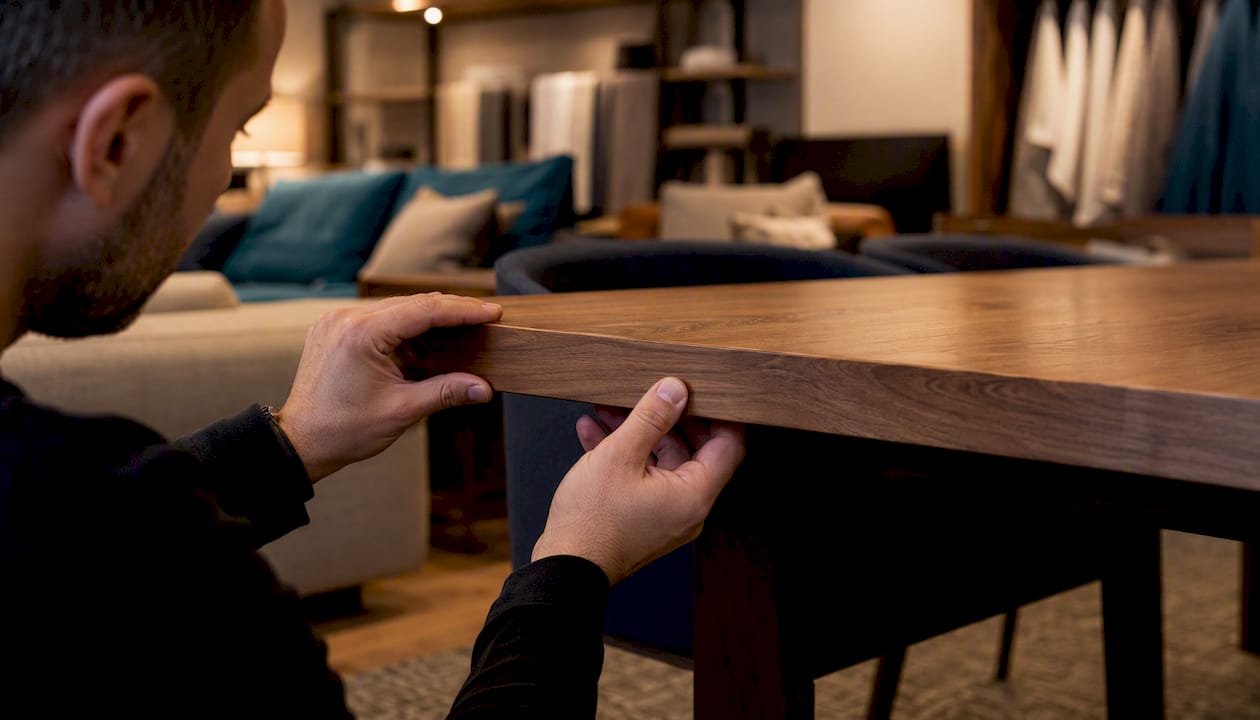
Checkbook’s national buyer guide notes that surface appearances can mask engineered-board construction, so physical tests matter more than visual impressions for case goods.
Joinery inspection:
- Look for dovetail joints on drawer corners and mortise-and-tenon connections on leg-to-rail joints. These indicate hand or precision machine work. Corner blocks glued and screwed inside a cabinet add meaningful strength.
- Staples or nails alone at joints are a shortcut that reduces longevity significantly. Learn more about what these details mean for durability in cozyhome furniture’s signs of quality furniture construction guide.
Material checks:
- Knock on tabletops and cabinet sides. Solid wood produces a dull thud; hollow-core or thin veneer over particleboard sounds noticeably lighter and tinnier.
- Ask whether the piece is solid wood, engineered wood, or veneer over MDF. Each has a different price-to-longevity tradeoff, and the answer should come without hesitation.
- Ask about kiln-drying. Properly kiln-dried wood resists warping and cracking far better than green or air-dried lumber.
Drawer and hinge checks:
- Pull every drawer to full extension. It should glide smoothly, stay level, and not tip forward.
- Soft-close runners are a quality indicator on mid-range and higher pieces. Their absence on a premium-priced item is worth questioning.
- Check door alignment by opening and closing cabinet doors. Gaps wider than 1–2 mm or doors that spring open suggest poor fitting or weak hinges.
Finish quality:
- Run your fingertips across the surface. Even, smooth finish with no drips, glue streaks, or blotchy staining is the standard.
- Check the underside and back panels. Unfinished backs are common, but rough, splintered edges on visible surfaces indicate rushed production.
What questions should you ask every showroom salesperson?
Good salespeople answer these without pausing. Evasive or vague answers are data points. Good Housekeeping’s furniture checklist emphasizes getting measurements and specs confirmed before purchase, not after.
- Build specs: What is the frame material and joinery method? What spring or suspension system does this use? What is the foam density and fabric rub count?
- Origin and lead time: Where is this piece made? What is the current lead time for this configuration? What factors change that timeline?
- Policies: Can you provide the warranty terms in writing? What is the return or cancellation window for a custom order? Does delivery include assembly and removal of old furniture?
- After-sale service: If a cushion or frame has a defect after delivery, what is the repair or replacement process and timeline?
Ask for a written spec sheet, the model code, and a copy of the warranty before you sign anything. A store that can’t produce these documents on request is one to reconsider.
How do policies, pricing transparency, and origin affect long-term value?
Policies are where many buyers get surprised after the sale. Verify these in writing:
- Warranty scope: Does the warranty cover the frame, cushions, and fabric separately? What voids it? Frame warranties of 5–10 years are reasonable for quality construction; cushion and fabric coverage of 1–2 years is typical.
- Returns and cancellations: Custom orders often carry no-return policies once production begins. Know the cancellation window and any restocking fees before you pay a deposit.
- Delivery terms: Confirm whether delivery includes white-glove assembly and old-furniture removal, or just curbside drop-off. These can add meaningful cost if not included.
- Hidden costs: Ask about delivery fees, protection plan upsells, and disposal charges upfront. Promotional pricing sometimes shifts these costs rather than eliminating them.
On supply chain: overseas production can lower the sticker price but often extends lead times and complicates defect resolution. A piece made domestically typically ships in 6–12 weeks for custom orders; overseas production can run 16–24 weeks or longer, with limited recourse if something arrives damaged.
What red flags should make you leave a furniture showroom?
Some problems are worth asking about. Others are reasons to walk out. Checkbook’s buyer guidance recommends reading verified customer ratings alongside your in-store visit, because patterns in reviews often surface problems the showroom floor won’t reveal.
Walk-away signals:
- No written warranty available, or staff can’t explain what it covers.
- Floor models with creaking frames, drawers that don’t close flush, or fabric that pills under a basic rub test.
- Staff who can’t name the frame material, spring type, or foam density.
- Pressure tactics: urgency language, “today only” pricing, or discouragement from taking time to decide.
- Evasive or inconsistent answers about lead times and delivery.
- No spec sheets available, or refusal to provide them before purchase.
Decision rule: If a piece fails two or more of the physical tests above, or if staff can’t answer two or more of the build-spec questions, ask for documentation and time to review it. If neither is offered, move on. Avoiding common furniture shopping mistakes starts with recognizing these signals early.
A compact showroom audit template you can use today
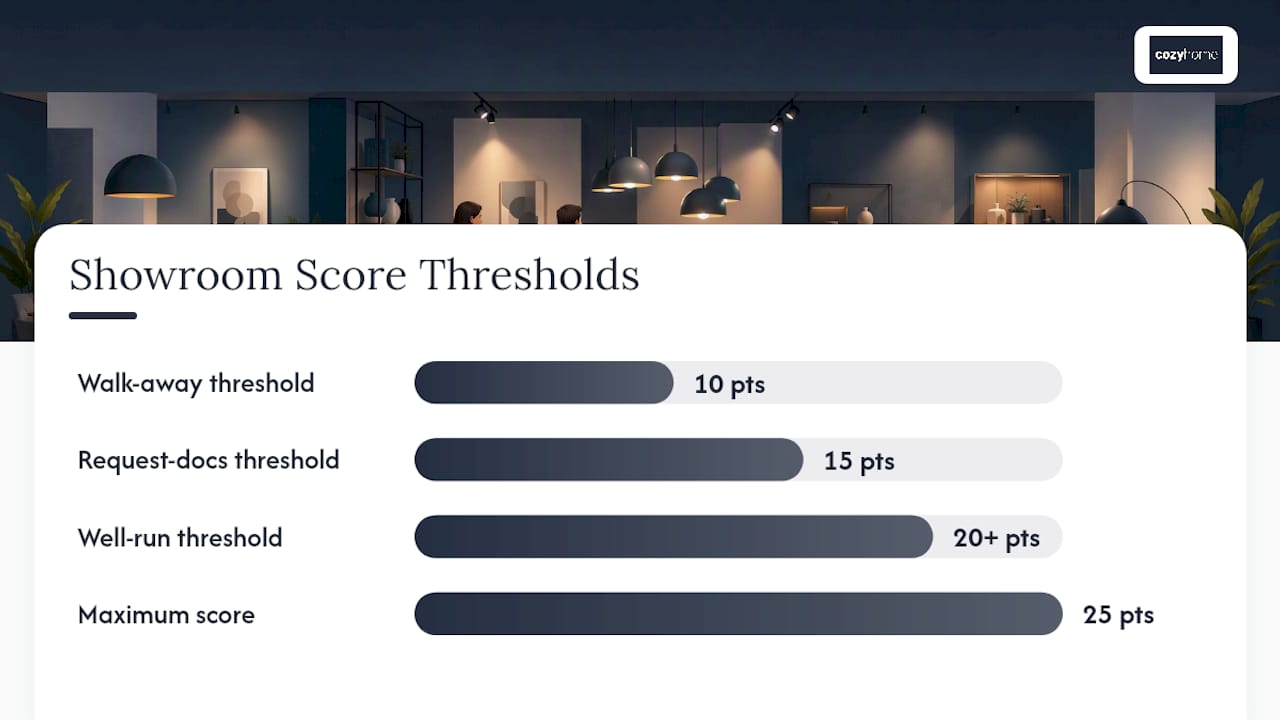
Use this scoring table during your visit. Rate each category 1–5, then total the score.
Quick-score formula: Total out of 25. A score of 20 or higher indicates a well-run showroom worth serious consideration. Below 15, request documentation before proceeding. Below 10, walk away.
Designer version: Add two rows for foam density (confirmed in writing) and joinery notes (dovetail/mortise confirmed vs. stapled). This gives a 35-point scale that maps directly to specification requirements for client projects.
Photo checklist: Photograph spec tags, model codes, fabric labels, and any posted warranty information. SafetyCulture’s dealer evaluation templates recommend timestamping every photo so you can match images to your notes when comparing multiple stores post-visit.
- Photograph the spec tag on every piece you’re seriously considering.
- Capture the model code and fabric code together in one frame.
- Take a wide shot of the piece in context so you can assess scale later.
- Photograph any posted warranty or return-policy signage.
How do online reviews help you screen showrooms before visiting?
Reviews do their best work before you walk in the door. Look for patterns across at least 20–30 reviews rather than reacting to individual outliers.
- Verified purchase tags confirm the reviewer actually bought something, not just browsed. Weight these more heavily than anonymous comments.
- Delivery and assembly notes are among the most reliable signals. Repeated complaints about late deliveries, damaged pieces on arrival, or assembly crews who don’t show up predict post-sale experience accurately.
- Warranty handling comments reveal how a store behaves after the sale. A store that resolves defects quickly and without argument is worth more than one with a slightly lower price.
- Cushion compression complaints appearing in multiple reviews suggest the store sells pieces with foam density below what it claims or below what the price implies.
Use reviews to prioritize which stores to visit first and which questions to lead with. If reviews consistently flag slow custom-order communication, make lead-time documentation your first ask when you arrive.
How a well-run local showroom puts these checks into practice
The checklist above describes what a good showroom experience looks like in theory. cozyhome furniture’s Plano, TX location is a practical example of how it works in person.
When a customer walks into the cozyhome furniture showroom, staff walk them through fabric swatches from a selection of 700+ options, explain the frame construction and spring system on each piece, and provide documented lead times for custom orders before any deposit is taken. Customers can request take-home fabric samples, sit on floor models as long as they need, and leave with a written spec sheet covering frame material, foam density, and fabric performance ratings. For designers, the team offers build-spec PDFs and sample kits that speed up client approvals without requiring a second visit.
Designers working on DFW projects can use the appointment process to request sample kits and written specs in a single visit, which reduces back-and-forth and keeps project timelines on track.
What most shoppers miss about the showroom visit
The physical tests in this guide get most of the attention, and they should. But the part shoppers consistently underestimate is the staff interaction. A salesperson who can’t name the foam density or spring type on a piece they sell every day is telling you something about how that store operates, not just about their personal knowledge.
We’d also suggest leaving your credit card at home on a first visit to a high-end showroom. Checkbook’s guidance recommends this specifically: use the first visit to test, photograph, and write down descriptors; then return to buy once you’ve compared notes. Showroom staging is designed to make everything feel right in the moment. The checklist keeps you grounded.
One more thing designers often overlook: bring the client, or at minimum a photo of the room with accurate dimensions. Scale problems discovered after delivery are expensive to fix and almost always avoidable with a tape measure and a floor plan sketch.
cozyhome furniture makes the custom-first process straightforward
For DFW homeowners and designers who want documented build specs, fabric samples, and honest lead times from the first visit, cozyhome furniture’s Plano showroom is built around exactly that process. Every piece comes with American-made craftsmanship, a choice from 700+ fabrics and leathers, and staff who can answer every question on the checklist above without hesitation.
Browse the Excelsior sofa or the Quinn sectional to see how construction and customization come together in practice. When you’re ready, book an in-person consultation at the Plano showroom. We’ll bring the swatches, the spec sheets, and the tape measure. Free local delivery and white-glove placement are included.
Sources
- How to Shop for Furniture - Consumer Reports
- How to Assess Furniture Quality - Puget Sound Consumers’ Checkbook
- How to Assess Furniture Quality - Checkbook (national)
- Furniture shopping checklist — Good Housekeeping
- Showroom audit checklist — SafetyCulture
- Sofa showroom checklist — ProperSofa
FAQ
How long should you sit on a sofa in a showroom?
Sit for at least 2 minutes in your normal positions, and up to 10 minutes if you can. ProperSofa’s checklist recommends simulating how you actually sit at home, not just a brief upright perch.
What foam density should you ask for in a quality sofa?
Ask for a minimum of 32–35 kg/m³ for seat cushions. Designers use this as a baseline for residential durability, with higher density recommended for heavy daily use.
What does a Martindale rub count mean for fabric durability?
The Martindale rub count measures how many cycles of friction a fabric withstands before showing wear. A minimum of 25,000 rubs is the general residential standard; households with pets or children benefit from higher ratings.
What should you do if a showroom won’t provide written warranty terms?
Request the warranty in writing before paying any deposit. If staff can’t or won’t provide it, treat that as a red flag and consider visiting a different store.
How does cozyhome furniture handle custom-order documentation?
cozyhome furniture provides written spec sheets covering frame material, foam density, and fabric performance ratings, along with documented lead times, before any deposit is taken at the Plano showroom.