

Will a Sofa Fit Through Your Door? The Real Answer
Diagonal depth, not sofa length, decides whether your sofa fits through the door. Most sofas that look too big will still pass if you tilt them, because the diagonal measurement from the front foot to the top back corner is almost always shorter than the sofa’s full depth. Before you panic or call in extra hands, run through three fixes that solve the majority of tight-fit problems:
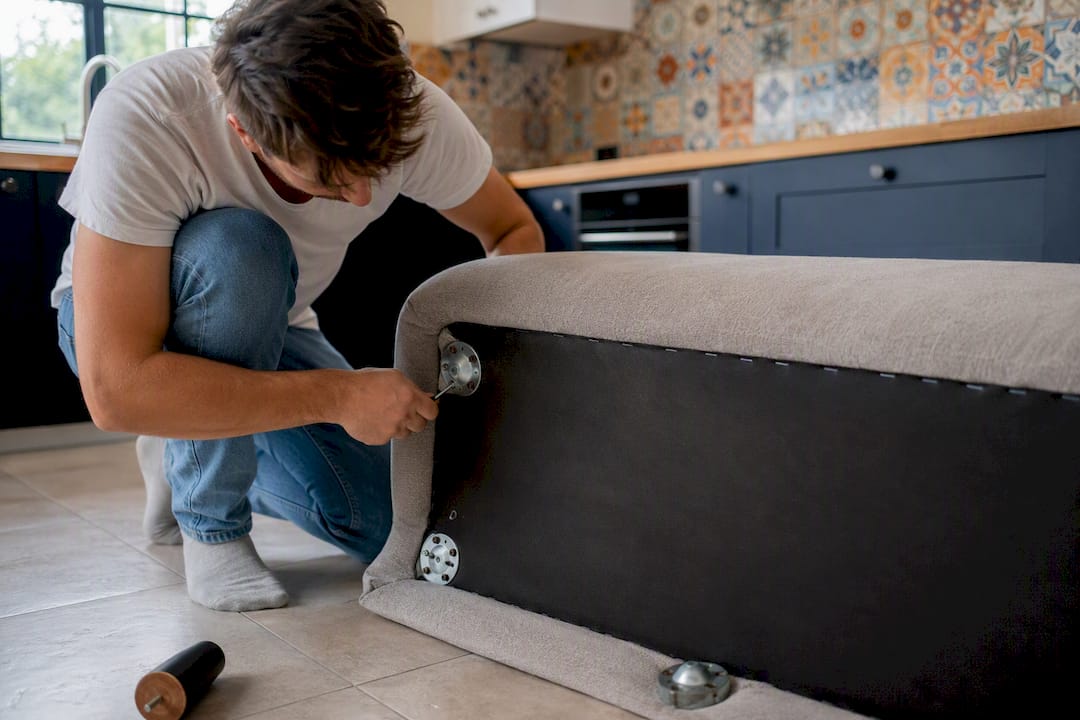
- Pull the cushions and legs first. Removing legs alone typically frees 4 to 6 inches of clearance, often enough to turn a “no” into a “yes.”
- Lift the door off its hinges. Ten minutes with a screwdriver removes the door entirely and the frame it’s attached to, opening up the full jamb width.
- Tilt and pivot, don’t push. Standing the sofa on one arm and walking it through at an angle uses diagonal depth instead of full depth.
Once you’ve got your quick fixes lined up, measure the entire route, not just the door, and check your numbers against the calculator and manual math below.
Key Takeaways
Diagonal depth, not straight sofa depth, determines whether a sofa fits through the door, and removing legs or the door itself usually closes the gap.
| Point | Details |
|---|---|
| Measure diagonal depth | Compare the bottom front to top back corner measurement against the door’s clear opening. |
| Measure the clear opening | Check the actual gap with the door fully open, not the nominal door size on the label. |
| Remove legs for quick inches | Pulling legs typically frees 4 to 6 inches of clearance in seconds. |
| Check the whole route | Hallways, stair landings, and elevators cause more failed moves than the door itself. |
| Consider custom sizing | cozyhome furniture builds sofas and sectionals sized to your specific doorway and route. |
Table of Contents
- Does a Sofa Fit Through the Door? Start With These Measurements
- How Do You Measure a Doorway for a Sofa?
- How to Tell if Your Sofa Will Fit: Calculator and Math
- Tilt-and-Pivot: The Move That Saves Most Deliveries
- Check the Whole Route, Not Just the Door
- When Should You Call Professional Movers?
- How cozyhome furniture Prevents This Problem Before It Starts
- Tools That Make Maneuvering a Tight Sofa Easier
- What the Research Actually Tells You About Sofa Fit
- Get a Sofa That Fits Before You Buy It
- Sources
- FAQ
Does a Sofa Fit Through the Door? Start With These Measurements
You can’t know if your sofa fits through the door until you have four numbers: width, depth, height, and diagonal depth. Skip one and you’re guessing.
- Width runs from the widest point of one arm to the widest point of the other, including any flared arm panels.
- Depth is measured from the front of the seat cushion to the back of the frame, not including a headrest that reclines.
- Height goes from the floor to the highest fixed point, usually the top of the back cushions.
- Diagonal depth runs from the bottom front corner to the top back corner. This is the number that actually matters once you start tilting the piece to get it through a narrow opening, and it’s usually shorter than depth alone.
Measure with cushions on and legs attached first, since that’s how the sofa currently sits. Then measure again after pulling the cushions and unscrewing the legs. Removing legs alone typically frees 4 to 6 inches of height, which matters when a doorway is short as well as narrow.
Pro Tip: Photograph every measurement next to a tape measure before you disassemble anything. It sounds unnecessary until you’re standing in a stairwell trying to remember whether the depth was 38 or 40 inches.
How Do You Measure a Doorway for a Sofa?
The number on the door frame’s label means nothing. What matters is the clear opening, the actual gap the sofa has to pass through once the door is fully open.
- Measure edge to edge between the door stops, not the frame’s outer trim, with the door swung open to 90 degrees or more.
- A door sold as a nominal 32-inch has a real clear opening closer to 30 or 31 inches once you account for the stop molding and hinge hardware.
- Check the height too, especially if there’s a header, transom, or hanging light fixture nearby.
- Measure hallway width, corner turning space, stair landings, and elevator interiors using the same clear-opening standard, since these choke points fail moves more often than the door itself.
Door handles, hinges, and partially opened leaves all eat into that clearance. Removing the door and its hinge pins is a ten-minute job that regularly adds 2 to 3.5 inches of usable width, which is often the difference between a sofa that fits through the door and one that doesn’t.
How to Tell if Your Sofa Will Fit: Calculator and Math
The decision comes down to one comparison: sofa depth versus door clear opening. Run it in this order.
- If sofa depth is less than or equal to the clear opening, the sofa will fit straight through.
- If depth is greater than the opening, calculate diagonal depth and compare that number instead, since diagonal depth is what decides whether tilting works.
- If diagonal still exceeds the opening, add back the inches you’ll gain from removing the door (roughly 1 to 1.5 inches) and removing legs (4 to 6 inches), then compare again.
Here’s a worked example: a sofa measures 40 inches deep against a door with a 32 inch clear opening. Straight depth fails. But the diagonal depth on that same sofa often runs closer to 34 or 35 inches once tilted, and pulling the legs drops the effective height enough to clear a low header. Removing the door adds another 1 to 1.5 inches of width. That combination frequently converts a fail into a pass.
| Scenario | Sofa Measurement | Door Clear Opening | Verdict |
|---|---|---|---|
| Straight depth check | 40 in depth | 32 in | Fail, depth exceeds opening |
| Diagonal depth check | 34 in diagonal | 32 in | Still tight |
| After removing door and legs | 34 in diagonal | 32 in effective opening becomes 34 in | Pass |
Online furniture fit calculators run this same logic, but they’re only as good as the numbers you enter. Feed one a nominal door size instead of the actual clear opening and it’ll give you a false pass.
Tilt-and-Pivot: The Move That Saves Most Deliveries
Most “it won’t fit” situations resolve with the right technique, not a bigger doorway. The tilt-and-pivot method is the standard maneuver for narrow openings, and it works because it swaps the sofa’s full depth for its shorter diagonal measurement.
- Position two people, one on each end. The person leading into the room tips the sofa’s front corner down and forward first.
- Feed the leading corner through at an angle, roughly 30 to 45 degrees off vertical, while the trailing person keeps the back corner clear of the frame.
- Pivot the sofa’s midpoint through the opening once the leading half clears, rotating rather than pushing straight ahead.
- Straighten the piece once fully through and set it down gently, checking upholstery hasn’t caught on the frame.
For extremely tight spots, a vertical carry, standing the sofa on one arm, sometimes clears a header height that a horizontal tilt can’t. Use it when ceiling height near the door is the limiting factor rather than width.
Pull cushions by hand, no tools needed, and detach legs with a screwdriver or hex key; that alone often saves 4 to 6 inches. If the sofa has removable arms, check the underside for bolts before assuming they’re fixed. Padding door frames and sofa corners with moving blankets before you start prevents gouged walls and torn fabric, which is cheaper than fixing either after the fact.
Pro Tip: Stop the moment you feel real resistance. Forcing a tilt past the point where fabric or wood starts to strain almost always means damage, not progress.
Check the Whole Route, Not Just the Door
The door is rarely the actual problem. Most failed deliveries happen at a hallway turn or a stair landing, not the doorway itself, so measure the complete path before you commit to a purchase or a moving day.
- Measure hallway width at its narrowest point, usually where it meets a corner.
- Check stair landings for turning radius, since a sofa that clears a straight hallway can still jam on a switchback staircase.
- Measure elevator interior dimensions and door width separately; elevators often have a smaller usable opening than their cab suggests.
- If the route fails everywhere else, consider a patio door, ground-floor window, or balcony as an alternate entry point, especially for oversized single-piece sofas.
- Rank your fixes by effort: removing the door first, then door stops, then disassembling the sofa itself, since each step gains inches but costs more time.
Split sectionals sidestep this entire problem since each piece moves through on its own.
When Should You Call Professional Movers?
Some situations call for professional help instead of another hour with a tape measure.
- Rigid sleeper frames or solid wood pieces that can’t tilt or flex without risking structural damage.
- Narrow staircases with tight switchbacks, especially above the second floor.
- Heavy single pieces that need two or more people just to lift, let alone maneuver at an angle.
Labor-only movers, disassembly and reassembly crews, and specialty rigging services that hoist furniture through windows all solve different versions of this problem. Before you call, send exact measurements, photos of the doorway and route, and ask whether the crew has handled a similar layout before. A mover who’s done a third-floor walk-up with a switchback staircase already knows the tricks you’d otherwise learn the hard way.
How cozyhome furniture Prevents This Problem Before It Starts
Every fit calculation above assumes you’re working backward from a sofa you already own or already fell in love with online. cozyhome furniture flips that order.
- In-store staff walk you through measurement checklists before you order anything, comparing your doorway and route against the piece you’re considering.
- Custom sizing means a sofa can be built to your exact door and hallway constraints rather than forcing your home to accommodate a fixed factory size.
- Free local delivery in the Plano and Dallas-Fort Worth area includes a team that has handled these routes before and knows what a tight stairwell actually requires.
| Fit Risk | How cozyhome furniture Addresses It |
|---|---|
| Unknown door clearance | In-store staff review measurements before the order is placed |
| Sofa too large for the space | Custom sizing adjusts depth and dimensions to the buyer’s route |
| Delivery day surprises | Free local delivery includes a crew familiar with tight residential access |
Tools That Make Maneuvering a Tight Sofa Easier
A few inexpensive aids solve the maneuvering problems that measurements alone can’t fix. Furniture sliders, the same plastic or felt discs used to move couches across hardwood, let you pivot a sofa’s weight on a landing without gouging the floor or straining your back mid-turn. Slide them under each leg before you start the tilt-and-pivot sequence, not after you’re already stuck halfway through.
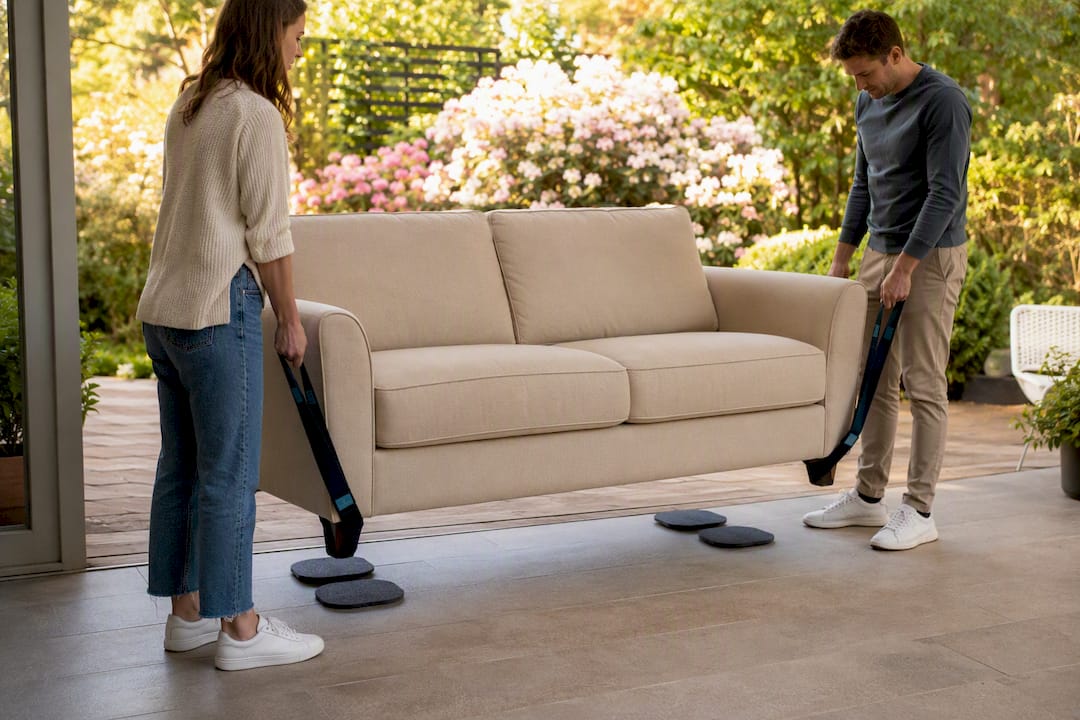
A lifting strap, sometimes sold as a forearm forklift, redistributes the sofa’s weight onto your shoulders and forearms instead of your lower back. That matters most on stairs, where a two-person carry without straps tends to concentrate all the weight on whoever’s on the downhill side. Moving blankets or old bedsheets wrapped around corners protect both the upholstery and the door frame from scuffs during the tightest part of the maneuver, and they’re cheap enough to buy specifically for one move.
A basic doorstop or wedge keeps a propped-open door from swinging shut mid-carry, which sounds minor until it happens with your hands full and the sofa half through the frame. For anyone tackling a staircase with a switchback, a stair-climbing hand truck (rented, not bought) removes most of the physical strain from carrying weight up or down steps.
None of these tools substitute for accurate measurements. They just make execution safer once you’ve confirmed the sofa fits through the door on paper.
What the Research Actually Tells You About Sofa Fit
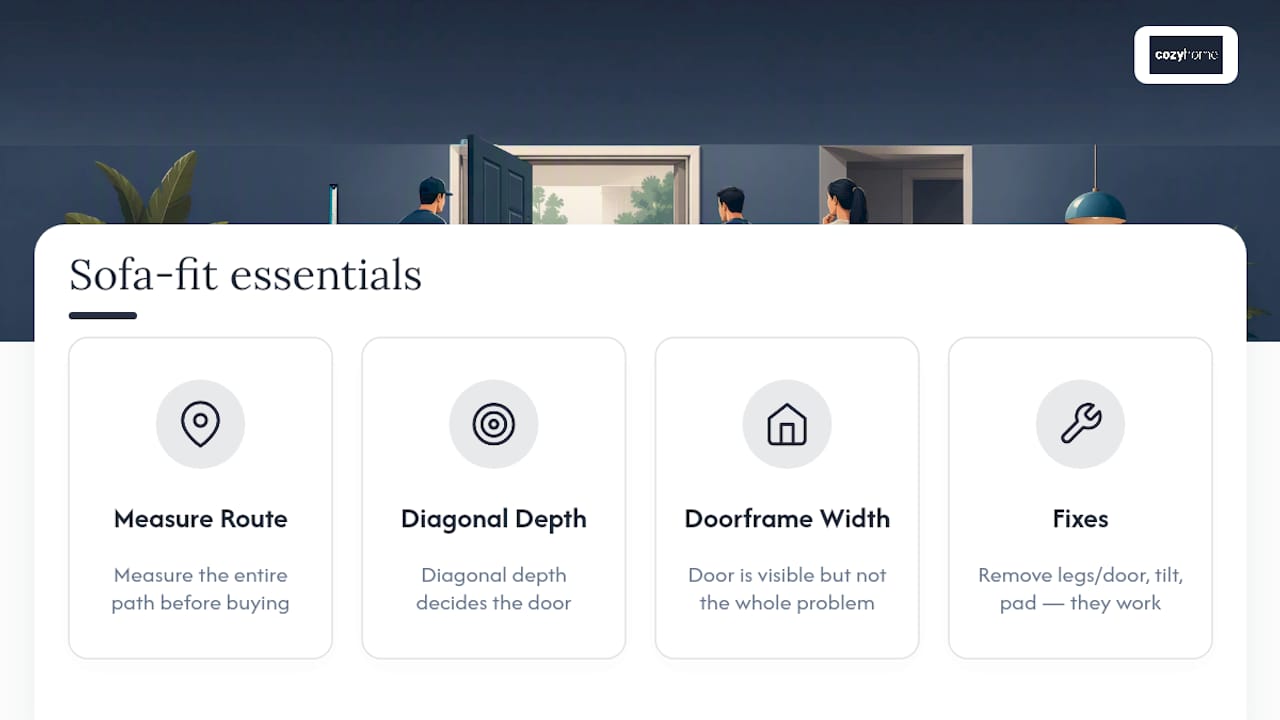
The measurement advice repeated across most moving guides is right, but it’s incomplete on its own. Depth and diagonal depth matter enormously, and the fixes (removing legs, removing the door, tilting rather than pushing) work exactly as described. Where conventional advice falls short is treating the doorway as the whole problem when it’s usually just the most visible one.
The route itself, hallway turns, stair landings, elevator cabs, causes more failed deliveries than the door ever does. That’s not a hunch; it’s the pattern behind most “we measured the door and it still didn’t work” complaints. A sofa that clears a 32 inch doorway with room to spare can still get stuck on a switchback staircase that nobody thought to measure until moving day.
If you take one thing from this guide, measure the entire path before you buy, not after. Diagonal depth decides the door. The full route decides everything else. Readers who want to skip the guesswork entirely should look at custom-sized sofas built around their actual home, rather than hoping a factory-standard piece happens to cooperate.
— Dean P.
Get a Sofa That Fits Before You Buy It
Skip the tape measure standoff entirely. cozyhome furniture builds sofas and sectionals to your exact doorway, hallway, and stairwell dimensions instead of asking you to hope a factory-standard piece cooperates.
Every piece comes in 700+ fabric and leather options with sizing worked out during your visit to the Plano showroom, so the diagonal depth question gets answered before delivery day, not during it. If a single-piece sofa is too much of a gamble for your layout, a modular option like the Quinn sectional ships in separate pieces and reconfigures on site, removing the doorway problem altogether. Prefer a ready-to-order piece with proven dimensions? The Excelsior sofa is a solid starting point for showroom staff to size against your space. Free local delivery across the Plano, Frisco, Allen, and McKinney area means the same team that helped you measure also handles the move in. Visit the showroom or start with a fit conversation before you commit to a size.
Sources
- Allied — Tips for getting a couch through a door
- The Spruce — How to move a sofa through a narrow door
- MeltFlexAI — Will my sofa fit through the door? Calculator + size chart
- HireAHelper — How to move a couch through a narrow door
FAQ
What Size Sofa Will Fit Through a Door?
A sofa whose diagonal depth is equal to or smaller than the door’s actual clear opening will typically fit, even if the sofa’s straight depth measures larger.
Will a 40 Inch Wide Sofa Fit Through a 30 Inch Door?
It depends on diagonal depth, not width alone; a 40 inch sofa often has a diagonal depth closer to 34 or 35 inches, which may still be too large for a 30 inch clear opening without removing the door and legs first.
How Do You Get a Couch to Fit Through a Door?
Remove the cushions and legs, take the door off its hinges, then use the tilt-and-pivot method to walk the sofa through at an angle using its diagonal depth instead of full depth.
Do Most Sofas Fit Through Standard Doors?
Most sofas fit through a standard 32 inch doorway once cushions and legs are removed and the tilt-and-pivot technique is used, though sectionals and oversized pieces sometimes need the door removed entirely or an alternate entry point.
Can cozyhome furniture Build a Sofa Sized to My Doorway?
Yes, cozyhome furniture offers custom sizing during in-store consultations, letting you build a sofa or sectional around your specific doorway and hallway measurements rather than guessing after the fact.