

30,000 Double Rubs: Pick Sofa Fabrics That Survive Kids, Pets, Sun
For heavy family use and homes with pets, performance blends, solution-dyed acrylics, and microfiber outperform almost everything else. For long-term durability without a synthetic feel, tightly woven wool or wool-blend upholstery is your best bet. Linen and traditional velvet look wonderful but belong in low-traffic or formal rooms unless you choose a performance version. Whatever you pick, check the lightfastness rating and cleaning code before you buy, and always test a swatch in your own room first.
TL;DR:
- Performance blends, solution-dyed acrylics, and microfiber are best suited for homes with heavy family use and pets, offering high durability and stain resistance.
- Wool and wool-blend fabrics provide long-term durability and lower damage rates, especially when tightly woven, making them a smart choice for lasting comfort.
- Fabrics like linen and traditional velvet are better for low-traffic or formal rooms unless upgraded with performance treatments or solution dyeing for added resilience.
- Always verify rub counts of at least 30,000, lightfastness ratings of six or higher, and cleaning codes matching household needs before purchasing.
- Prioritize testing swatches in your space for several days and reviewing the fabric’s durability specs to ensure longevity in daily life.
Table of Contents
- Sofa Fabric Guide: Comparing the Main Fabric Types
- How to Read Durability and Cleanability Specs
- Matching Fabric to How You Actually Live
- Testing Swatches Before You Commit
- Everyday Fabric Care That Actually Extends Life
- How cozyhome Furniture Puts This Guide Into Practice
- The Spec Sheet Matters More Than the Swatch Wall
- Sources
- FAQ
Sofa Fabric Guide: Comparing the Main Fabric Types
Every fabric on a showroom floor makes a promise. Some keep it for fifteen years; others start pilling by month six. Here’s how the major sofa upholstery materials actually stack up once daily life gets involved.
- Cotton. Soft, breathable, and easy to dye in almost any color, but on its own it stains easily and crushes under heavy use. Rub counts vary widely, so it suits guest rooms and low-traffic sofas more than a family room. Blended with synthetics, it holds up far better.
- Linen. Beautiful drape and a relaxed, textured look, but it wrinkles, sunfades, and wears thin with friction. Reserve pure linen for formal living rooms; ask about solution-dyed linen-look performance weaves if you want the aesthetic in a busier space.
- Wool and wool blends. Naturally stain-resistant, flame-resistant, and remarkably durable. A large consumer survey found wool and wool-blends had lower rates of owner-reported damage than most other upholstery materials, which makes tightly woven wool one of the smartest long-game choices on this list.
- Velvet. Rich color depth and a plush hand, but traditional velvet crushes, shows pile direction, and can be tricky to clean. Modern performance velvets solve most of that, offering the same look with real family-room toughness.
- Chenille. Soft, nubby texture with decent durability in a tight weave; loosely woven versions snag on pet claws and buttons. Performance chenille has closed much of that gap.
- Bouclé. Trendy, textured, and cozy, but its looped construction snags easily around cats and kids’ zippers. Best suited to accent chairs or lower-traffic sofas rather than the main family seat.
- Microfiber. A synthetic workhorse: wipeable, pet-hair-resistant, and typically rated for medium-to-heavy residential use. It won’t feel like natural fiber, but it earns its keep in busy households.
- Polyester and olefin. Budget-friendly, fade-resistant, and often solution-dyed, making them strong performers in sunny rooms. Cleaning is usually straightforward, though the hand can feel slightly plasticky in cheaper grades.
- Leather. Not a woven fabric at all, but worth naming here since it’s the natural alternative many shoppers weigh against fabric. It resists spills and pet hair well but shows scratches and needs conditioning; see our fabric versus leather comparison if you’re torn between the two.
- Performance blends. Engineered synthetic or blended fibers built specifically for stain resistance and abrasion resistance. As Revolution Fabrics explains, “performance” isn’t one fiber, it’s a category, so the best results come from solution-dyed fibers paired with a topical protective finish rather than the label alone.
How to Read Durability and Cleanability Specs
Rub count, technically called double rubs or Martindale count, measures how many back-and-forth motions a fabric survives in lab testing before it visibly wears. It’s the single most useful number on a spec sheet, and most shoppers never think to ask for it.
Lightfastness works on a 1 to 8 scale and predicts how well a fabric resists sun fading. According to Fabric Resource’s designer guide, more upholstery damage actually comes from sunlight than from spills, so a sofa in a bright window deserves a rating of 6 or higher, while a shaded room can get by with 4.
Cleaning codes tell you what you’re allowed to use on a stain: W means water-based cleaners only, S means solvent-based only, W/S means either works, and X means vacuum only, no liquid cleaners at all. Mismatching a cleaner to the code can permanently ring or stiffen a fabric.
| Rub count (double rubs) | Recommended use |
|---|---|
| — | Light use: guest rooms, formal sitting areas |
| 30,000 | Medium use: adult households, moderate traffic |
| 30,000 | Heavy residential: families, pets, daily lounging |
| — | Heavy commercial or extreme household use |
These bands come from Fabric Resource’s durability guidance, and they’re worth writing down before you shop.
Matching Fabric to How You Actually Live
Choosing sofa upholstery materials starts with an honest look at your room, not the showroom. Designers call this a room audit, and it’s the same process Fabric Resource recommends: audit first, set a durability floor, then narrow by fiber and weave.
- Ask who uses the sofa daily. Kids, teenagers, adults only, or a rotating cast of weekend guests all put different stress on a fabric.
- Account for food, drink, and pets. A household with toddlers or dogs should set a durability floor of at least 30,000 double rubs and lean toward a W/S cleaning code.
- Check sun exposure. A sofa facing a large window needs a lightfastness rating of 6 or higher regardless of how tough the weave is.
- Estimate expected lifespan. If you want the piece to last 5+ years under daily use, that alone rules out delicate cotton and traditional velvet.
- Prioritize traits in order. Stain resistance and a tight weave matter more than color for busy households; mid-tone neutrals also hide everyday wear better than very light or very dark solids, a tip The Spruce backs consistently.
- Ask direct questions before buying. Get the rub count, the lightfastness number, the cleaning code, whether the fiber is solution-dyed or has a topical finish, and the store’s swatch or return policy in writing.
If you’re wrangling a cat that treats the arm of the sofa like a scratching post, it’s worth reading up on reducing scratching behavior alongside picking a tougher weave.
Testing Swatches Before You Commit
A photo on a screen tells you almost nothing about how a fabric will actually look in your living room. Here’s the routine worth following before you sign off on any sofa fabric.
- Order at least three swatches. Comparing options side by side reveals undertones and texture differences a single sample hides.
- Tape them where the sofa will sit. Leave them up for 3 to 5 days and check them in morning, afternoon, and evening light, since color and finish shift more than people expect once natural light changes.
- Check texture and behavior. Run a hand across the pile, note whether pet hair clings, and watch for early pilling or snagging on a corner.
- Go bigger if needed. A taped square is a start, but a fabric-covered cushion or a larger mounted sample gives a truer read on wear and hand-feel before you order.
- Run the final checklist. Confirm rub count, lightfastness, cleaning code, warranty terms, and the retailer’s return or swatch policy before placing the order.
Everyday Fabric Care That Actually Extends Life
Cleaning code should dictate your first move on any spill. Get it wrong and you risk a permanent ring instead of a clean fix.
- W: blot with a water-based cleaner or mild soap and water, working from the outside in.
- S: use a solvent-based cleaner only; water can leave lasting stains on these fibers.
- W/S: either method works, giving you the most flexibility for family rooms.
- X: vacuum only, no liquids at all, since moisture can damage the fiber or backing.
- Vacuum weekly, rotate and flip cushions monthly, and brush pile fabrics like velvet or chenille in one direction to keep the nap even.
- Keep sofas out of direct sun where possible, and drape a throw over the highest-wear cushion or armrest.
- Skip bleach, over-wetting, and abrasive scrubbing on any fabric, and call in a professional cleaner for set-in stains rather than experimenting.
How cozyhome Furniture Puts This Guide Into Practice
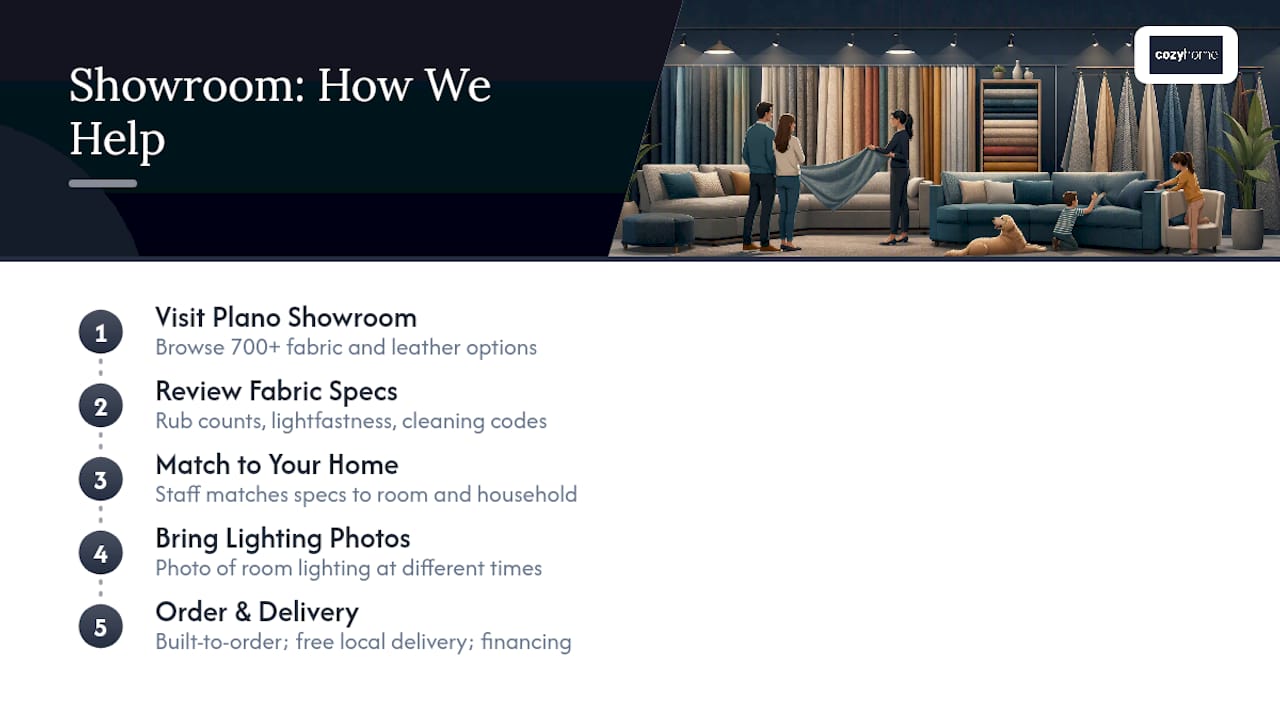
Every fabric conversation above is exactly what happens on our Plano showroom floor. With more than 700 fabric and leather options, our staff walks you through rub counts, lightfastness, and cleaning codes in person, then matches those specs to your actual room and household. Every piece is built to order with American-made craftsmanship, backed by free local delivery and flexible financing.
Pro Tip: Bring a photo of your room’s lighting at different times of day when you visit, it helps our team steer you toward fabrics with the right lightfastness rating before you fall in love with the wrong swatch.
If you already know your durability floor, browse configurations like the Excelsior sofa in cream or explore our custom upholstery process to see how fabric selection fits into building your sofa from scratch.
The Spec Sheet Matters More Than the Swatch Wall
Most sofa shopping advice obsesses over color and texture, and almost ignores the numbers that predict whether that fabric survives contact with real life. That’s backwards. A gorgeous linen weave with no lightfastness rating listed is a bigger gamble than a plain performance fabric rated 7 for sun resistance and 40,000 double rubs.
The conventional wisdom, “just pick what you love, then be careful with it,” ignores how households actually behave. Nobody enforces a no-drinks-on-the-couch rule for five straight years. The fabrics that hold up are the ones engineered to forgive daily mistakes, not the ones that demand vigilance.
If you take one thing from this guide, let it be this: set your durability floor before you fall in love with a color. Ask for the rub count and cleaning code in writing, and never skip the multi-day swatch test. The couch that still looks good in year six is rarely the one that looked best in the showroom on day one.
— Dean P.
Sources
- How To Choose Upholstery Fabric: The Complete Guide To Durability, Style, And What Designers Recommend » Fabric Resource
- What is performance fabric? » Revolution Fabrics
- The most and least durable sofa fabrics - Which?
- Best couch fabrics: types and selection guidance » The Spruce
FAQ
What type of fabric is best for a sofa?
There’s no single best fabric, it depends on use. Performance blends and microfiber suit families and pets, tightly woven wool handles daily wear well, and linen or traditional velvet fit lower-traffic, formal rooms.
What is the 2/3 rule for couches?
Definitions of this rule vary across sources and it isn’t a standard upholstery term, so treat any specific version you see with caution rather than as an industry-wide standard.
What is the best fabric to use for a sofa?
For most households wanting a sofa to last 5+ years, look for a solution-dyed performance fabric or tightly woven wool blend rated at least 30,000 double rubs with a W/S cleaning code.
What is the best fabric for a sofa with kids or pets?
Performance blends, solution-dyed acrylics, and microfiber hold up best against spills, scratches, and pet hair, especially when paired with a W/S cleaning code for easy cleanup.
How do I know if a sofa fabric will fade in sunlight?
Check the lightfastness rating on the spec sheet. Aim for at least a 4 in shaded rooms and 6 or higher for sofas near large windows or direct sun exposure.