

8x10 or 9x12? Tape Out to Nail Rug Size for Your Sectional
Most sectionals look best on an 8x10 or 9x12 rug, with 10x14 or 12x18 reserved for large L-shaped and U-shaped layouts. The default placement rule is simple: rest the front legs of the sofa on the rug, leaving 8 to 18 inches of floor visible beyond the sofa’s front edge. Before you buy, measure your sectional’s full footprint, including the chaise, and tape out that size on the floor to confirm it works.
TL;DR:
- Rug sizes should match the sectional footprint, with 8x10 to 9x12 for standard L-shapes and 10x14 to 12x18 for larger U or double-chaise layouts.
- When in doubt, sizing up is preferable, especially if the chaise extends past the main seating area or if a larger rug better defines a spacious room.
- Placing only the front legs on the rug is the most practical and cost-effective placement style for everyday living rooms.
- Always measure the entire sectional and leave 8 to 18 inches of floor visible beyond the front edge to achieve proper proportion.
- Testing sizes with painter’s tape before purchase prevents costly mistakes and ensures the rug fits both the space and foot traffic flow.
Table of Contents
- What Rug Size Fits Your Sectional?
- Front Legs, All Legs, or Floating: Choosing Rug Placement
- Sizing by Sectional Shape: L, U, Chaise, and Apartment Layouts
- Measuring and Testing Your Rug Size Before You Buy
- Rug Sizing Mistakes That Are Easy to Fix
- How Custom Sectionals Change the Rug Math
- Cozy Comfort or Formal Anchor: Picking Your Rug Style
- Sources
- FAQ
What Rug Size Fits Your Sectional?
Rug shopping for a sectional gets confusing fast because sectionals themselves vary so much in footprint. A tight apartment sectional and a sprawling U-shaped one need completely different rugs, so the smartest approach is matching rug size to your sofa’s actual dimensions rather than guessing from a photo online.
For a compact loveseat-style sectional or a small apartment sofa, a 5x8 or 6x9 rug usually does the job. These sizes fit under coffee tables in tighter living rooms without swallowing the whole floor. Once you move into a standard L-shaped sectional, most designers and rug guides point to 9x12 as the “safe” size, with 8x10 working as a minimum for smaller L-shapes or apartment-scale rooms.
Larger sectionals need more rug, especially if you consider how oversized interior doors expand architectural scale and influence room proportions. A U-shaped sectional or a double-chaise layout in an open-plan room often calls for a 10x14 or even a 12x18, since the rug has to stretch across a much wider seating area. Retailer sizing charts commonly map longer sectional footprints, in the 100 to 130 inch range, to these larger rug sizes.
Here’s how footprint translates to rug size in practice:
| Sectional footprint (approximate) | Sectional type | Recommended rug size |
|---|---|---|
| 6 feet long side | Small apartment sectional | 5x8 or 6x9 |
| 7 feet long side | Compact L-shaped | 8x10 |
| 9 to 10 feet long side | Standard L-shaped | 9x12 |
| 10 feet long side | Large L-shaped or U-shaped | 9x12 or 10x14 |
| open-plan large | U-shaped or double chaise | 10x14 or 12x18 |
A few situations push you toward the next size up:
- The chaise extends well past the main seating line, and you want its front legs on the rug too.
- You want the coffee table fully resting on the rug rather than half on, half off.
- Your living room is large enough that a smaller rug would look like a postage stamp on the floor.
When you’re stuck between two sizes, sizing up almost always looks better than sizing down. A rug that runs slightly large still frames the seating area; a rug that’s too small just looks like an accident.
Front Legs, All Legs, or Floating: Choosing Rug Placement
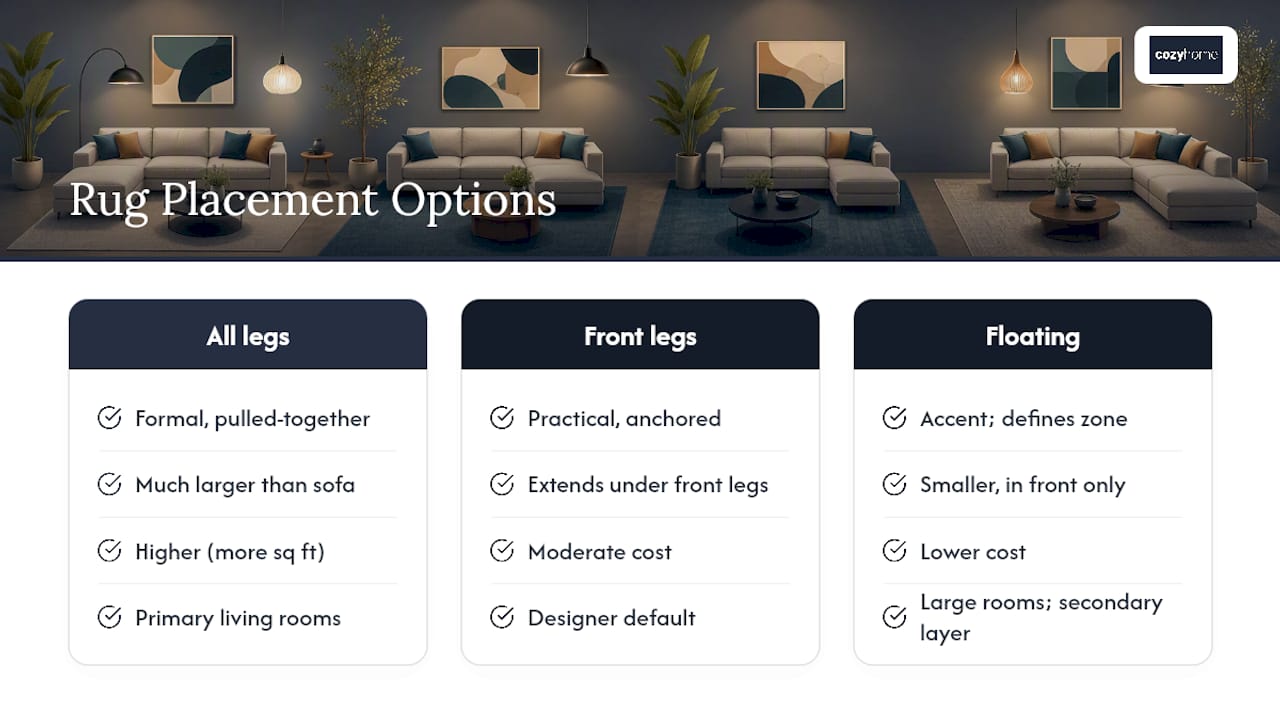
Three placement styles cover almost every sectional setup, and each sends a different visual signal about the room.
All legs on the rug is the most formal, put-together look. Every leg of the sectional sits on the rug, which means the rug has to be considerably larger than the sofa itself, often extending well past the coffee table. It reads as intentional and pulled-together, but it also costs more since you’re buying significantly more square footage of rug.
Front legs on the rug is the placement most designers recommend as the practical default. The front two legs of each section rest on the rug while the back legs stay on bare flooring. This anchors the seating area visually without requiring an oversized (and expensive) rug, and it’s forgiving of slightly imperfect measurements.
Floating the rug in front of the sectional, with no legs touching it at all, works best as an accent move in large rooms where the rug’s job is to define a conversation zone in front of the sofa rather than anchor the sofa itself. It’s the least common choice for a primary living room rug and works better as a secondary layer.
For visible border, most guides suggest leaving 8 to 18 inches of floor showing beyond the sofa’s front edge. Small rooms can get away with 6 to 8 inches, but going tighter than that starts to feel cramped rather than cozy.
Pro Tip: If you’re torn between two rug sizes, pick the one that gets you into the 8 to 18 inch border range rather than the one that “feels” closer to your sofa’s exact length. A little extra rug almost always reads better than a little too little.
Sizing by Sectional Shape: L, U, Chaise, and Apartment Layouts
Shape changes the math more than most shoppers expect. Here’s how to size for the four most common sectional configurations.
- L-shaped sectionals. A 9x12 works as the practical minimum for most L-shaped sofas, with 10x14 as the preferred size once the room has the square footage to support it. Smaller rugs around the 8x10 range may be appropriate for genuinely compact L-shapes with shorter dimensions.
- U-shaped sectionals. Because seating wraps around three sides, a standard rectangle often leaves one arm of the sectional floating awkwardly off the rug. Large rectangles like 12x18, or a square rug in the 10x10 to 12x12 range, do a better job filling the seating “well” and anchoring all three sides at once.
- Chaise sectionals. The chaise is where most sizing mistakes happen. Either size the rug so the chaise’s front legs land on it too, or commit to letting the chaise float entirely with clear visual intent, like a distinct rug layered under just the main seating run. Splitting the difference, where the chaise almost reaches the rug, looks like a measuring error.
- Small apartment sectionals. A 5x8 or 6x9 with front-legs-only placement keeps the room open without eating your entire floor. Watch door swing and walking paths closely here. In tight apartments, a rug that blocks a door from opening fully or narrows a hallway to the kitchen causes more daily friction than a slightly undersized rug ever will.
Rug shape should generally echo sectional shape: rectangular rugs suit L-shaped sofas, while square rugs handle U-shaped seating wells more naturally than a long rectangle ever could.
Measuring and Testing Your Rug Size Before You Buy
Get this step right and you’ll skip the return shipping entirely.
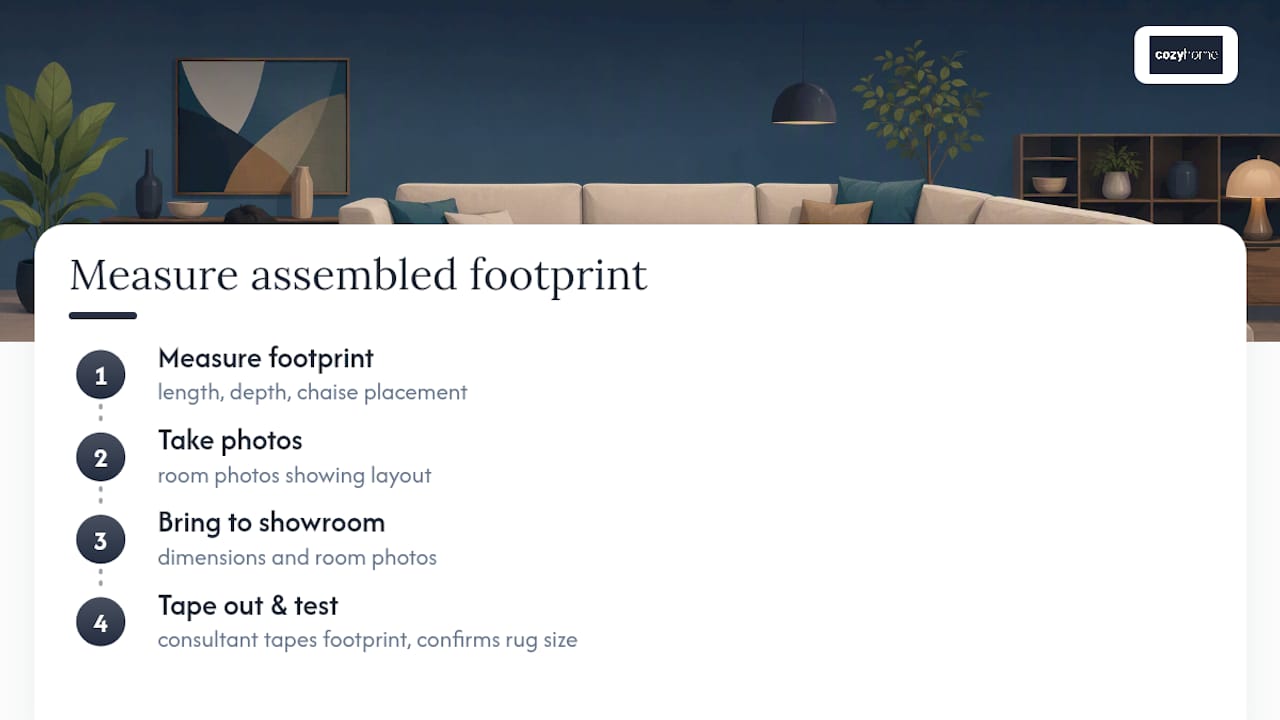
- Measure your sectional’s full assembled footprint, chaise included, both length and depth.
- Add your target border, 12 to 18 inches on the open side of the room, 6 to 8 inches minimum if the room is small.
- Mark two or three candidate rug sizes on the floor with painter’s tape. This tape-out method is the test most flooring and rug guides recommend before committing to a purchase.
- Walk the space for a day. Check that doors clear, that the coffee table sits where you want it, and that foot traffic to the kitchen or hallway feels normal.
- Factor in a rug pad. Padding adds loft and grip, and higher pile can make a rug read larger and cause furniture legs to sink slightly, which changes how the border looks once furniture is back in place.
Painter’s tape costs a few dollars and takes fifteen minutes to lay out. A rug that gets shipped back because it was two feet too short costs considerably more than that in restocking fees and wasted time.
Rug Sizing Mistakes That Are Easy to Fix
The single most common error is buying a rug that’s too small for the sectional. The fix is straightforward: size up one standard increment, or make sure at minimum the front legs land on the rug instead of floating just short of it.
Wrong shape is the second-biggest issue. A long rectangle under a U-shaped sectional leaves one seating arm stranded off the rug; a square rug under a simple L-shape can look boxy and undersized on the open end.
Blocking circulation rounds out the list. A rug that creeps too close to a doorway or narrows a walking path gets walked on unevenly and curls at the edges faster. Tape it out and check door clearance before you buy, not after.
How Custom Sectionals Change the Rug Math
Modular and custom sectionals complicate standard rug charts because chaise depth and arm configuration vary piece to piece. A deep-seat modular chaise can run several inches beyond a standard sofa, which shifts your rug size up a notch even when the overall “footprint” looks similar on paper.
Before a showroom visit, bring the full assembled length, depth, and chaise placement of your current or planned sectional, along with room photos if you have them. cozyhome furniture consultants can walk through a checklist of dimensions to bring to a custom order and tape out footprints in-store, the same method recommended for testing rugs at home, so you leave with a size and placement plan that’s already been tested against your actual configuration.
Cozy Comfort or Formal Anchor: Picking Your Rug Style
Full-coverage rugs, all legs included, read as formal and expensive. They anchor a room the way a magazine spread does. Front-legs-only is more relaxed and easier on the budget, which is why it works for most everyday living rooms.
Neither choice is wrong. Pick the feeling you want first, then confirm it with painter’s tape before you spend a dollar on a rug you can’t return in time.
— Dean P.
Sources
- Best rug size for a living room sectional (The Spruce)
- Rug under sectional: how to size and place it right (D & G Flooring)
- How to place a rug under a sectional sofa (Atlanta Designer Rugs)
- What size rug for a sectional or L-shaped sofa? (Rugsizing)
FAQ
What Is the Rule for Sizing a Rug Under a Couch?
A common guideline is that the rug should extend far enough for at least the front legs of the sofa to rest on it, with roughly 8 to 18 inches of visible floor beyond the sofa’s front edge.
What Kind of Rug Goes Best With a Sectional?
A 9x12 rectangular rug fits most L-shaped sectionals, while U-shaped or double-chaise layouts typically need a 12x18 rectangle or a large square rug to cover the seating well.
Should a Rug Be Longer or Wider Than the Couch?
The rug should extend beyond the sofa on the open side, generally by 8 to 18 inches, rather than matching the sofa’s exact width, which tends to look cramped.
How Do You Place an 8x10 Rug Under a Sectional?
An 8x10 works best under smaller or compact L-shaped sectionals with the front legs resting on the rug and the back legs on bare floor, leaving a visible border in front.