

Online vs In-Store Furniture: How to Choose in Plano
For most big, comfort-dependent pieces, the best path is a mix of both. Research online, then sit, touch and measure in person before ordering. Online shopping tends to win on selection and sticker price. A showroom wins on comfort testing, personal guidance and, according to Consumer Reports’ survey, more frequent white-glove delivery. At cozyhome, we work with Plano and DFW homeowners every day, and we see the strongest results when the two approaches support each other.
TL;DR
- Online stores often offer wider selection and lower prices, while showrooms offer hands-on testing, personal attention and easier returns, based on Consumer Reports’ furniture survey.
- Sofa comfort cannot be judged from a photo. Sit on it, or at least request a swatch before buying.
- Damage or missing parts affected 10% of online purchases and 6% of in-store purchases in that survey.
- The smartest approach is hybrid: browse online, confirm quality in person, and measure your room and doorways before any order.
- For a sofa, sectional, bed or dining table sized to your space, a local showroom that builds to order removes much of the guesswork.
Table of Contents
- What really separates online from in-store furniture shopping
- What shoppers actually prefer
- Comfort, fabric and fit: what a screen cannot tell you
- Price, delivery and damage: the practical comparison
- Which pieces to try in person and which are safe to buy online
- A hybrid plan that uses the best of both
- Our perspective
- What this means in Plano and the wider DFW area
- See it in person at cozyhome
- FAQ
- Sources
What really separates online from in-store furniture shopping
The two channels solve different problems. Online shopping solves discovery: thousands of options, easy price comparison and no driving. A showroom solves confidence: you see the real color, feel the fabric, sit on the cushion and ask a person who knows the construction.
Consumer Reports’ April 2020 Furniture Retailers Survey covered more than 38,000 members who had bought furniture online or in a brick-and-mortar store over two years. Its summary of the results says online stores may offer a larger selection and lower prices, while in-store shopping can provide more personal attention and easier returns. Satisfaction was high for both. Consumer Reports also notes that most of those purchases came before pandemic restrictions, so habits may have shifted since.
Here is a side-by-side view of the factors that matter most.
| Factor | Online | Showroom |
|---|---|---|
| Selection | Very wide, often many styles at once | Curated, with staff helping narrow choices |
| Price | Often lower sticker prices | Often higher, but products and quality tiers differ |
| Comfort and feel | Judged from photos and reviews | Tested in person |
| Color and fabric | Varies by screen | Seen in your own light, with samples in hand |
| Delivery | Often standard shipping | White-glove delivery more common |
| Damage risk | Higher in the survey | Lower in the survey |
| Guidance | Chat, reviews, product pages | Face-to-face help with sizing and layout |
None of these rows is a verdict on its own. A $400 side table and a $4,000 sectional deserve different approaches, and the sections below explain why.
What shoppers actually prefer
Preferences are more mixed than the headlines suggest. A BigCommerce survey of 3,007 U.S. adults who had bought home furnishings online in the prior 12 months, published in August 2024, found that 48% still preferred buying home furnishings in store. Only 28% preferred online, and 24% had no preference. These were people who had already bought online, which makes the in-store lead more telling.

The 3D Cloud Furniture Shopping Trends Study 2024 points the same way. It reported that 19% of respondents shopped online only, 33% shopped in store only, and 48% used both. Online-only shoppers emphasized convenience, variety and price. Those who visited stores first and then bought online were often looking for discounts or free shipping.
Why do people go online at all? In the Provoke Insights and Furniture Today survey of fall 2024 and winter 2025, the leading reasons were better prices (27%), free delivery (25%), wider selection (19%) and a faster shopping experience (16%). Smaller groups said they had no nearby in-person location (7%) or that their preferred source sold only online (8%).
For Plano and DFW shoppers, that last point matters less than elsewhere. Showrooms are a short drive away, so the question is less “can I try it?” and more “which pieces deserve the trip?”
Comfort, fabric and fit: what a screen cannot tell you
Some qualities simply do not translate to a product page.
Seat comfort. Consumer Reports states in its furniture shopping guide that sofa comfort cannot be determined online. Seat depth, cushion firmness and back angle feel different to a 5’2" person than to a 6’3" one. Ten minutes of sitting, leaning back and stretching out tells you more than fifty reviews.

Fabric and finish. Texture, weight and sheen are hard to judge from a photo. A showroom lets you rub a fabric, compare leather grains and hold a swatch against your wall color. Our own guide on swatch-first color tests and crocking checks walks through how to do this before committing to a sofa color.
Construction. Joinery, frame materials and cushion cores are easier to ask about when a person is standing next to the piece. If you want a checklist, our buyer’s guide to quality construction covers what to look for.
Scale. Furniture often looks smaller in a photo than it does in a living room. Online listings give dimensions, but it is hard to feel a 94-inch sofa until you stand beside one.
Price, delivery and damage: the practical comparison
Price
In Consumer Reports’ survey, the median amount spent on a single item was $1,455 at a walk-in store versus $459 online. The same guide reported average spending of $2,281 for an in-store dining table versus $961 online. Consumer Reports is clear that these are averages across different products and retailers, not like-for-like prices.
That caveat is the key. A lower online price usually reflects a different product: different frame materials, different finishes, a different expected lifespan. Compare what each piece is made of before you compare what it costs.
Delivery
The delivery gap is large. In the same survey, nearly nine in ten in-store purchases that were delivered used white-glove service, compared with 17% of online purchases. White-glove means the delivery team brings the piece inside, sets it up and takes away packaging. Online buyers more often received standard shipping, which can mean a curbside drop-off and assembly on their own.
We offer free local delivery for our customers in Plano and the surrounding area, which takes much of the heavy lifting off the buyer.
Damage and delays
According to Consumer Reports, 6% of in-store purchases and 10% of online purchases arrived damaged or with missing parts. Delivery was delayed or rescheduled for 6% of purchases in either channel. Damage or missing parts was also the most common reason for returns, followed by unexpected quality, comfort or color, and furniture that did not fit in the home.
Those reasons line up with what can be prevented before ordering: color, comfort and fit are all things you can check in person.
Returns
Return terms can change the whole equation. BigCommerce found that more than 60% of respondents were more likely to buy from an online home furnishings brand offering free return shipping. No restocking fees, longer return windows and return pickup were also influential, cited by 37%, 36% and 34%. Large furniture is expensive to ship back, so read the return policy before you pay, wherever you shop.
Which pieces to try in person and which are safe to buy online
Not every item deserves a showroom visit. A simple way to sort the shopping list:
Try in person first
- Sofas, sectionals and recliners, where comfort is everything
- Beds and bed frames you will look at every day
- Dining tables and chairs, where seat comfort and table height matter
- Anything in a color or fabric you have never lived with
- Any piece you plan to have custom sized
Often fine to buy online
- Small accent tables, shelves and lamps
- Pieces from a brand whose quality you already know from experience
- Items with a clear, generous return policy and standard dimensions you have already verified
The more a piece costs, the longer you will keep it, and the more it depends on how it feels, the stronger the case for seeing it first. That is also the reasoning behind our guide to common furniture shopping mistakes.
A hybrid plan that uses the best of both
The 3D Cloud study describes the hybrid process as researching online, then confirming quality in person. Respondents said stores let them see, feel and test furniture, while online research supplied convenience, variety and price comparison. The two channels work as stages, not rivals. Here is how that can look in practice.
- Set the room first. Measure the room, and measure every access route the piece must travel: front door, hallway, stairs, elevator, tight corners. Consumer Reports recommends checking the dimensions of the room and access routes against the furniture. Wirecutter’s furniture shopping advice suggests mapping a sofa’s footprint on the floor with painter’s tape. Our walkthrough on scaling a furniture floor plan can help.
- Browse online to build a shortlist. Save styles, note dimensions and decide on a budget range. Reviews help here: Furniture Today reported that 31% of furniture shoppers in the Provoke survey looked at online reviews, compared with 23% of shoppers in other categories. Look for comments about assembly, quality and color rather than star ratings alone.
- Visit a showroom with your shortlist. Sit on the sofas, open the drawers, compare fabrics. Bring your measurements and a photo of the room.
- Request samples. Ask for fabric swatches or wood samples, and for larger swatches where possible. View them at home in morning and evening light, and check color on more than one screen if you are also looking at photos.
- Read the fine print. Wirecutter advises checking maintenance needs, such as fluffing down cushions, and reading warranty and return-policy details.
- Confirm delivery. Ask who brings the piece in, whether setup is included and what happens if something arrives damaged.
If you want a structured way to judge a store, our practical checklist for evaluating furniture showrooms is a good companion for step three.
Our perspective
We hear the same story often. A shopper finds a sofa online, the photo looks right and the price looks fair. Then it arrives, and the seat is too deep, the color reads differently in the living room or the piece barely fits through the door. Nobody did anything wrong. A screen just cannot answer those questions.
That is why we built cozyhome around the showroom. When someone walks in, we start with the room and the way it will be lived in: who sits where, how the space flows, what the doorways allow. Then we look at fabric, size and configuration together. With more than 700 fabric and leather options and made-to-order, American-made construction, the piece can be built around the space rather than squeezed into it.
We are not against research from home. We like it when people arrive informed, with measurements, photos and a shortlist. We believe the most confident purchase comes when that preparation meets a hands-on conversation, which is something a warehouse floor or a checkout page does not offer. Our team stays with the customer from the first visit to final placement.
Dean P.
What this means in Plano and the wider DFW area
Local shoppers have an advantage: the showroom is close enough to visit before a decision, and delivery is local rather than cross-country. That changes the trade-offs in a few ways.
- Try before you commit. With a showroom nearby, testing a sofa or bed costs an afternoon, not a shipping label.
- Ask about customization. Many DFW homes, from newer builds in Frisco and Allen to established neighborhoods in Plano and McKinney, have rooms that do not suit standard sizes. Made-to-order lets you choose dimensions and configuration.
- Know the store type. Showrooms, warehouse stores and online-only brands work differently. Our guides on furniture store types and on showrooms versus warehouse stores in DFW explain the differences.
- Check what “American made” means for you. We outline three in-store checks shoppers can make before they buy.
- Plan the whole home. If you are furnishing several rooms, our room-by-room redesign checklist helps you decide what to buy first. For a local-specific walkthrough, see what to check before visiting furniture stores in Plano.
Interior designers sourcing for clients, first-time buyers and families all benefit from the same principle: use online research for range and comparison, and use the showroom for the final decision on the pieces that matter most.
See it in person at cozyhome
If you are ready to try furniture before you buy, our Plano showroom is built for that. Our team helps with fabric selection, sizing and configuration, so each piece suits the room and the way it will be used. We offer made-to-order custom sofas, sectionals, beds and dining furniture in more than 700 fabric and leather options, along with flexible financing and free local delivery.
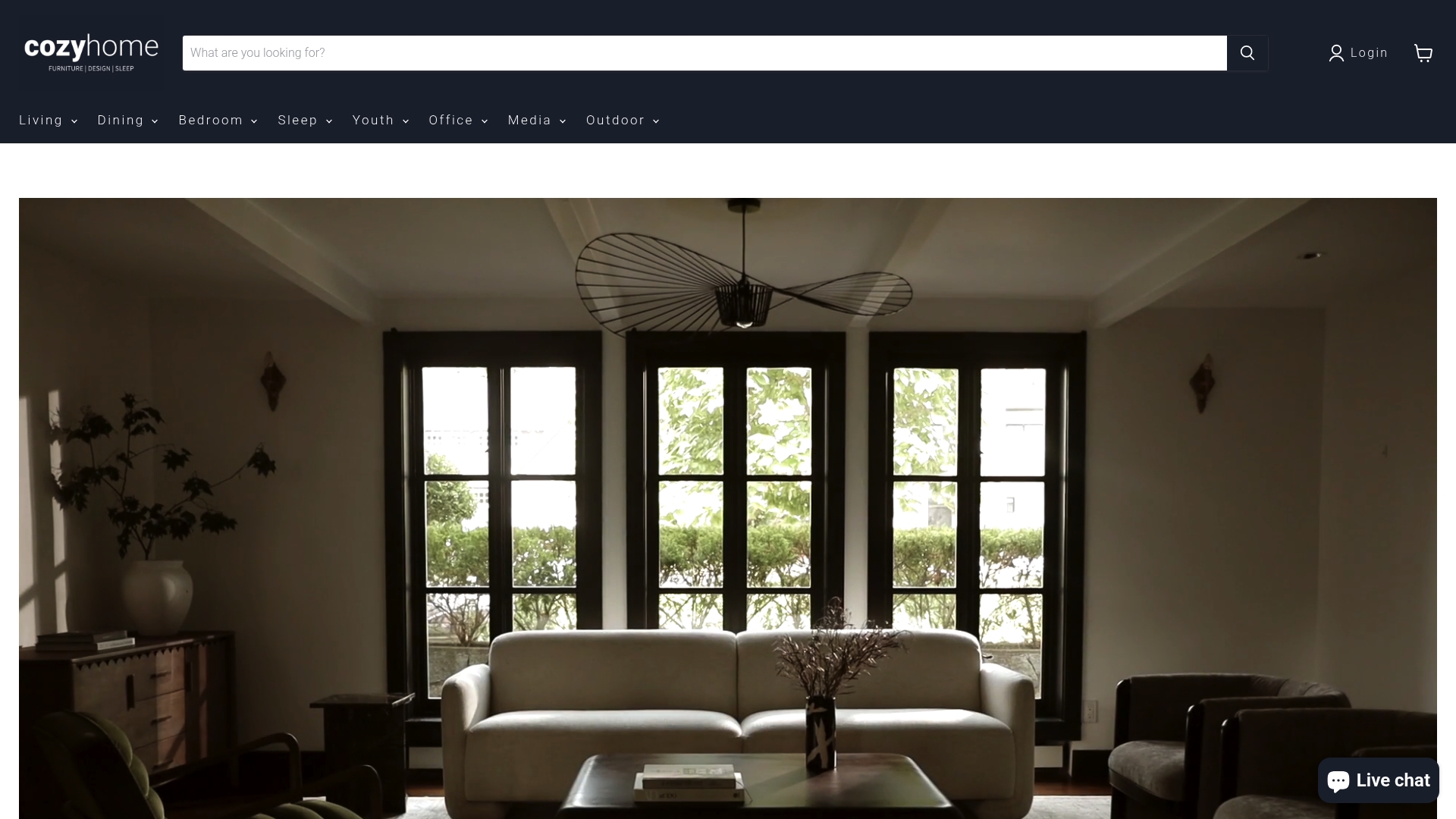
Prefer to browse first? Our full collection covers living, dining, bedroom and more, so you can arrive with a shortlist and make the most of your visit.
FAQ
Is it cheaper to buy furniture online or in a store?
Online is often cheaper at the sticker level. In Consumer Reports’ survey, the median spend on one item was $459 online versus $1,455 in a walk-in store. Those figures compare different products and retailers, so they do not show like-for-like savings. Compare materials, construction and delivery terms, not only price.
Can I really tell if a sofa is comfortable without sitting on it?
Not reliably. Consumer Reports states that sofa comfort cannot be determined online. Reviews can hint at firmness or depth, but body size and sitting habits vary. For a sofa or sectional you will use daily, a showroom visit is the safer route.
What should I measure before ordering furniture?
Measure the room, then every path the piece will travel to get there: doors, hallways, stairs and tight turns. Mark the footprint on the floor with painter’s tape to see how it fits with walkways and other furniture. Write down the dimensions of your shortlisted pieces and compare them before ordering.
Is white-glove delivery worth asking about?
Yes. In the Consumer Reports survey, nearly nine in ten delivered in-store purchases used white-glove service, compared with 17% of online purchases. It usually means the team brings in and sets up the piece. Ask about it for any large item, wherever you buy.
Can I combine online research with a showroom visit?
Yes, and many shoppers do. A 3D Cloud study found that 48% of respondents used both online and in-store browsing. Browse online for ideas and dimensions, then visit the showroom to test comfort, compare fabrics and confirm sizing.
Sources
- Best Places to Buy Furniture for Your Home, Consumer Reports
- How to Shop for Furniture, Consumer Reports
- Make Furniture Delivery and Returns as Hassle-Free as Possible, Consumer Reports
- The Advice I Swear by for Furniture Shopping, Wirecutter
- Online or in store? Consumers reveal preferred channel, Furniture Today
- The Omnichannel Customer Journey: BigCommerce consumer survey
- 3D Cloud Furniture Shopping Trends Study 2024