

24–28 Inch Nightstand Height: Measure First Rules and Fast Fixes
The best rule of thumb: your nightstand top should sit level with your mattress top, or up to about 4 inches higher. Most nightstands that hit this mark land somewhere between 24 and 28 inches tall, though 20 to 30 inches is the full standard range. Platform beds and pillow-top mattresses push that number in opposite directions, so the “right” height always comes back to what your bed is actually doing.
TL;DR:
- Most nightstand heights should be between 20 and 30 inches, with a common ideal range of 24 to 28 inches for standard mattresses.
- To determine the correct height, measure from the floor to the top of your mattress, including toppers, and add up to 4 inches for a comfortable reach.
- Platform beds and low-profile frames require shorter nightstands around 20 to 22 inches, while tall mattresses or pillow-tops may need nightstands up to 30 inches.
- When existing nightstands are too low, risers, low-profile box springs, or leg extensions can effectively adjust their height; severe mismatches may warrant replacement.
- Proper lamp height depends on the nightstand height, with the shade’s lower edge ideally aligning with seated eye level for comfort.
Table of Contents
- Standard Nightstand Height Ranges and the Mattress-Top Rule
- How to Measure Your Bed and Calculate the Ideal Nightstand Height
- Adjusting the Rule for Different Bed Types and Common Situations
- What to Do When Your Existing Nightstand Doesn’t Match Your Bed
- Width, Depth, and Proportion: Sizing a Nightstand Beyond Height
- Lamp and Lighting Alignment with Nightstand Height
- Quick Shopping Checklist and Questions to Ask Before You Buy
- Showroom-Tested Perspective and Real Examples from cozyhome Furniture
- An Editorial Take on Getting Nightstand Height Right
- Sources
- FAQ
Standard Nightstand Height Ranges and the Mattress-Top Rule
Walk into most furniture showrooms and you’ll notice nightstands cluster around the same handful of measurements. That’s not an accident. It reflects decades of bedroom ergonomics settling into a workable consensus.
Industry-wide, nightstand heights typically run from 20 to 30 inches, with the sweet spot for most standard beds sitting between 24 and 28 inches. That narrower band exists because it lines up with where most mattress tops end up once you stack a frame, box spring or foundation, and mattress together.
The logic behind the range comes down to one rule: designers commonly recommend keeping the nightstand top level with the mattress top, or raising it a few inches above it. A nightstand that sits noticeably lower than your mattress forces you to reach down and back for a glass of water, which is awkward at 2 a.m. and genuinely uncomfortable for anyone with mobility issues.
Here’s how the offset typically breaks down:
- Level with the mattress top (0 inches): the safest, most universally comfortable choice.
- 1 to 2 inches higher: the most commonly recommended range, giving you an easy reach without straining.
- Up to 4 to 6 inches higher: acceptable for tall beds or if you want the nightstand to visually anchor a large headboard.
- Lower than the mattress top: generally discouraged unless you’re working with a very low platform frame.
Statistic to remember: the most frequently cited nightstand height across design guides is 24 to 28 inches, which corresponds to the average mattress-top height of a standard bed frame with a low foundation.
Slightly higher almost always beats slightly lower. A taller nightstand gives you a flat surface you can reach without lifting your shoulder off the pillow, and it reads better visually next to a substantial headboard. A nightstand that dips below mattress height can look stranded, especially next to a bed with any real presence in the room.
How to Measure Your Bed and Calculate the Ideal Nightstand Height
Grab a tape measure before you shop, not after. Nightstand height guide math only works if you start with an accurate mattress-top measurement, and that means measuring the bed exactly as you sleep on it.
- Measure from the floor to the top of the bed frame (not including the mattress) to note your baseline.
- Add the mattress thickness, measuring from the base of the mattress to its highest point.
- Add any topper thickness. A 2 to 3 inch memory foam topper changes your total more than most people expect.
- Total the numbers to get your true floor-to-mattress-top height.
- Add 0 to 4 inches to that total to land on your target nightstand height.
A practical formula backs this up: measure floor to mattress top, then choose a nightstand within about 2 to 6 inches of that number, with most comfort-focused shoppers aiming for the tighter 0 to +2 inch window.
Pro Tip: Measure with the mattress topper already in place, and measure after you’ve been sleeping on the mattress for a few weeks. Memory foam and hybrid mattresses compress slightly with use, which can shave half an inch to an inch off your original measurement.
Adjusting the Rule for Different Bed Types and Common Situations
The mattress-top rule holds up across almost every bedroom, but the exact number shifts depending on what kind of bed you’re pairing it with.
Platform beds and low-profile frames sit noticeably closer to the floor than a traditional frame with a box spring. Since these mattresses often rest just 14 to 18 inches off the ground, a standard 26 inch nightstand will loom over the bed. Target something in the 20 to 22 inch range instead, and the proportions fall into place.
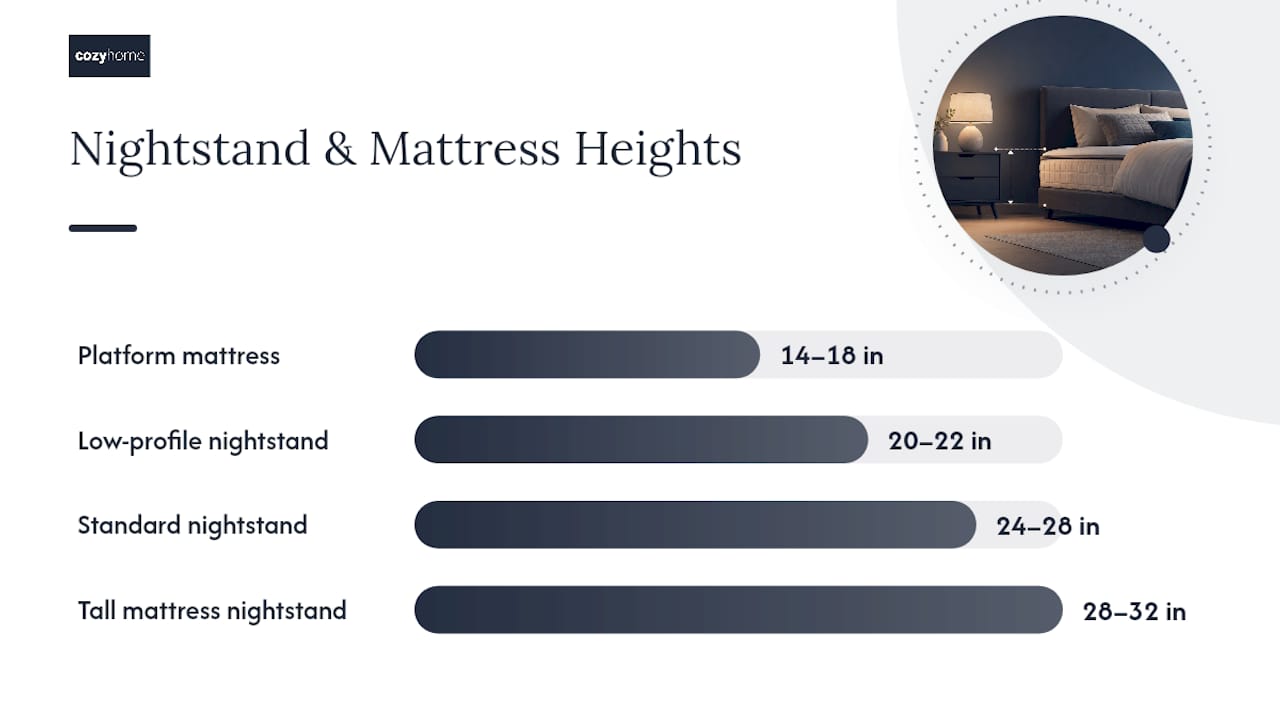
Tall mattresses, pillow-tops, and stacked box springs push in the other direction. A frame that includes a box spring foundation under a thick pillow-top mattress can put your mattress top well above 26 inches. In that case, standard nightstand heights run up to 30 inches, and a nightstand in the 28 to 32 inch range keeps the reach comfortable.
Adjustable bases complicate things because the mattress height changes when you raise the head or foot of the bed. There’s no perfect fix here, but a few adjustments help:
- Choose a nightstand height based on the base’s flat, resting position, not the raised position.
- Keep lamp cords and phone chargers routed along the back edge of the nightstand so they don’t pull taut when the bed adjusts.
- Consider a nightstand with a slightly larger top surface, since adjustable bases often need more surface area for remotes and devices.
Headboard scale matters too, even though it’s not part of the height formula itself. A tall, upholstered headboard can make a correctly sized 26 inch nightstand look small by comparison, even though the math is right. If you’re working with a dramatic headboard, sliding toward the higher end of your acceptable range, closer to +4 inches over the mattress top, usually balances the room better than staying at dead level. If you’re weighing headboard scale against nightstand height at the same time, this headboard height guide walks through the same measure-first approach.
What to Do When Your Existing Nightstand Doesn’t Match Your Bed
A mismatched nightstand is one of the most common bedroom complaints, and it’s almost always fixable without buying new furniture. Before you decide the nightstand is wrong, decide whether the bed or the nightstand is the actual problem.
If your nightstand sits too low for a taller mattress, quick fixes include:
- Furniture risers, which typically add 2 to 8 inches and are the fastest fix for a nightstand that’s a few inches short.
- Switching to a low-profile box spring on the bed side, which lowers the mattress top instead of raising the nightstand.
- Removable furniture feet or leg extensions, sold specifically for raising case goods a controlled amount.
- Thin shims or a stable platform under the nightstand’s existing feet, for small gaps of an inch or less.
Furniture risers, low-profile box springs, and nightstand replacement all solve the same core problem in different ways, and the right choice usually depends on how far off the current height actually is.
Replacing the nightstand outright makes more sense when the mismatch is severe, generally more than 6 to 8 inches off, or when you’re mid-way through a bigger bedroom redesign anyway. Stacking risers on a nightstand that’s already 6 inches too short starts to look unstable and defeats the point of a clean, intentional bedroom.
Pro Tip: If you use risers, choose a set rated for the nightstand’s weight plus whatever you keep on top of it, and always test for wobble before loading the surface with a lamp or a glass of water. A tippy nightstand next to the bed is a real hazard in the middle of the night.
Width, Depth, and Proportion: Sizing a Nightstand Beyond Height
Height gets most of the attention in a nightstand height guide, but width and depth decide whether the piece actually looks like it belongs next to your bed.
Width should scale to the bed, not just the room. Nightstands generally look best at roughly one-quarter to one-third of the bed’s width, with typical widths running from 18 to 28 inches depending on the bed size. A queen or king bed can carry a wider, 24 to 28 inch nightstand without looking oversized, while a twin or full bed usually looks more balanced with something closer to 18 to 22 inches.
Depth matters more for function than looks. Most nightstands run 12 to 20 inches deep:
- 12 to 15 inches suits tight bedrooms or narrow walkways where you need the surface but not the bulk.
- 16 to 18 inches is the most common depth, enough for a lamp, a book, and a phone without crowding.
- 18 to 20 inches works when you want real storage, drawers deep enough for more than remote controls and reading glasses.
Visual mass plays into the equation too. A nightstand with two drawers and solid wood construction reads heavier than an open shelf design at the exact same dimensions, so a smaller footprint with visual weight can balance a large bed just as well as a bigger piece with slim, tapered legs.
Lamp and Lighting Alignment with Nightstand Height
Get the nightstand height right and the lamp wrong, and you’ve solved half the problem. The goal is simple: the lower edge of the lamp shade should land close to eye level when you’re sitting up against the headboard.
That means lamp height depends directly on your nightstand height. A taller nightstand needs a shorter lamp, and a lower nightstand can carry a taller one, all aimed at keeping that shade edge in the same general zone. Designers tie lamp shade placement directly to seated eye level to avoid glare from an exposed bulb and to make reading in bed genuinely comfortable rather than just serviceable.
A few practical notes on getting this right:
- Measure your own seated eye height against the headboard before buying a lamp, since headboard angle changes this more than people expect.
- Oversized lamps on a small nightstand crowd out everything else on the surface. Match lamp base width to roughly a third of the nightstand’s depth.
- Position the switch and cord toward the back or side of the nightstand so the working surface in front stays clear for a book, glasses, or a water glass.
Pro Tip: If you’re between two lamp sizes, size down. A slightly smaller lamp on a nightstand almost always looks more intentional than one that overwhelms the surface, and it leaves more usable space for everything else you actually need within reach.
Quick Shopping Checklist and Questions to Ask Before You Buy
A wrong-height nightstand is an expensive mistake to fix after delivery, especially with return shipping fees on heavier furniture. Run through this before you commit to any piece, in-store or online:
- Measure your mattress-top height first, topper included, and write the number down before you shop.
- Check the listed total height on the product page or tag, not just the “nightstand height” callout, which sometimes excludes feet or hardware.
- Confirm lamp compatibility by checking the nightstand’s surface depth against your current or planned lamp base.
- Verify the return policy before ordering online, especially for taller pieces that are harder to modify after the fact.
- Ask directly whether the listed height includes feet, casters, or decorative knobs. Many listings measure only the case body.
- Ask whether the top-to-floor height is the number listed, or whether it’s an overall height that includes a raised backsplash or shelf.
Watch for a few red flags before you buy: missing dimensions on the product page, product photography that hides the piece next to a bed for scale, and return policies that charge a restocking fee on furniture over a certain weight. Any of those should slow you down, particularly on a purchase where an inch or two in the wrong direction means starting over.
Showroom-Tested Perspective and Real Examples from cozyhome Furniture
Most nightstand mismatches we see start the same way: someone falls in love with a nightstand’s style before they’ve measured their mattress top. It’s an easy mistake, and it’s exactly why a bed-first measurement process is best.
When customers shop for bedside furniture, measuring mattress-top height before anything else helps avoid mismatches. That single step catches most of the mismatches before they ever leave the store. A customer with a plush pillow-top mattress on a platform frame needs a different nightstand than someone with a low-profile mattress on a traditional box spring, even if both beds are technically “queen size.”
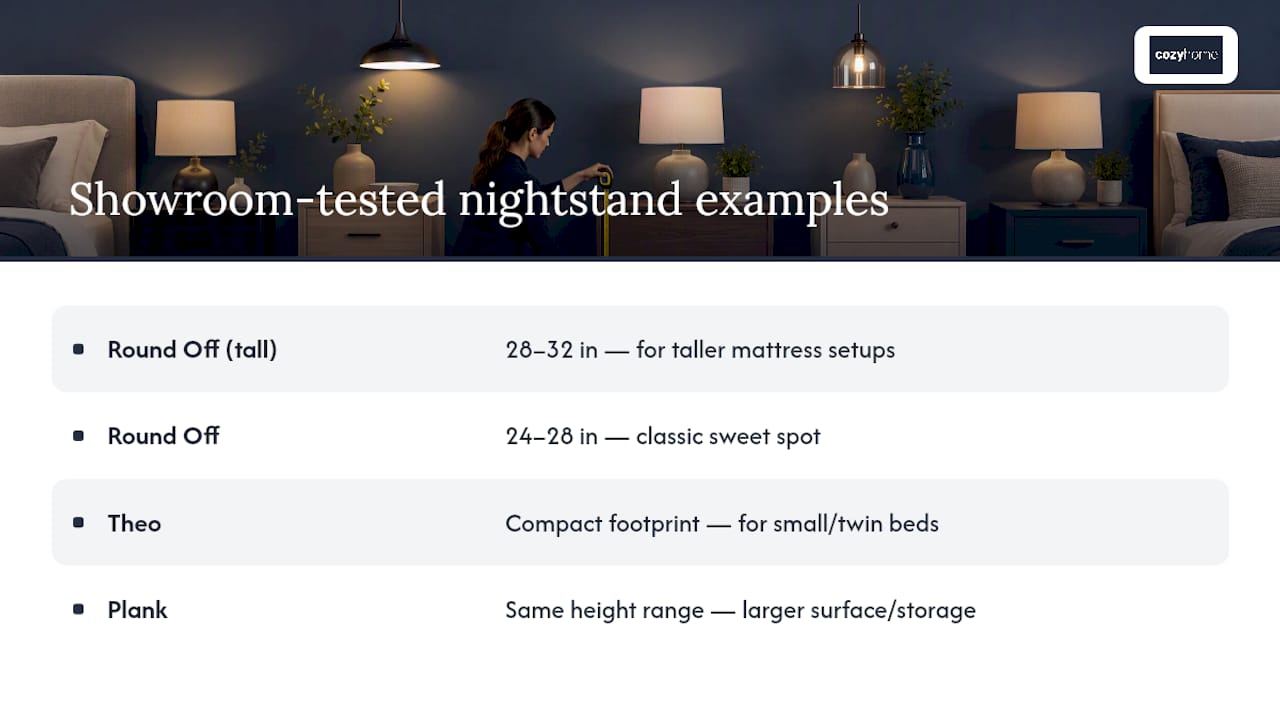
That measurement-first approach is also why we carry nightstands across a real height range rather than clustering everything in one safe middle zone. For taller mattress setups, a piece like the Round Off tall nightstand in light brown sits comfortably in the 28 to 32 inch zone that tall beds need. For standard frames landing in the classic 24 to 28 inch sweet spot, the Round Off nightstand in beige hits that range directly. And for smaller rooms or twin-bed pairings where a compact footprint matters as much as height, the Theo one-drawer nightstand in light brown keeps the proportions tight without sacrificing storage.
If you’re also weighing width and depth against a specific bed size, a piece like the Plank nightstand in light brown shows how storage and surface size can shift within the same general height range. And if the real issue in your bedroom is less about the nightstand and more about where everything else lives, from linens to chargers to books, it’s worth looking at broader home organization systems that can take pressure off the nightstand surface entirely.
None of this replaces a tape measure. But walking through the process in person, next to an actual mattress at actual height, catches problems that browsing product photos online almost never does.
An Editorial Take on Getting Nightstand Height Right
The conventional advice on nightstand height isn’t wrong, it’s just incomplete. Every guide repeats the mattress-top rule, and it holds up. What most of them skip is the sequencing problem: people buy nightstands based on style first and measure their bed second, which is backward. The measurement should come before you fall in love with a finish or a drawer pull.
The other thing that gets underweighted is how much toppers and mattress break-in change the math. A number you measured on day one can be off by an inch within a few months. That’s not a reason to obsess over precision. It’s a reason to build in a little slack, favoring the +1 to +2 inch zone over dead-level, so small shifts in mattress height don’t turn your nightstand into a reach.
If you take one thing from this guide, measure your actual mattress top, topper included, before you shop. Everything else, width, lamp scale, drawer count, is easy to adjust after that number is locked in.
— Dean P.
Sources
- How Tall Should a Nightstand Be? 5 Expert Tips
- Nightstand Height: How Tall Should It Be Relative to Your Bed? - Mattress Nut
- Nightstand dimensions explained: Size guide for every bed
FAQ
Should Your Nightstand Be Shorter Than Your Bed?
Generally, no. Most designers recommend keeping the nightstand level with the mattress top or slightly higher, since a shorter nightstand forces an awkward downward reach.
Is 30 Inches Too High for a Nightstand?
Not necessarily. A 30 inch nightstand fits well with tall mattresses, adjustable bases, or beds with a box spring foundation, where the mattress top itself sits well above 26 inches.
Should a Nightstand Be the Same Height as the Mattress?
Level with the mattress top is one of the safest choices, though many designers recommend going 1 to 4 inches higher for easier reach and better visual balance with the headboard.
How Much Space Should I Leave Between My Bed and Nightstand?
A gap of about 3 to 6 inches keeps the nightstand surface within easy reach while leaving enough clearance to walk past the bed comfortably.