

14–17 Inch Seats: Showroom Tested Low Profile Sofas Built to Fit
A low-profile sofa makes a room feel larger by keeping sightlines open and letting natural light travel across the space instead of stopping at a tall backrest. It also softens ceiling lines, reads as more modern, and sits at a friendlier height for kids and pets. Seat height changes how a room feels, a fact often demonstrated in furniture showrooms.
TL;DR:
- A low-profile sofa with a 28-inch back frees up more visual wall space, making ceilings appear higher and enhancing room openness.
- These sofas typically sit 14 to 17 inches high, favoring lounging and modern aesthetics but may be less suitable for mobility-concerned users.
- Custom-built low sofas can be tailored to precise room measurements, offering better fit and configuration than off-the-shelf options.
- Proper maintenance, including weekly vacuuming and fabric care, prolongs the sofa’s aesthetic and structural longevity, which can last 15 to 25 years.
- For small or open-plan spaces, choosing a low sofa improves natural light flow and defines zones without obstructive visual walls.
Table of Contents
- What Are the Benefits of a Low Profile Sofa for Your Space?
- Low Sofa Dimensions and Comfort Trade-Offs You Should Know
- Is a Low-Profile Sofa Right for Your Room?
- How to Measure and Buy a Low-Profile Sofa the Right Way
- Keeping a Low-Profile Sofa Looking Good for Years
- How Cozyhome Puts These Principles Into Practice
- Build Your Low-Profile Sofa Around Your Room, Not a Warehouse Floor
- Sources
- FAQ
What Are the Benefits of a Low Profile Sofa for Your Space?
The math behind this is simple, and it is the reason designers keep steering small-room clients toward lower backs. An 8-foot wall is 96 inches tall. A sofa with a 36-inch back covers roughly 37% of that wall, while a 28-inch back covers about 29%, according to Houzz’s breakdown of low-slung sofa design. That 8-point difference is what your eye reads as “more ceiling,” even though the actual ceiling never moved an inch.
Statistic Callout: A 36-inch sofa back eats up 37% of an 8-foot wall. Drop to a 28-inch back and that number falls to 29%, freeing up visual wall space your brain reads as extra height.
Sightlines matter just as much as wall space. A low back sits below most window sills, so daylight keeps moving instead of getting blocked at the four-foot mark. In open floor plans, that same low profile lets you see clear across the living area into the kitchen or dining space, which is why Houzz points to low sofas as unobtrusive room dividers rather than walls of upholstery. You get the zoning benefit of a sofa marking “living room starts here” without losing the open feel that made you want an open floor plan in the first place.
Here’s what a lower profile buys you, beyond the obvious:
- More visible floor and wall, which reads as square footage even when the room’s dimensions haven’t changed
- Better light penetration from low windows, since nothing blocks the lower third of the glass
- A cleaner divider between zones in open-plan living without a visual wall
- A distinctly modern silhouette that pairs with the low-slung aesthetic dominating current furniture trends, per Living Cozy’s roundup of top low-profile sofas
Low Sofa Dimensions and Comfort Trade-Offs You Should Know
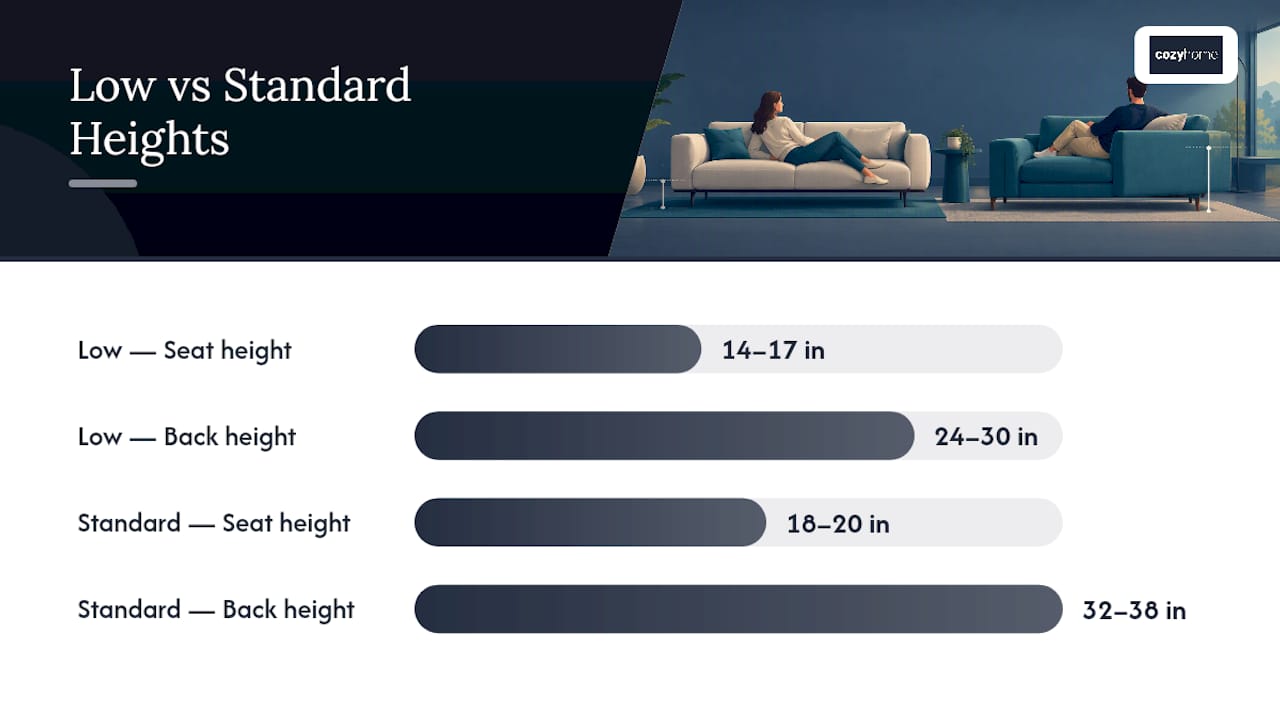
“Low profile” isn’t a marketing term, it’s a measurement. Most low-profile sofas run a 14 to 17 inch seat height with a 24 to 30 inch overall back height, compared with 18 to 20 inches and 32 to 38 inches on a standard sofa, according to Build-Construct’s design guide. That’s a real difference you’ll feel the moment you sit down, not just a number on a spec sheet.
The trade-off people ask about most is comfort, and the honest answer is: it depends less on height than on what’s underneath you. Seat depth on low sofas commonly runs 22 to 26 inches, deeper than average, which favors a lounging posture over an upright, formal sit. Comfort at that depth comes down to foam density and backrest angle rather than back height alone, and firmer foam in the 1.8 to 2.2 lb/ft³ range paired with a backrest angle around 105 to 115 degrees keeps a deep, low seat from feeling like a pit you sink into and can’t escape.
Frame and fabric choices matter just as much long term. A few things worth checking before you buy:
- Kiln-dried hardwood frames resist warping and hold joinery better than softwood or particleboard alternatives
- Performance fabrics such as Crypton or Sunbrella shrug off spills and hold up under daily use, per Build-Construct
- Leather needs a conditioning routine, but ages into a look that fabric can’t replicate
- Seat depth and cushion resilience deserve more attention than back height when you’re testing comfort in the showroom
Pro Tip: Sit in a low-profile sofa for a full five minutes before deciding, not five seconds. Depth and foam firmness only reveal themselves once your body settles in, and cozyhome’s seat height guide breaks down exactly what 17 to 19 inches feels like versus a deeper drop.
Is a Low-Profile Sofa Right for Your Room?
Low-profile sofas earn their keep in specific rooms. Small living rooms, open-concept layouts, apartments, and studios all benefit from the extra visible floor and softened wall presence, and rooms with low-sill windows gain the most light because nothing blocks the lower glass.
They also fit specific households well:
- Families with toddlers or pets, since a shorter seat-to-floor drop means less distance to fall and a wider, lower frame is harder to tip when a kid climbs on it, per Build-Construct
- Social entertainers who want a lounge-forward, conversation-friendly seat rather than a formal, upright one
- Style-first buyers chasing the modern, low-slung look that’s driving current design trends
Low profile isn’t the right call for everyone, though. If you deal with hip or knee mobility issues, a 14-inch seat height can make standing up a genuine chore. Readers who spend hours in one spot may also miss the firmer head and neck support a taller backrest provides. In those cases, a standard or high-back sofa is the smarter buy, even if it costs you some of that airy, open feeling.
How to Measure and Buy a Low-Profile Sofa the Right Way
Getting this right starts before you ever walk into a showroom. Measure your space first, then let those numbers guide every decision that follows.
- Measure room width and the walkway clearance you need around the sofa, at least 30 inches for comfortable foot traffic
- Check ceiling height and note where windows sit relative to a potential sofa back, since this determines how much light a low profile actually saves you
- Note your rug dimensions, since a rug that’s too small under a low sofa makes the whole arrangement look disconnected
- Decide on seat height (14 to 17 inches is standard low profile) and seat depth, using a buttock-to-knee measurement to confirm your ideal depth before ordering
- Choose leg style, since exposed legs read lighter and more modern than a skirted base that hides them
Before you commit, ask a few pointed questions:
- What’s the frame material, and is it kiln-dried hardwood?
- What foam density is used in the seat cushions?
- How cleanable is the fabric, and does it support removable, washable covers?
- Are narrower arm styles available to reclaim seat width in a tighter room?
- Is reupholstery an option down the road, or is the frame built for one fabric life only?
If you’re working with a genuinely small footprint, cozyhome’s guide to apartment-size sofas walks through fit decisions that apply directly to low-profile shopping too.
Keeping a Low-Profile Sofa Looking Good for Years
A sofa that sits closer to the floor also sits closer to dust, pet hair, and everything else that collects at ankle height. A weekly vacuum pass and a rug underneath cuts down on how much debris settles into the base of the frame.
Fabric care depends on what you chose. Performance fabrics like Crypton or Sunbrella wipe clean with mild soap and water, cotton and linen blends need more careful spot treatment, and leather wants conditioning every six months or so to stay supple, per Build-Construct’s maintenance notes.
- Vacuum weekly, especially along the base where dust settles
- Rotate and flip cushions monthly to even out wear
- Spot clean spills immediately rather than letting them set into low-pile fabric
- Condition leather roughly twice a year to prevent cracking
Statistic Callout: Well-built sofa frames commonly last 15 to 25 years, and reupholstering a quality frame is often cheaper than replacing the whole piece, a general rule worth knowing before you buy on price alone.
How Cozyhome Puts These Principles Into Practice
A perspective shaped by showroom experience emphasizes how small changes in seat height affect room feel. Custom sofas can be built around the specific room they will be placed in rather than standard measurements.
— Dean P.
Build Your Low-Profile Sofa Around Your Room, Not a Warehouse Floor
Big-box retailers sell sofas that are already built. Custom furniture services build sofas that can be adjusted in seat heights, seat depths, and arm widths to fit the space measured, with a variety of fabric and leather options.
That’s the real advantage of custom over off-the-shelf: you’re not guessing whether a 17-inch seat height or a 26-inch depth works in your living room, you’re confirming it in the Plano showroom with staff who walk you through fabric, sizing, and configuration in person. Free local delivery and flexible financing take the friction out of the rest. If you like the low-profile look, models like the Koba and Excelsior sofas show what that silhouette looks like finished, and either one can be reconfigured to your exact measurements. Ready to start? Visit the made-to-order custom furniture page and bring your room measurements with you.
Sources
- How low can you go? Living with a low-down, minimalist sofa — Houzz
- Low-Profile Sofas for Modern Living: Design Considerations and Selection Tips — Build-Construct
- How low-profile sofas make small living rooms look bigger — Ovios Home
- Our top low-profile sofas for 2026 — Living Cozy
FAQ
What counts as a low-profile sofa?
A low-profile sofa typically has a seat height of 14 to 17 inches and a back height of 24 to 30 inches, compared with 18 to 20 inches and 32 to 38 inches on a standard sofa, according to Build-Construct.
Do low-profile sofas actually make a room look bigger?
Yes. A lower back covers less visible wall space, which reads as a higher ceiling and an airier room, and open sightlines let light reach further across the space, per Houzz.
Are low-profile sofas comfortable for everyday lounging?
They can be, though comfort depends more on seat depth and foam density than on back height alone. A deeper seat with firmer foam supports lounging well, while a shallow seat with soft foam can feel unsupportive over time.
Is a low-profile sofa a good fit for older adults or anyone with mobility issues?
Not always. The lower seat height that makes these sofas feel spacious also makes standing up harder for people with hip or knee limitations, so a standard or high-back sofa is often the more practical choice.
Can I get a low-profile sofa custom-built to my room?
Yes, cozyhome furniture builds made-to-order sofas with adjustable seat height, seat depth, and arm width, with a wide variety of fabric and leather options, through its made-to-order furniture program.