

Extra Firm Mattress: Who Needs One and How to Choose
TL;DR:
- An extra firm mattress is best for stomach sleepers, back sleepers over 130 pounds, and heavy individuals over 250 pounds needing neutral spinal support. It’s measured at 8–9 out of 10 on firmness scales, with construction features like high-density foam and heavy-gauge coils ensuring true support. Most users require a 30-day adjustment period, and selecting a model with a thorough trial and reliable specs ensures proper fit and durability.
An extra firm mattress is the right call for stomach sleepers, most back sleepers, and anyone weighing over 250 pounds who needs a surface that holds the spine in a neutral, straight line without letting the hips sink. If you sleep on your side or weigh under 140 pounds, extra firm is likely too much of a good thing — you’ll wake up with pressure on your shoulders and hips rather than relief. For everyone else, here’s what to check first:
- Numeric firmness rating: Look for a firm rating near the upper end of an independent firmness scale. Marketing labels like “ultra-supportive” mean nothing without a number.
- Construction signal: A reinforced core — high-density base foam, heavy-gauge coils, or a flippable design — is what actually produces extra-firm performance. Thin comfort layers on top of a rigid core are a good sign.
- Trial and warranty: The adjustment period for a firmer bed runs about 30 days. A trial of at least 90 nights and a warranty of 10 years or more gives you real protection.
If you want the short version: stomach and back sleepers above 130 pounds should try an extra-firm model in-store or choose one with a documented construction spec and a generous trial period.
Table of Contents
- What “extra firm” actually means on the firmness scale
- Who actually benefits from extra-firm support
- How manufacturers build genuine extra-firm performance
- What types of mattresses come in extra-firm builds
- Which tests and specs actually predict extra-firm performance
- Your 8-step checklist for choosing the right extra-firm mattress
- How to survive the first 30–90 nights on an extra-firm mattress
- Protecting and extending the life of your extra-firm mattress
- Key Takeaways
- A note on finding the right fit — from cozyhome furniture
- The cozyhome furniture showroom is worth a visit before you buy
- Useful sources
- FAQ
What “extra firm” actually means on the firmness scale
Extra firm sits at the top of the standard 1–10 mattress firmness scale, typically rated 8–9 out of 10. A regular “firm” mattress usually lands at 7–8, so the gap is real but not always obvious from a label alone. The goal of an extra-firm surface is not to feel like sleeping on a floor. Sleep experts emphasize that the purpose is support and neutral spinal alignment — keeping the hips and shoulders from sinking unevenly — rather than sheer hardness.
The bigger problem for shoppers is that firmness labeling is not standardized across brands. One company’s “firm” is another’s “medium-firm,” and terms like “orthopedic” carry no formal regulatory definition. That means a mattress marketed as orthopedic could be a 6 or a 9 on any independent scale. Independent testers who use pressure-mapping equipment and weight-stratified testing are the most reliable guides, because they assign numeric ratings based on measured compression rather than brand claims.
What matters most: “Support — rather than pure hardness — is the goal of an extra-firm surface. Measured pressure-mapping and spinal alignment tests are better guides than subjective ‘firm’ labels.” — Sleep Foundation
Pro Tip: When comparing models in-store or online, ask for the independent firmness rating (not the brand’s own scale) and look for pressure-mapping test results. If a retailer can only offer a subjective description, that’s a gap in the spec sheet worth noting.
Who actually benefits from extra-firm support
Extra-firm mattresses are designed primarily for three groups: stomach sleepers, back sleepers who prefer a very lifted feel, and heavier sleepers typically above 250 pounds. Here’s why each group benefits:
- Stomach sleepers need a surface that prevents the hips from sinking below the shoulders. When the midsection drops into a softer mattress, the lumbar spine arches unnaturally, which is a common driver of lower back pain. A firm, flat surface keeps the body level.
- Back sleepers who prefer a lifted feel benefit from a surface that supports the lumbar curve without letting the lower back sag. A very firm core holds that curve in place through the night.
- Heavier sleepers (250+ lb) compress comfort layers more deeply than lighter sleepers do. A mattress rated 9/10 for a 150-pound sleeper can feel noticeably softer for someone over 250 pounds, because their body weight pushes further into the materials. Reinforced edge support and high-density base foams counter that compression and maintain consistent support.
Extra firm is generally not the right fit for side sleepers, who need the mattress to give at the shoulder and hip to keep the spine aligned. Lighter sleepers under roughly 140 pounds often rest “on top” of an extra-firm surface rather than sinking in enough for proper alignment. People managing hip or shoulder pain typically need more pressure relief than an extra-firm surface provides.
Adjustment period: Expect about 30 days for your body to adapt to a firmer surface, especially if you’re coming from a soft or medium mattress. Muscle and soft-tissue adaptation takes time. If discomfort is improving week over week, that’s a good sign. If pain is getting worse after four weeks, the bed may not be the right fit.
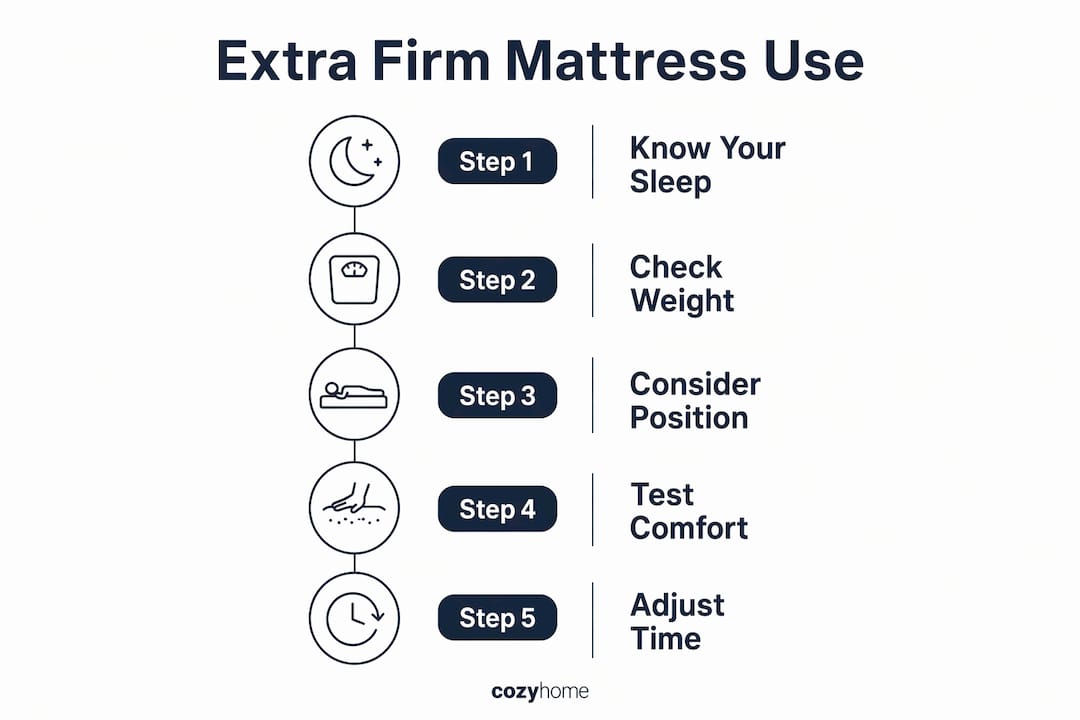
Pro Tip: Keep a simple sleep log for the first month — note where you feel pressure and whether it’s improving. This documentation is also useful if you need to make a warranty or return claim later.
How manufacturers build genuine extra-firm performance
The construction of a mattress determines its real-world firmness far more reliably than any label. Here are the core components that produce extra-firm performance:
- High-density base foam: The foundation layer should be dense enough to resist compression under heavier loads. Low-density foams break down faster and lose their support profile within a few years.
- Heavy-gauge pocketed coils: Heavier-gauge steel coils (in the 13.75–14 gauge range) resist compression more effectively than lighter-gauge springs. Higher coil counts also distribute weight more evenly.
- Latex layers: Natural latex is responsive and firm without the slow-sink feel of memory foam. It holds its shape well over time and adds durability to the support core.
- Zoned lumbar support: Targeted lumbar reinforcement and zoned coil systems correlate with better spinal support, particularly for back sleepers. Zones concentrate firmness where the body is heaviest.
- Flippable design: A flippable mattress distributes wear across two sleeping surfaces, extending service life. It also lets you choose between two firmness levels without buying a second bed.
Top-layer strategy matters too. The best extra-firm builds use thin comfort layers — sometimes just a quilted cover or a thin layer of quick-response latex — that take the edge off the rigid core without softening the overall support profile. Thick pillow tops or memory foam comfort layers can undermine the firmness of even a very firm base.
Construction checklist for spec sheets and showroom visits:
| Feature | What to look for | Red flag |
|---|---|---|
| Base foam density | High-density (ideally stated in spec sheet) | No density listed |
| Coil gauge | 13.75–14 gauge for extra firm | Gauge not disclosed |
| Coil count | Higher count for even weight distribution | Count absent from specs |
| Edge support | Reinforced perimeter coils or foam encasement | No edge-support mention |
| Flippability | Dual-sided design noted in product details | Single-sided only with no explanation |
| Comfort layer thickness | Thin (1–2 inches) for genuine extra firm | Thick pillow top on an “extra firm” label |

What types of mattresses come in extra-firm builds
Not every mattress construction can reach the 8–9/10 firmness range. Here’s how the main types compare:
Flippable foam and hybrid models are the most consistent performers in independent extra-firm testing. Independent testers consistently identify flippable designs as reaching the highest measured firmness scores. The dual-surface design also extends the mattress lifespan by distributing wear evenly.
Hybrid/coil models combine a pocketed coil support core with thin comfort layers. They offer good edge support, natural bounce, and airflow through the coil layer, which helps with temperature regulation. The coil system is what drives the firmness, so coil gauge and count are the specs to scrutinize.
Latex models are naturally responsive and hold their shape well under sustained pressure. Organic and natural latex options tend to be durable and breathable. They don’t have the slow-sink feel of memory foam, which makes them a good fit for sleepers who want firm support with a bit of surface give.
Traditional innerspring models lean firm by default due to their coil-dominant construction, but without foam comfort layers they can put too much pressure on joints. A thick pillow top added to an innerspring can actually reduce the effective firmness, so check the spec sheet carefully.
| Type | Firmness range | Best for | Cooling | Typical durability |
|---|---|---|---|---|
| Flippable hybrid | 8–9/10 | Back, stomach, heavier sleepers | Good (coil airflow) | High (two surfaces) |
| Latex | 7–9/10 | Back sleepers, eco-conscious buyers | Good (breathable) | Very high |
| Hybrid/coil | 7–9/10 | Back, stomach, couples | Good | High |
| Traditional innerspring | 7–8/10 | Back sleepers, budget buyers | Excellent | Moderate |
Pro Tip: If you share a bed with a partner who prefers a softer surface, a flippable hybrid is the most practical solution — one side firm, one side extra firm, no compromise needed.
Which tests and specs actually predict extra-firm performance
Marketing language in the mattress industry is notoriously unreliable. The term “orthopedic,” for example, carries no formal regulatory definition — any manufacturer can apply it to any bed. That means you need to look past the label and focus on what’s measurable.
Tests and specs worth trusting:
- Independent firmness rating (1–10): Assigned by a third-party tester using standardized compression methods, not the brand’s own scale.
- Pressure-mapping results: Show where a mattress creates high-pressure zones on the body. A genuinely supportive extra-firm bed should distribute pressure evenly, not concentrate it at the hips or shoulders.
- Durability cycle testing: Simulates years of use to check whether the mattress holds its firmness profile over time. Look for results that show minimal indentation after extended cycles.
- Edge support scores: A firm mattress should hold its shape at the perimeter. Testers who prioritize edge support scores of 4/5 or higher are flagging a real performance dimension, not a minor detail.
- Weight-stratified user reviews: A review from a 130-pound side sleeper tells you almost nothing about how the mattress performs for a 270-pound back sleeper. Look for reviews from people who match your weight and sleep position.
Red flags to watch for:
- Vague density claims (“high-density foam” with no number)
- No coil gauge or count listed
- Trial period under 90 nights for an extra-firm model (the adjustment period alone can run 30 days)
- No weight-specific reviews or testing data
- “Orthopedic” label with no construction specs to back it up
Pro Tip: Price is not a reliable proxy for firmness. Some of the highest-rated extra-firm models use simpler constructions — heavy-gauge coils or dense base foams — that cost less to produce than multilayered luxury hybrids. A well-built firm bed can be a genuine value buy.
Your 8-step checklist for choosing the right extra-firm mattress
Use this checklist when comparing models online or walking a showroom floor. It keeps the decision grounded in specs rather than sales language.
- Confirm the numeric firmness rating. Ask for an independent rating, not the brand’s own scale. Extra firm starts at 8/10 on a standard scale.
- Check the core construction. Look for high-density base foam, heavy-gauge coils (13.75–14 gauge), or a natural latex core. These are the materials that produce and maintain extra-firm support.
- Verify coil gauge and count (for hybrids and innersprings). Higher coil counts and heavier gauge wire mean more durable, consistent support, especially for heavier sleepers.
- Assess responsiveness and pressure relief. Even an extra-firm mattress needs some surface give. Look for thin comfort layers that contour slightly without undermining the core. Pressure-mapping scores above 4/5 are a good benchmark.
- Check cooling features. Firm mattresses with coil systems tend to sleep cooler than all-foam models. If you run hot, prioritize hybrid or latex builds with breathable covers.
- Evaluate edge support and durability. Reinforced perimeter coils or foam encasement prevent the edges from collapsing, which matters for getting in and out of bed and for overall longevity.
- Read the trial and warranty terms carefully. A 90-night trial minimum is the standard for extra-firm models, given the adjustment period. Warranties of 10 years or more, with clear coverage terms, are the baseline for quality builds. Check what voids the warranty (improper base, stains, removed tags).
- Compare price against construction, not brand name. Extra-firm models built on heavy-gauge coils or dense foams can deliver excellent performance at a lower price than complex luxury hybrids. Set a budget, then compare specs within that range.
Expected price ranges: Entry-level extra-firm models (queen size) typically start around $500–$800. Mid-range hybrids and latex options run $900–$1,500. Premium flippable hybrids and organic latex models can reach $1,500–$2,500 or more. Trial lengths of 90–365 nights are common across the mid-to-premium range.
Red-flag checklist — when to hesitate or request a return:
- Visible sagging or indentation deeper than 1 inch within the warranty period
- Persistent pain that worsens rather than improves after 30 days
- Firmness that feels noticeably different from what was advertised or tested in-store
- Edge support that collapses when sitting on the perimeter
If you need to file a warranty claim, document the issue with time-stamped photos, measure the indentation depth in inches, and keep a sleep log showing when discomfort began. Thorough documentation correlates with stronger outcomes in the claims process.
How to survive the first 30–90 nights on an extra-firm mattress
Switching from a soft or medium mattress to an extra-firm model is a real physical adjustment. Your muscles and soft tissue need time to adapt to a new support profile, and the mattress itself may soften slightly as the materials break in. Both processes take time.
Here’s what actually helps during the first 30–90 nights:
- Rotate the mattress every two weeks (if the manufacturer allows it). This distributes early wear evenly and helps the surface break in more uniformly.
- Adjust your pillow height. A firmer mattress changes the angle of your neck relative to the surface. Back sleepers often need a thinner pillow; stomach sleepers may need almost none.
- Try a thin mattress topper if discomfort is significant. A 1–2 inch latex or wool topper adds surface comfort without defeating the firm core underneath. Avoid thick memory foam toppers — they can make an extra-firm bed feel like a medium, which defeats the purpose.
- Give it at least 30 days before deciding. Most sleepers who stick with an extra-firm surface through the first month report that initial discomfort fades as the body adapts.
- Sleep in your primary position consistently. Switching positions frequently during the break-in period makes it harder to assess whether the mattress is working for you.
Pro Tip: If you’re using a topper to get through the adjustment period, choose latex over memory foam. Latex adds cushion without the slow-sink feel that undermines spinal alignment on a firm base.
Protecting and extending the life of your extra-firm mattress
A well-built extra-firm mattress can last 8–12 years with proper care. Here’s how to protect that investment:
- Use the right foundation. A slatted platform bed with slats no more than 3 inches apart, or a solid platform base, is ideal for most extra-firm mattresses. Box springs are generally not recommended for modern foam or hybrid builds, and using one can void your warranty.
- Rotate regularly. Most manufacturers recommend rotating head-to-foot every 3–6 months. Only flip if the mattress is specifically designed as flippable.
- Use a quality mattress protector. A waterproof protector guards against stains, which commonly void warranty coverage. It also protects foam and latex from humidity, which can degrade materials over time.
- Keep the room at a stable temperature. Extreme heat or humidity can affect foam density and latex performance. A climate-controlled bedroom extends the life of the support core.
- Check for sagging at the 1-year mark. Measure indentation depth across the sleeping surface. Any indentation over 1 inch within the warranty period is typically a covered defect — document it immediately with photos and measurements.
Warranty triggers to know: Common actions that void mattress warranties include using an unsupported base (a box spring where a platform is required), allowing visible staining, and removing the law tag. Read the warranty terms before you set up the bed, not after something goes wrong.
Pro Tip: Set a calendar reminder for your first rotation at 90 days and your first warranty check at 12 months. Most people forget both, and catching a sagging issue early gives you the best chance of a successful claim.
Key Takeaways
An extra firm mattress delivers genuine value for stomach sleepers, back sleepers, and heavier sleepers — but only when the construction specs back up the firmness label.
| Point | Details |
|---|---|
| Who benefits most | Stomach sleepers, back sleepers, and sleepers over 250 lb need extra-firm support for neutral spinal alignment. |
| Firmness rating to target | Look for an independent rating of 8–9/10; brand labels alone are not reliable. |
| Construction signals | Prioritize heavy-gauge coils (13.75–14 gauge), high-density base foam, or a flippable design. |
| Trial and warranty | A trial period of sufficient length and a warranty with clear coverage terms are important considerations for quality extra-firm builds. |
| Cozyhome Furniture | Visit the Cozyhome Furniture showroom in Plano to test bed frames and get matched to the right firmness and foundation for your space. |
A note on finding the right fit — from cozyhome furniture
We’ve helped a lot of DFW homeowners work through the mattress question, and the pattern we see most often is this: people choose a firmness level based on a label, skip the in-store test, and then spend the first month wondering if they made the right call. The firmness scale matters, but so does the bed frame underneath. A quality extra-firm mattress on the wrong foundation loses its support profile faster than it should, and that’s a problem no trial period can fix after the fact.
At cozyhome furniture’s Plano showroom, our staff can walk you through the connection between mattress firmness and bed frame construction — from platform bed options that provide the solid, even support an extra-firm mattress needs, to sizing and configuration guidance that makes sure everything fits the room. We carry a range of bed frames built with the same attention to construction quality we apply to every piece in the showroom. Knowing what’s underneath your mattress is just as important as knowing what’s in it, and that’s a conversation worth having in person.
The cozyhome furniture showroom is worth a visit before you buy
If you’re narrowing down your mattress search and want to see how firmness translates to a real bed setup, cozyhome furniture’s Plano showroom is a practical next step. We’re not a mattress retailer, but we are the local resource for the bed frames, platform bases, and custom configurations that determine how well any mattress performs night after night.

Our in-store team helps you measure for the right frame size, match foundation type to your mattress specs, and see the difference between a slatted platform and a solid base in person. For DFW homeowners in Plano, Frisco, Allen, McKinney, and surrounding areas, that hands-on guidance is something you won’t get from a warehouse floor or a product page. Browse our king bed options and queen bed frames online to get a sense of what’s available, then stop by the showroom to see them in person. Free local delivery and flexible financing make it easy to get the full setup right the first time. Visit us at our Plano location or reach out to schedule a time with one of our furniture specialists.
Useful sources
The following sources informed this guide and are worth bookmarking for further research:
- Sleep Foundation — Best Orthopedic Mattress: Evidence-based guidance on spinal alignment, support goals, and mattress construction for back and joint health.
- NapLab — Best Extra Firm Mattress: Independent testing of 380+ mattresses with numeric firmness ratings, pressure-mapping results, and weight-stratified reviews.
- Forbes — Best Extra Firm Mattresses: Buyer-focused roundup with construction analysis and warranty documentation guidance.
- AARP — Best Firm Mattresses: Expert-reviewed firmness scale definitions and sleep-position guidance tested by real users.
- Orthopedic Mattress — Wikipedia: Background on the unregulated use of “orthopedic” as a marketing term in the mattress industry.
- Avocado Extra Firm Mattress: Product-level detail on coil gauge, base foam density, and weight-specific performance for extra-firm builds.
This article is general information for educational purposes. For personalized guidance on mattress firmness and sleep health, consult a qualified healthcare professional or sleep specialist.
FAQ
What does “extra firm” mean on a mattress?
Extra firm refers to a mattress rated approximately 8–9 out of 10 on a standard firmness scale, designed to keep the spine in a neutral position with minimal surface give. The goal is support and alignment, not maximum hardness.
Who should use an extra firm mattress?
Stomach sleepers, back sleepers, and heavier sleepers typically over 250 pounds benefit most from extra-firm support, which prevents the hips from sinking and maintains neutral spinal alignment through the night.
Which type of mattress is the firmest?
Flippable hybrid models and certain latex hybrids consistently reach the highest measured firmness scores in independent testing, often hitting 9/10 on the firmness scale.
What is the most extra firm mattress available?
Independent testers consistently rank flippable hybrid mattresses — those with heavy-gauge coil cores and minimal comfort layers — as the firmest options on the market, with some reaching a measured 9/10 firmness rating.
How long does it take to adjust to an extra firm mattress?
Most sleepers need about 30 days to adapt to an extra-firm surface as muscles and soft tissue adjust to the new support profile. Choose a mattress with a trial of at least 90 nights to give yourself enough time to make a fair assessment.