

5 Minute Mockup to Nail Coffee Table Size
Aim for a coffee table about 16 to 18 inches high, sitting 1 to 2 inches below your sofa seat cushions. Length should land at roughly two-thirds of your sofa’s length, and you’ll want 14 to 18 inches of breathing room between the table and the sofa, plus 24 to 36 inches of clearance for walking paths. We’ll walk you through a 5-minute way to test these numbers against your own living room before you buy anything.
TL;DR:
- A coffee table should be approximately two-thirds of the sofa’s length, with a typical size ranging from 42 to 60 inches for rectangular shapes.
- The height should be 16 to 18 inches, sitting one to two inches below the seat cushions for comfort and aesthetics.
- Allow for 14 to 18 inches of space between the sofa and table, and ensure 24 to 36 inches of clearance for walking paths.
- Measure your space and run a quick tape-and-tape measure test to confirm fit before purchasing, accounting for room layout and furniture shapes.
- For large sofas or sectionals, scale the table length accordingly, and consider shape and additional clearance when choosing round, square, or oval designs.
Table of Contents
- What Is the Coffee Table Size Guide Rule Everyone Uses?
- What Size Coffee Table Fits Each Shape?
- What Size Coffee Table Fits a Sectional or Long Sofa?
- How Do You Measure for a Coffee Table Before Buying?
- Where Should a Coffee Table Sit With a Rug and TV?
- Should You Prioritize Storage, Safety, or a Multiuse Surface?
- Why a Showroom Measurement Beats Guessing
- The Numbers Matter Less Than the Sofa in Front of You
- Sources
- FAQ
What Is the Coffee Table Size Guide Rule Everyone Uses?
Three numbers do almost all the work in a coffee table size guide: height, length, and clearance. Get those right and the table will feel like it belongs in the room, not like it was dropped in from a different house.
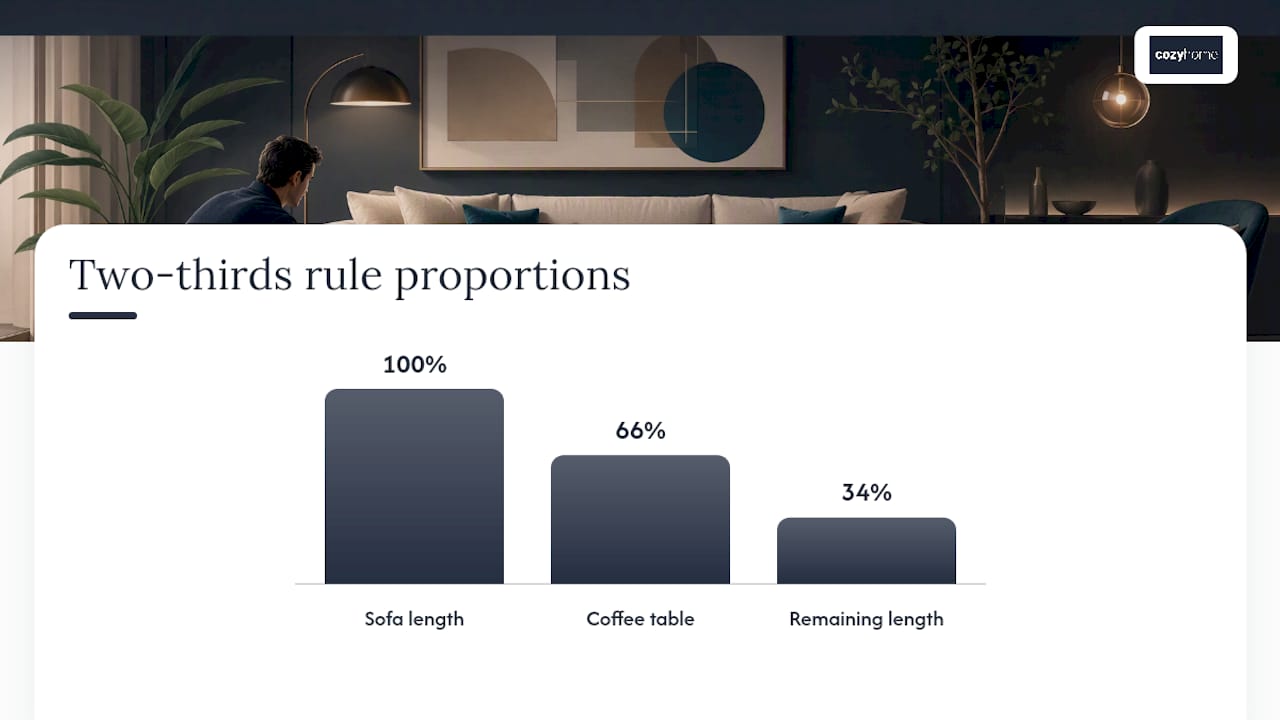
The two-thirds rule says your table length should be about 66% of your sofa’s length. A sofa that’s shorter than the table looks unbalanced, and a table that’s much shorter leaves an awkward gap of empty floor. This ratio also keeps the table within comfortable reaching distance from every seat, which is really the point of the whole exercise.
Height follows the seat cushion. Furniture guides recommend keeping the table 16 to 18 inches tall, matching or sitting slightly below the cushion. A table that sits higher than the seat forces you to reach up and over, which feels wrong every time you set down a drink.
Clearance ties it together. Standard spacing guidelines call for 14 to 18 inches between the sofa and table, and 24 to 36 inches for the main walkway through the room. Tight apartments can get away with 24 inches as a floor, but going lower usually means bruised shins.
- Height: 16 to 18 inches, 1 to 2 inches below the seat cushion
- Length: about two-thirds of your sofa’s length
- Sofa-to-table gap: 14 to 18 inches
- Main walkway: 24 to 36 inches
These three rules solve the vast majority of coffee table sizing complaints, from tables that feel like an obstacle course to ones that leave you leaning too far forward to reach your coffee.
What Size Coffee Table Fits Each Shape?
Shape changes how much floor space a table actually eats up, even when the footprint looks similar on paper.
Rectangular tables are the default for a reason. Most run 42 to 60 inches long and 24 to 30 inches deep, which lines up naturally with standard sofa lengths. Narrower depths, closer to 24 inches, work better when your walkway is already tight.
Round and square tables typically run 30 to 48 inches across. They’re a smart pick for small living rooms because there’s no corner to bump into when you’re walking past, and rounded shapes tend to be safer in homes with young kids.
Oval tables split the difference: you get the length of a rectangle with none of the corners. Typical dimensions run similar to rectangular tables, just softened at the ends.
- Rectangular: 42 to 60 in long, 24 to 30 in deep
- Round or square: 30 to 48 in diameter or side length
- Oval: similar length to rectangular, no corners
One caution applies across every shape: going deeper than about 24 inches front to back starts eating into your walking clearance, and design guidance flags this as a mistake unless the room is genuinely large or you need the extra surface for storage.
What Size Coffee Table Fits a Sectional or Long Sofa?
The two-thirds rule scales directly with sofa length, so once you know your sofa’s measurement, the math takes seconds.
- 72-inch loveseat or small sofa: target a table around 48 inches long.
- 84-inch standard sofa: target roughly 56 inches.
- 96-inch long sofa: target around 64 inches.
- Sectionals: measure the longest straight run, or the open floor area in front of the seating, rather than the total footprint including the corner.
- Low-profile sofas: drop your table height toward the lower end of the 16 to 18 inch range; tall-seat sofas can handle the higher end.
For U-shaped or wraparound sectionals, a single centered table needs 16 to 18 inches of reach from every seated side, or you may be better off with a square or round table, or even two smaller tables, so you’re not blocking the path through the middle of the seating area.
How Do You Measure for a Coffee Table Before Buying?
You don’t need a tape measure app or a design consultation to get this right. Five minutes with a measuring tape and some painter’s tape will tell you almost everything.
- Measure your sofa’s seat cushion height and the full length of the sofa, arm to arm.
- Calculate your target table length by multiplying sofa length by 0.66, then check that against the shape ranges above for width.
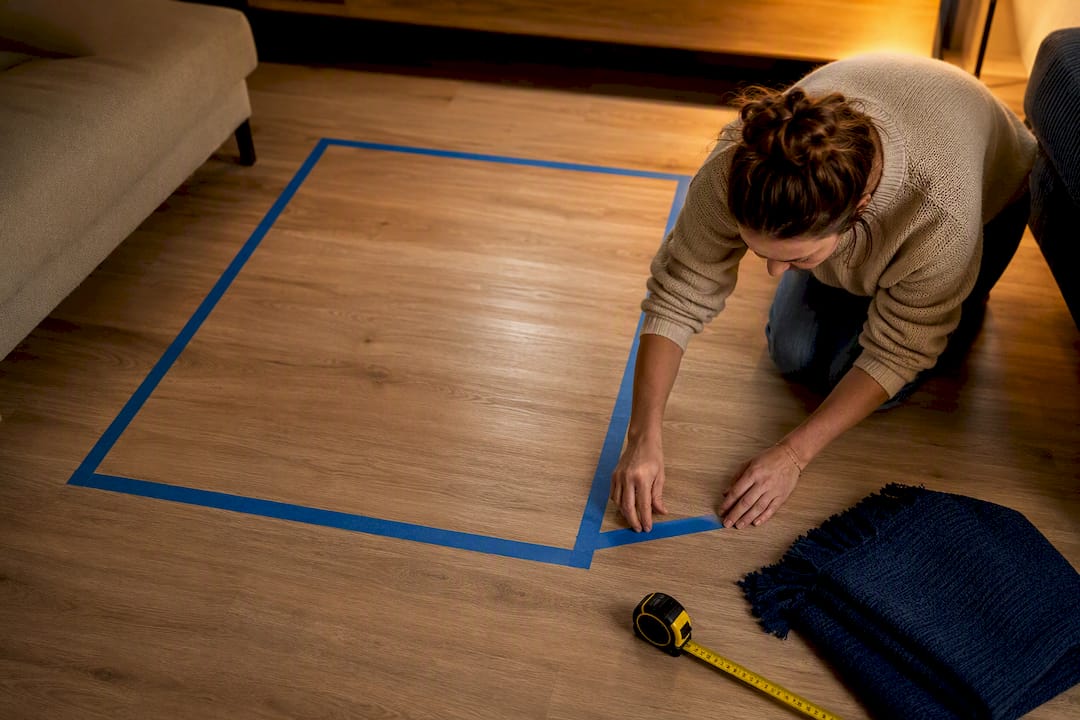
- Tape out the footprint on your floor using painter’s tape, then sit on the sofa and reach forward. If you can’t comfortably touch the far edge, the table is too deep or placed too far out.
- Walk around the taped footprint the way you would in daily life. If you’re squeezing past, adjust the width, depth, or position before you buy.
Before you commit, run through this: does the table sit 1 to 2 inches below your seat cushions? Is the length within a few inches of two-thirds your sofa’s length? Do you have at least 14 inches of reach room and 24 inches to walk?
Pro Tip: Tape out the footprint at night with the lights on. Shadows and lamp placement change how big a space feels, and you’ll catch clearance problems you’d miss in daylight.
Where Should a Coffee Table Sit With a Rug and TV?
Rug size and table placement work together more than most people realize. A rug that only peeks out from under the table edges looks like an afterthought.
You’ve got two solid options: put the entire table on the rug with room to spare on all sides, or set just the front legs of the sofa and the table on the rug, letting the back legs sit on bare floor. Either way, aim for enough rug showing around the furniture that it reads as a defined seating area, not a random square underfoot.
- Keep your 24 to 36 inch walkway clear even after the rug goes down.
- Center the table between the sofa and the TV or focal point, not just visually but by measured distance.
- In narrow rooms or homes with multiple doorways, prioritize the walking path over rug coverage.
- Open-plan layouts benefit from a rug that visually anchors the seating group away from the kitchen or dining area.
If you’re planning a full room layout rather than just a table swap, our guide to building a cohesive living room covers how furniture groupings and traffic paths interact beyond just the coffee table.
Should You Prioritize Storage, Safety, or a Multiuse Surface?
Every coffee table decision involves a tradeoff, and it’s worth deciding upfront which one matters most in your house.
Storage tables with drawers or lower shelves add real function, but depth over 24 inches starts cutting into your walkway, so keep storage tables on the shallower end of the shape ranges above unless your room is genuinely spacious. Families with young kids do better with round or oval shapes and softer edges, and a slightly lower height keeps things safer during floor play. If the table doubles as a dining surface or laptop station, match it closer to seat height rather than dropping the full 2 inches, since a lower surface gets awkward for eating or typing.
- Storage: keep depth under 24 inches when clearance is tight.
- Kid-safe: round or oval shapes, lower height, no sharp corners.
- Multiuse: match seat height closely if it doubles as a work or dining surface.
Pro Tip: If you can’t decide between one large table and better flexibility, a nesting set solves both problems. Pull out the second piece for extra surface during game night, then tuck it away when you need the floor space back.
Why a Showroom Measurement Beats Guessing
Online dimension charts get you close, but they can’t account for your actual sofa’s seat height, your room’s odd angle, or the way your walkway narrows near a doorway. That’s the gap a showroom visit closes. Walking through a furniture showroom with a tape measure and a staff member who has experience fitting many rooms tends to catch sizing mistakes before they turn into a return.
Custom sizing solves the harder cases: awkward alcoves, sectionals that don’t match standard sofa lengths, or rooms where a stock 48 inch table is two inches too long. If you’re already customizing a sofa’s dimensions and profile, pairing it with a table sized to match makes more sense than adjusting around an off-the-shelf piece later. Off-the-shelf, like the Eske coffee table, works fine for standard rooms. Custom earns its cost when your space genuinely isn’t standard.
The Numbers Matter Less Than the Sofa in Front of You
Most coffee table advice treats the two-thirds rule and the height formula like they’re the whole answer. They’re not. They’re a starting point, and design experts are right to frame them that way: the actual decision depends on your specific sofa’s seat height, how deep the cushions sit, and whether anyone in the house is going to put their feet up on it every night.
Where conventional guides fall short is treating every sofa the same. A low-profile sofa with a 16 inch seat height needs a different table than a tall-seat sofa at 19 inches, and the right adjustment depends on the sofa in front of you, not a blanket rule. If the table is also going to hold dinner plates or a laptop twice a week, that changes the height math more than any style guide will tell you.
Prioritize the tape and painter’s tape mockup over any calculator. It takes five minutes, and it will catch a bad fit that a spec sheet never will. The two-thirds rule gets you in the right neighborhood. Your actual living room decides the rest.
— Dean P.
Sources
- Coffee table height guides and rules | BobVila
- Coffee Table Size Calculator | Apartment Notes
- Standard coffee table dimensions | SizeMarker
FAQ
Is a 30-Inch Coffee Table Too Small?
It depends on your sofa. A 30 inch table fits a loveseat or small sofa shorter than a standard sofa, but it will look undersized in front of a standard 84 inch sofa.
What Size Coffee Table Fits a 7-Foot Sofa?
An 84 inch sofa, so two-thirds of that puts your target coffee table length around 56 inches.
What Is the Standard Size of a Rectangular Coffee Table?
Rectangular coffee tables commonly run 42 to 60 inches long and 24 to 30 inches deep, with the shorter end suiting smaller rooms and tighter walkways.