

Home Redesign Checklist: New Furniture, Room by Room
TL;DR:
- Following a step-by-step approach to measuring and planning ensures furniture fits properly and reduces costly returns. Prioritizing anchor pieces early and timing purchases with sales months helps stay within budget and minimizes delays. Coordinating delivery with renovation phases and using tested templates lead to a successful, efficient home redesign.
Use this room-by-room checklist for redesigning your home with new furniture to finish on time, on budget, and with far fewer returns. The eight-step process runs like this: define goals → set a budget → measure everything → sequence anchor pieces first → buy at the right time of year → coordinate delivery → install and adjust → maintain. Full room-by-room details, measurement templates, and a sample budget table follow below.
Your quick-reference checklist (screenshot or print this):
- Define room function, lifestyle needs, and style priorities
- Set a total budget with a 10–15% contingency, then split it by room
- Measure every room, doorway, stairwell, and hallway before ordering anything
- Choose anchor pieces first (sofa, bed, dining table) before rugs or accessories
- Order custom pieces early; schedule ready-to-ship items closer to install
- Confirm delivery type, access path, and floor protection before delivery day
- Inspect every piece on arrival and document any damage immediately
- Follow material-specific care instructions from day one
A printable PDF version of this checklist is linked in the Useful Sources section at the bottom of this article.
Table of Contents
- How do you set a realistic budget and timeline for new furniture?
- How do you measure a room before buying furniture?
- What goes on a room-by-room furniture checklist?
- How do you shop smart and evaluate furniture quality?
- What does a delivery and installation checklist look like?
- How do you align furniture orders with renovation phases?
- What research backs the major recommendations in this checklist?
- Key Takeaways
- The part of furniture redesigns most people get wrong
- Useful sources
- FAQ
How do you set a realistic budget and timeline for new furniture?
A budget without a timeline is just a wish list. Pair the two together and you have a plan you can actually execute.
The 80/20 budget split
A common budgeting approach allocates most funds to anchor and functional pieces, with a smaller portion reserved for secondary items. This keeps the pieces you use every day high-quality while leaving room for the finishing touches that personalize the space.
Always add a contingency of 10–15% on top of your total, as Extra Space Storage’s planning guide recommends. Unexpected delivery fees, a replacement cushion, or a rug that turns out to be the wrong scale in person will eat that buffer fast.
Room-by-room budget allocation
| Room | % of Total Furniture Budget | Priority Anchor Piece |
|---|---|---|
| Living room typically takes the largest share of the budget, prioritizing the sofa or sectional. | ||
| The primary bedroom budget focuses heavily on the bed frame and mattress. | ||
| Dining room budget prioritizes dining table and chairs. | ||
| Home office budget includes desk and ergonomic chair. | ||
| Entry or mudroom area requires a smaller portion of the budget for functional pieces. | ||
| Outdoor furniture budget is generally smaller, focusing on a seating set. |
How do you measure a room before buying furniture?
Measuring is the step most homeowners rush, and it’s the one that causes the most expensive mistakes. Wirecutter’s furniture shopping guide is direct about this: many returns happen because large pieces simply cannot be moved through the home’s entry path. Measure the room, and then measure every inch of the path the furniture must travel to get there.
What to measure
| Measurement | Why it matters |
|---|---|
| Room length and width | Sets the maximum footprint for all furniture |
| Ceiling height | Determines safe height for shelving, beds, and tall cabinets |
| Window placement (height from floor, width) | Affects sofa and console placement |
| Door width and height | Confirms whether boxed furniture can enter |
| Hallway width | Needed for navigating large pieces from entry to room |
| Stairwell width and turn radius | Critical for upper-floor deliveries |
| Outlet and vent locations | Prevents blocking HVAC or requiring extension cords |
| Diagonal clearance at turns | Required for sofas and bed frames that must pivot |
Pro Tip: Measure the diagonal of any large piece (length² + height² = diagonal²) and compare it to the diagonal clearance of your doorway. A sofa that is 84 inches long and 34 inches tall has a diagonal of roughly 91 inches. If your doorway diagonal is smaller, the piece won’t make it in. This is the measurement most people forget, and interior door clearances matter as much as the door width itself.
What goes on a room-by-room furniture checklist?
This is the core of any home furniture makeover checklist. Work through each room in the order below, buying anchors before anything else.
Living room
Anchors first:
- Sofa or sectional (measure for 84–120 inches depending on room width)
- Coffee table (length should be roughly two-thirds the sofa length)
- Primary rug (large enough that front legs of all seating rest on it)
Secondary pieces:
- Accent chair or loveseat
- Side tables (one per seating end)
- Media console or TV stand
Lighting and décor last:
- Floor lamp, table lamps, overhead fixture
- Throw pillows, blankets, art
For small living rooms, a sectional with a chaise often replaces both a sofa and accent chair, freeing floor space. For households with pets or young children, choosing furniture built for the way you actually live means prioritizing performance fabrics over delicate textiles from the start.
Primary bedroom
- Bed frame sized to your mattress (leave 24–30 inches on each walkable side)
- Mattress (test in-store for at least 10 minutes)
- Nightstands (height should be within 2–3 inches of mattress top)
- Dresser or wardrobe
- Bench or accent chair (if space allows)
Dining room
- Dining table (allow 36–48 inches between table edge and wall)
- Dining chairs (seat height 17–19 inches for standard tables)
- Buffet or sideboard
- Pendant lighting (hang 30–36 inches above table surface)
Home office
- Desk (minimum 48 inches wide for dual-monitor setups)
- Ergonomic chair (seat height adjustable, lumbar support included)
- Bookcase or filing cabinet
- Task lighting
An ergonomic office chair and a properly sized desk are the two pieces that affect your daily comfort most in a home office. Seat height, monitor distance, and lumbar support all depend on getting those two anchors right before adding anything else.
Entry and mudroom
- Console table or bench (a leather bench works well for durability and easy cleaning)
- Mirror
- Storage hooks or cabinet
Outdoor
- Primary seating set (weather-resistant frames: powder-coated aluminum, teak, or all-weather wicker)
- Outdoor dining table (if space allows)
- Side tables and weather-resistant cushions
A room-by-room redesign checklist that walks through defining purpose, measuring, and sequencing purchases confirms this order consistently reduces returns and mismatched scale.
How do you shop smart and evaluate furniture quality?
Knowing what to look for in person and what to confirm online separates a confident purchase from a regrettable one. Consumer Reports’ furniture shopping guidance and Wirecutter’s in-store testing advice both emphasize skepticism toward marketing claims and the value of hands-on testing.
Materials at a glance
| Material | Best for | Watch out for |
|---|---|---|
| Performance fabric (e.g., Crypton, Sunbrella) | Pets, kids, high-traffic rooms | Can feel less luxurious than natural textiles |
| Linen/cotton blend | Calm, natural aesthetic | Stains more easily; less durable with pets |
| Full-grain leather | Long-term durability, ages well | Higher upfront cost; needs conditioning |
| Bonded/faux leather | Budget-friendly look | Peels within 2–5 years with regular use |
| Solid hardwood (oak, maple, walnut) | Heirloom-quality pieces | Heavier; more expensive |
| Engineered wood (MDF, plywood) | Budget-friendly; stable in humidity | Less repairable if damaged |
What to test in person
- Sit on every sofa and chair for at least five minutes. Cushion fill that feels firm in the showroom often softens quickly; ask about the fill type (high-density foam, down-wrapped, or spring-assisted).
- Push on the frame corners. A solid frame won’t flex. Any wobble signals weak joinery.
- Open and close every drawer. Dovetail joinery and soft-close glides indicate quality construction.
- Request fabric swatches and test them at home in your actual lighting conditions. Testing samples in your home’s natural light applies equally to upholstery and wall coverings.
For a deeper look at what separates well-built pieces from mass-market ones, the signs of quality furniture construction guide covers frame, joinery, and upholstery in detail.
When to buy and how to negotiate
Furniture retailers follow predictable sale cycles. Consumer Reports identifies January/February and August/September as the strongest months for indoor furniture deals, when retailers clear inventory ahead of new model arrivals. Shoppers who asked for a discount during those windows often secured better prices, since list prices are frequently flexible.
Building a relationship with local showroom staff also pays off. Consumer Reports notes that knowledgeable staff can provide advance notice of upcoming sales and are more likely to work with repeat customers on pricing.
Questions to ask any dealer before buying:
- What is the lead time for this piece, and is it in stock?
- What does the warranty cover, and for how long?
- What is the return or exchange policy if the piece doesn’t fit?
- What are the boxed dimensions, and what delivery type is included?
Avoid common furniture shopping mistakes like ordering without confirming boxed dimensions or skipping the return policy review.
What does a delivery and installation checklist look like?
Getting furniture to the right room without damage requires preparation on your end, not just the delivery crew’s.
Before delivery day
- Confirm delivery type: curbside (you carry it in), threshold (inside the front door only), or white-glove (placed and assembled in the room).
- Re-measure the delivery path: front door, hallway, stairwell, and room entry.
- Protect floors with cardboard, moving blankets, or felt pads on high-traffic paths.
- Clear the path completely, including removing doors from hinges if clearance is tight.
- Confirm the delivery window and have someone present the entire time.
On delivery day
- Inspect every piece before signing. Open boxes and check for damage to frames, legs, and fabric.
- Document any damage with photos immediately and note it on the delivery receipt.
- Do not discard packaging until you’ve confirmed the piece fits and functions correctly.
Pro Tip: For white-glove delivery, ask in advance whether assembly is included or costs extra. Some services place furniture but don’t assemble it. Knowing this before delivery day prevents a frustrating surprise.
How do you align furniture orders with renovation phases?
Furniture arriving before floors are finished or paint is dry creates real problems: scratches, delays, and pieces stored in rooms they don’t belong in. NAHB’s remodeling guidance frames renovation phases clearly, and aligning your furniture orders to those phases prevents most of those headaches.
Renovation phase alignment table
| Renovation phase | What’s happening | Furniture action |
|---|---|---|
| Demo and rough-in | Walls open, subfloor exposed | Order custom pieces now (8–16 week lead time begins) |
| Mechanical and insulation | Electrical, plumbing, HVAC rough-in | Finalize floor plan; confirm all measurements |
| Drywall and paint | Walls closed, painting underway | Order ready-to-ship secondary pieces |
| Flooring installation | Hardwood, tile, or carpet going in | Hold all deliveries until flooring is complete and cured |
| Final trim and clean | Baseboards, doors, final paint touch-ups | Schedule white-glove delivery and installation |
| Punch list complete | Contractor done | Receive and place all furniture |
What to communicate to your contractor
- Identify which rooms need flooring complete before any furniture enters.
- Confirm the date when final paint and trim will be done in each room.
- Agree on a protected-floor protocol for delivery crews (cardboard or Masonite runners).
- Schedule contractor access for any built-ins or fixed cabinetry before furniture placement.
- Get a written completion date for each room so you can confirm delivery windows with confidence.
A short note on permits: if your redesign includes built-in shelving, fixed cabinetry, or structural changes that affect room layout, those elements may require a building permit depending on your municipality. Confirm with your local building department before ordering furniture that depends on those installations being complete.
What research backs the major recommendations in this checklist?
The guidance in this article draws on several well-established sources. Here’s a summary of the strongest evidence-based tips and the templates you can use directly.
Key research-backed tips
- Anchor-first sequencing is recommended by professional designers and validated by Room3D’s AI design framework, which shows that buying a sofa or bed before rugs and accessories prevents scale mismatches and reduces returns.
- January/February and August/September are the peak sale months for indoor furniture, per Consumer Reports. Timing a major purchase around those windows, combined with asking for a discount, gives you the best chance of a lower price.
- Measure the delivery path, not just the room. Wirecutter highlights that doorway and stairwell measurements prevent the most common and costly return scenario.
- A 10–15% contingency on your furniture budget, as recommended by Extra Space Storage’s buying guide, absorbs delivery fees, replacement parts, and scale corrections without derailing the project.
Downloadable templates included with this article
| Template | What it covers | Format |
|---|---|---|
| Room measurement sheet | All dimensions, clearances, and doorway data | PDF / printable |
| Room-by-room checklist | Anchor, secondary, and décor items per room | PDF / printable |
| Sample budget table | Room allocations, contingency, and totals | PDF / CSV |
| Ordering timeline | Order-by and deliver-by dates per piece | CSV |
For a detailed look at how craftsmanship grades affect long-term value, the furniture craftsmanship guide explains what separates custom-built pieces from mass-market alternatives. The upholstery process guide walks through swatch selection and fabric options in detail, which is especially useful when ordering custom pieces remotely.
Key Takeaways
A successful home redesign with new furniture comes down to sequencing: measure first, buy anchors before anything else, and align deliveries with your renovation timeline.
| Point | Details |
|---|---|
| Anchor pieces come first | Buy sofa, bed, or dining table before rugs, lighting, or accessories to avoid scale mismatches. |
| Budget with a contingency | Allocate 10–15% above your furniture total to cover delivery fees, corrections, and replacements. |
| Measure the delivery path | Doorway, hallway, and stairwell dimensions matter as much as room size — many returns happen because pieces won’t fit through the entry path. |
| Time purchases strategically | January/February and August/September are the strongest months for indoor furniture deals, per Consumer Reports. |
| cozyhome furniture | Offers custom sizing, 700+ fabric options, and white-glove local delivery for DFW homeowners ready to buy anchor pieces built for their space. |
The part of furniture redesigns most people get wrong
Most redesign advice focuses on style. Pick a color palette, find your aesthetic, create a mood board. That’s all useful, but it’s not where projects actually break down.
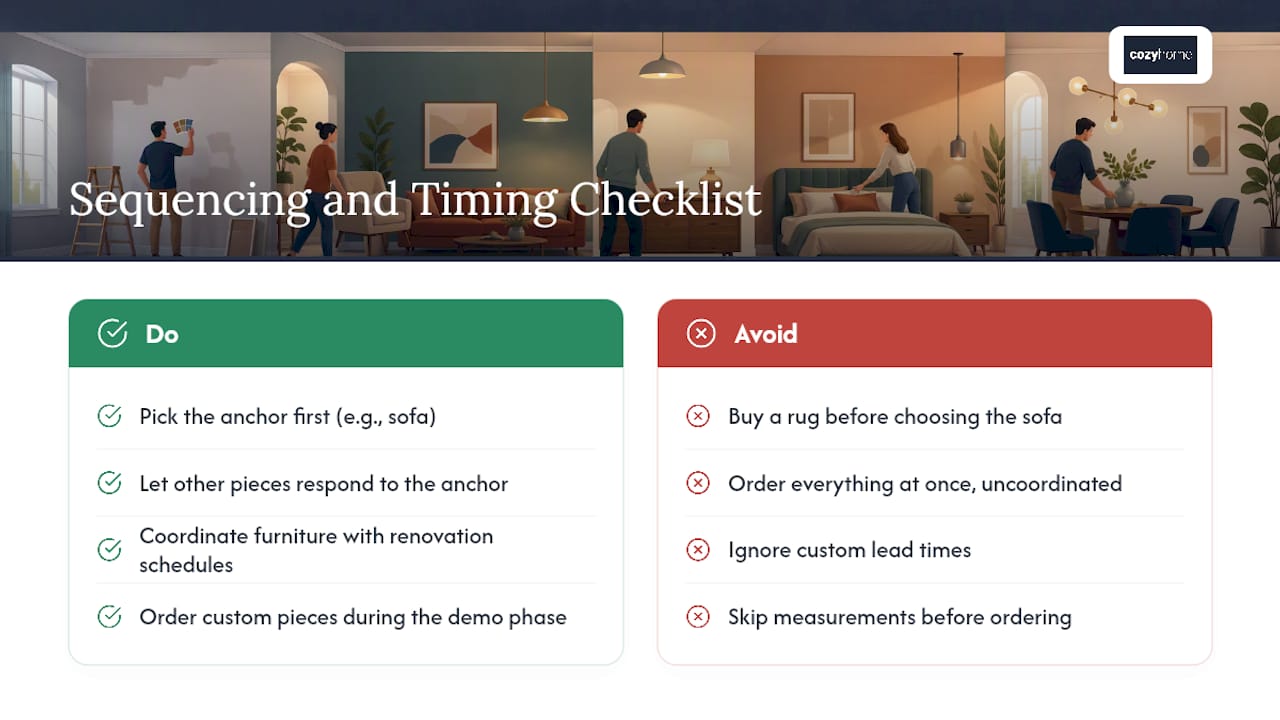
Where things go wrong is sequencing and timing. Homeowners buy a beautiful rug before they’ve chosen a sofa, then discover the sofa they love doesn’t work with the rug’s scale. Or they order everything at once, the custom pieces arrive in 12 weeks, the ready-to-ship items arrive in two, and suddenly the living room is full of boxes while the floors are still being refinished.
The checklist structure in this article exists specifically to prevent those scenarios. The anchor-first rule isn’t a style preference; it’s a practical constraint. The room your sofa defines is a different room than the one you imagined without it. Everything else, the rug, the coffee table, the lighting, should respond to that anchor, not compete with it.
The same logic applies to renovation coordination. Furniture and construction are two separate project tracks that have to be deliberately synchronized. Ordering custom pieces during the demo phase is smart planning, not impatience. It means your 12-week lead time runs concurrently with your contractor’s schedule, so both finish close to the same time.
One more thing worth saying directly: the measurement step is not optional. It’s the single most skipped step, and it’s the one that generates the most returns, the most frustration, and the most wasted money. Measure the room. Measure the doorway. Measure the diagonal. Then order.
Useful sources
Here are the primary sources and tools referenced throughout this article, with a short note on what each covers.
- How to shop for furniture | Consumer Reports
- The Advice I Swear by for Furniture Shopping | Wirecutter (NYT)
- Tips for buying new furniture | Extra Space Storage
- The 10-Step Room Redesign Checklist To Transform Any Space with Confidence — Jane Blog It
- Interior Design Ideas Before Buying Furniture: An AI-Powered Decision Framework (2026)
- How to Choose Furniture for a New Home: A Real Guide (2026)
- How to Buy Furniture: A Step-by-Step Guide for Smart Shoppers - Furniture Path
- Thinking About Home Remodeling? Start Here | NAHB
“Measure the room, measure the doorway, and measure the path the furniture must travel to get there. Most returns happen not because the piece was wrong for the room, but because it couldn’t get into the room in the first place.” — Wirecutter furniture shopping guidance
Downloadable templates (PDF and CSV) for the room measurement sheet, room-by-room checklist, sample budget table, and ordering timeline are available for print from this page. Contact the cozyhome furniture showroom in Plano for in-person help applying any of these templates to your specific floor plan.
FAQ
What is the 30% rule for home renovations?
The 30% rule is a general guideline suggesting you should not spend more than 30% of your home’s current value on a single renovation project, to protect resale value. It applies broadly to remodels, not specifically to furniture purchases.
What is the 60/40 rule for furniture?
Visual balance in a room means a majority of the space should be occupied by larger anchor pieces with enough open area left for circulation and negative space. This balance helps prevent rooms from feeling crowded or sparse. It helps prevent rooms from feeling crowded or sparse.
In what order should home renovations be done?
Renovations typically follow this sequence: demolition, rough-in work (electrical, plumbing, HVAC), insulation, drywall and paint, flooring, then final trim and fixtures. Furniture should be ordered during the rough-in phase for custom pieces and delivered only after flooring and paint are complete.
What are five things that make a living room look dated?
Matching furniture sets where every piece is identical, overly dark window treatments that block natural light, furniture pushed against every wall, a rug that is too small for the seating group, and overhead lighting as the only light source are the five most common culprits.
When is the best time of year to buy furniture?
Consumer Reports identifies January/February and August/September as the strongest months for indoor furniture deals, when retailers clear inventory ahead of new arrivals. Asking for a discount during those windows often results in a better price.