

What Is a Furniture Statement Piece — and How to Choose One
TL;DR:
- A statement furniture piece is a visually dominant item that anchors a room and reflects personal style. It creates visual hierarchy, guides room orientation, and sets an emotional tone, with scale, form, color, and intentional placement being key traits. Typically, one focal point per room is recommended, but multiple can work in large or open-plan spaces if hierarchy is maintained.
A furniture statement piece is a single, visually dominant item that anchors a room’s look, orients the space, and expresses your personal style at a glance. Think of an oversized sofa, a sculptural coffee table, or an architectural cabinet — pieces designed to be noticed first and remembered longest. Every other furnishing in the room plays a supporting role.
Why does this matter? A well-chosen statement piece creates visual hierarchy, gives visitors an immediate sense of the room’s purpose, and sets the emotional tone before anyone sits down. Without one, even a beautifully furnished room can feel directionless.
Pro Tip: Most designers follow a “one statement piece” guideline per room to keep things cohesive. In a large or open-plan space, you can use two or three focal points — but one should always read as the clear leader.
Table of Contents
- What makes a piece of furniture a “statement”?
- Why a statement piece changes how a room feels
- Common types of statement furniture — and why each works
- How to choose the right statement piece for your room
- How to arrange a room around its statement piece
- How material, color, and finish create statement quality
- Small styling moves that make the statement piece shine
- Mistakes people make with statement furniture
- Are statement pieces expensive? Budgeting and value
- Your quick checklist before buying a statement piece
- How cozyhome furniture designs a statement sofa from scratch
- Key Takeaways
- The case for restraint — and knowing when to break it
- cozyhome furniture makes custom statement sofas approachable
- FAQ
What makes a piece of furniture a “statement”?
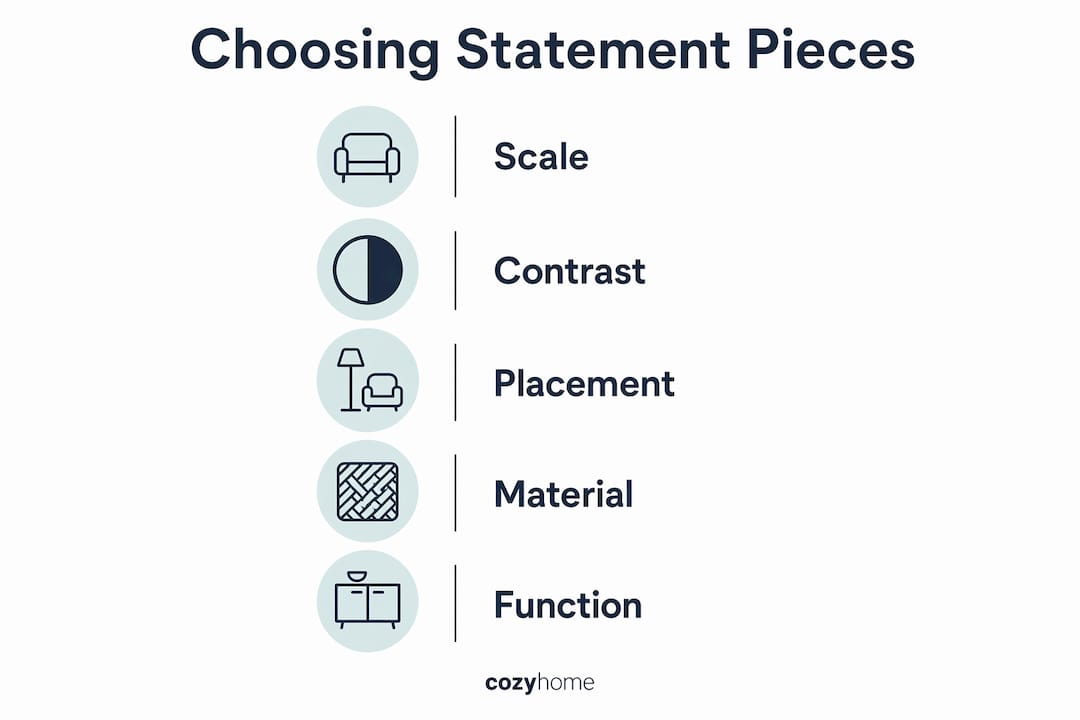
Not every bold or expensive item qualifies. A true statement piece earns its status through a specific combination of traits, and price alone is never the deciding factor.
- Scale relative to the room: The piece occupies enough visual real estate to command attention. A small accent item, no matter how beautiful, reads as clutter rather than a focal point when it’s undersized for the space.
- Distinctive silhouette or form: Sculptural shapes, curved profiles, and architectural proportions make a piece stand out from standard rectangular furniture.
- Bold color, material, or finish: A deep jewel-toned velvet sofa, a stone-topped console, or a lacquered cabinet with a high-gloss finish all create immediate contrast.
- Intentional presence: The piece looks placed, not landed. It reads as a deliberate design decision, not an afterthought.
- Functional clarity: Statement furniture still does its job. A sofa that’s too delicate to sit on or a coffee table too precious to use near loses its authority quickly.
The Cambridge Dictionary defines a statement piece as something noticeable and stylistically defining — not simply unusual or expensive. That distinction keeps the concept grounded in real-world decorating rather than budget-chasing.
Why a statement piece changes how a room feels
A furniture focal point does more than look good. It tells people where to look, where to sit, and what the room is about. Visual orientation happens almost instantly — when a statement piece works, visitors understand a room’s layout and primary function without a tour.
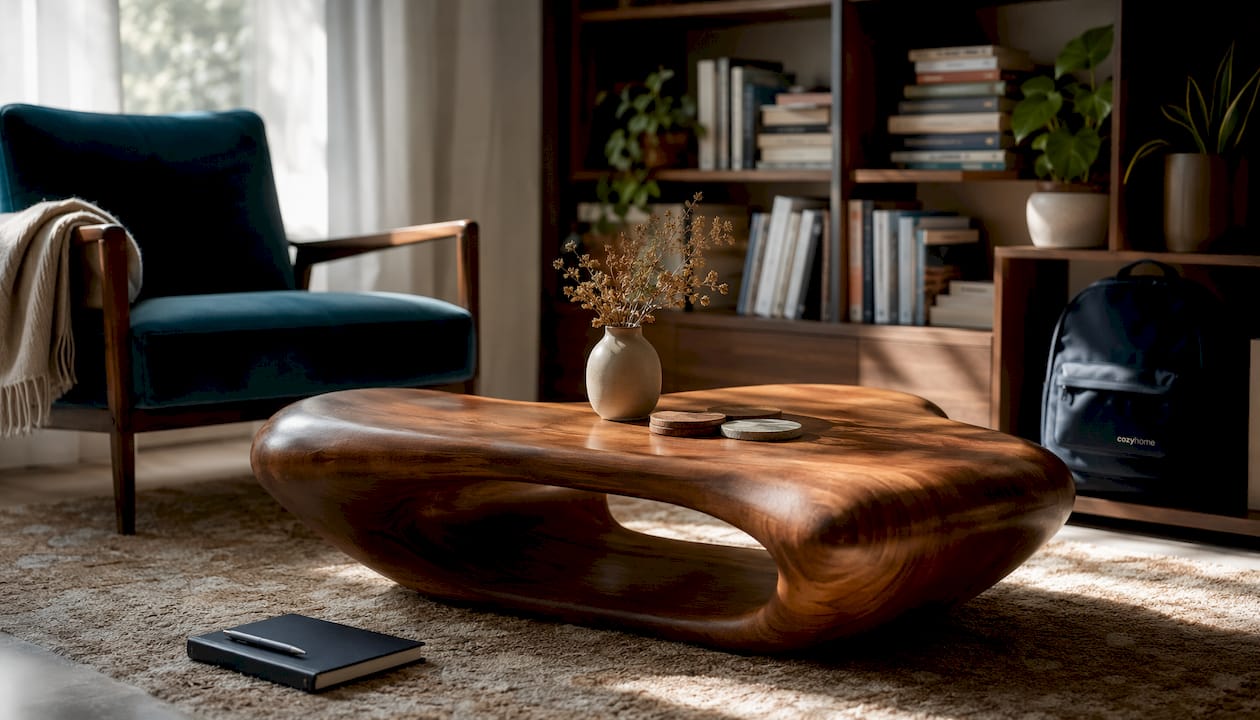
The emotional effects are just as real. A bold sofa in a confident color signals personality. A sculptural coffee table becomes a conversation starter. Rooms with a clear anchor tend to feel more considered and more welcoming, even when the rest of the furnishings are simple.
Contemporary luxury design leans into this idea fully. Fewer, higher-impact pieces give rooms a curated, gallery-like quality where craftsmanship can actually be appreciated. The restraint is the point.
Common types of statement furniture — and why each works
A focal point can be a single piece or a composed grouping. Here are the most common furniture types that take on this role, and what makes each one effective.
- Large sofas and sectionals: Scale is the primary reason. A generously proportioned sofa in a rich fabric or unexpected color occupies enough visual weight to anchor an entire living room. The silhouette matters too — a curved back or low-slung profile reads differently than a boxy standard frame.
- Sculptural coffee tables: Shape and material do the heavy lifting here. A multicolor sculptural table or a matte black geometric design draws the eye to the center of the seating area and holds it there.
- Accent chairs and wingbacks: A single chair in a bold pattern or an unexpected finish can command a corner without competing with the sofa. Pattern and form work together — a wingback in a graphic fabric reads as a statement even in a neutral room.
- Lighting at furniture scale: Chandeliers and oversized pendants function as statement pieces the moment they drop low enough to interact with the furniture below them. Current chandelier design trends favor sculptural forms that read as art objects, not just light sources.
- Rugs as anchors: A large-format rug with a strong pattern or color defines a zone and grounds the furniture above it. When the rug is bold enough, it becomes the statement and the furniture can stay quieter.
- Architectural cabinetry: A floor-to-ceiling bookcase or a lacquered sideboard brings architectural weight to a room that lacks built-ins. These pieces work because they fill vertical space and create a backdrop for everything in front of them.
Wall art can also serve as a room’s focal anchor when no single furniture piece is large enough. A statement wall piece follows the same rules: scale, contrast, and intentional placement.
How to choose the right statement piece for your room
Choosing well means measuring before you fall in love with something. Here’s a practical sequence.
- Measure the room and set scale boundaries. Note the length of the wall your piece will occupy. A sofa or cabinet should cover at least one-third of that wall to read as a focal point rather than furniture floating in space. Mark minimum and maximum footprints on the floor with painter’s tape before shopping.
- Run the sightline test. Stand in the doorway. Then sit in the primary seating position. The sightline test from both positions tells you whether the piece will be visible and oriented correctly for daily use, not just for first impressions.
- Connect it to the room with one or two shared elements. A statement piece should surprise but still belong. Match one color, one material, or one proportion to something already in the room. A deep navy sofa in a room with navy throw pillows reads as intentional; the same sofa in a room with zero blue reads as a mistake.
- Decide function first. Are you prioritizing comfort, durability, or sculptural impact? A family room with kids and pets needs a statement piece that can handle real use. A formal sitting room has more latitude for delicate materials.
- Ask yourself two questions before buying: “Will this dominate the room in a way I’ll still love in five years?” and “Does it fit how we actually live?” Trend-driven choices can feel dated quickly; pieces chosen for form and function tend to stay satisfying.
- Consider custom sizing when standard dimensions don’t fit. If your room has an unusual footprint, low ceilings, or a sightline that standard furniture doesn’t address, a made-to-order piece is often the most practical solution. cozyhome furniture’s custom sofa process starts with exactly these measurements.
Pro Tip: Bring a photo of the room and your measurements to the showroom. Seeing a fabric or finish in context — even on a phone screen — helps you make a faster, more confident decision.

How to arrange a room around its statement piece
Once you have the piece, the arrangement of everything else follows from it.
- Orient primary seating toward the focal piece. Placing the main sofa with its back to the statement item creates a “backwards” room — a common orientation error that makes the space feel disconnected. Seating should face or angle toward the anchor.
- Use symmetry when you want calm, asymmetry when you want energy. Two matching chairs flanking a fireplace reads as formal and settled. One accent chair offset from a sofa reads as relaxed and modern. Neither is wrong — choose based on the room’s purpose.
- Group supporting pieces as a composition. A side table, a floor lamp, and a small plant placed near the statement sofa read as a deliberate cluster. The same items scattered randomly compete with the focal piece rather than supporting it.
- Account for visual weight, not just physical size. A dark, matte piece reads heavier than a light, glossy one of the same dimensions. Balance a visually heavy statement piece with lighter-toned supporting furniture on the opposite side of the room.
Pro Tip: In open-plan spaces, use multiple focal points — one per zone — but keep a clear hierarchy. The living room anchor should be the most visually dominant. The dining or workspace anchor should be secondary in scale or color intensity.
In large or open-plan rooms, designers use multiple anchors to serve distinct zones, but one always remains the dominant focal point to prevent visual competition.
How material, color, and finish create statement quality
The right material does two things at once: it creates presence now and holds up over time.
| Material | Statement Effect | Durability | Care Level |
|---|---|---|---|
| Velvet upholstery | Rich color depth, tactile contrast | Moderate | Medium — brush regularly |
| Full-grain leather | Warm, aged presence | High | Low — wipe clean |
| Solid sculpted wood | Architectural weight | Very high | Low |
| Stone or marble top | Luxury, visual mass | High | Medium — seal periodically |
| Brushed metal frame | Industrial contrast | High | Low |
Colors that read as statement-level include saturated jewel tones (deep teal, forest green, burgundy), high-contrast neutrals (matte black, warm ivory), and unexpected accents like terracotta or dusty rose against a neutral backdrop. The contrast between the piece and its surroundings is what creates the effect — a navy sofa against a white wall creates immediate visual hierarchy in a way that a beige sofa against a cream wall simply cannot.
- Matte finishes feel grounded and contemporary; they absorb light rather than reflect it.
- Glossy or lacquered finishes command attention from across the room and work well in smaller spaces where you want the piece to feel larger.
- Hand-applied patinas and artisanal textures signal craftsmanship and tend to age beautifully, which is why luxury design increasingly treats statement furniture as collectible objects rather than replaceable goods.
Small styling moves that make the statement piece shine
Supporting pieces should frame the focal item, not fight it.
- Use a floor lamp or pendant positioned just outside the statement piece to draw the eye toward it with light.
- Keep side tables and accent pieces low-profile and quieter in color so they don’t compete.
- Repeat one color or finish from the statement piece in small doses — a throw pillow, a vase, a book cover — to create cohesion without redundancy.
- Allow negative space around the piece. Crowding it with accessories diminishes its presence.
Simple pairing suggestions:
- Bold sofa: Pair with a low, simple coffee table in a natural material (wood or stone) and a solid-color rug that picks up one tone from the sofa.
- Sculptural coffee table: Keep the sofa neutral and the rug understated. Let the table’s form do the work.
- Accent chair: Place a single floor lamp behind it, one small side table beside it, and leave the wall behind it relatively bare.
Mistakes people make with statement furniture
Most missteps fall into a few predictable patterns.
- Multiple competing statement items in the same sightline. Designers follow the one-statement-piece rule precisely because too many focal items fragment a room’s visual logic. If everything competes, nothing wins.
- Wrong scale — too small or too large. A piece that’s too small reads as clutter. One that’s too large overwhelms the room and blocks circulation. The painter’s tape test before buying prevents both.
- Ignoring sightlines. A beautiful piece placed where it’s only visible from the doorway but not oriented for daily use creates a backwards room. The primary seating should feel connected to the anchor.
- Assuming price equals statement quality. A $300 secondhand cabinet in a striking finish can outperform a $3,000 generic piece in a forgettable neutral.
Quick fixes:
- If multiple pieces compete, choose one and neutralize the others with slipcovers, paint, or repositioning.
- If scale is wrong, reposition the piece to a room where it fits, or use a large rug to visually contain an oversized item.
- If sightlines are off, rotate the seating arrangement before buying anything new.
Are statement pieces expensive? Budgeting and value
Statement furniture spans a wide price range, and the right investment level depends on how central the piece is to daily life.
- Under $600: Large-format art prints, secondhand statement furniture with strong bones, or an oversized mirror can all create focal impact at low cost.
- $600–$2,000: Quality vintage or antique pieces, custom-painted furniture, or well-made mid-market sofas in distinctive fabrics.
- $2,000 and up: Custom-sized, made-to-order pieces in premium materials — the category where longevity and exact fit justify the investment.
The general principle: spend more on pieces you touch every day (sofas, chairs, beds) and less on purely visual anchors (art, mirrors, cabinetry you don’t open often). Reupholstering a well-built vintage frame in a bold fabric is one of the most cost-effective ways to create a high-impact statement piece without starting from scratch.
Pro Tip: Before buying new, check estate sales and auction houses for solid-wood frames with good proportions. A quality reupholstery job on a well-built vintage sofa often costs less than a new piece of comparable quality — and the result is genuinely one-of-a-kind.
Your quick checklist before buying a statement piece
Use this before committing, whether you’re shopping in-store or online.
Measurements and clearance:
- Does the piece fit within your target scale range (minimum one-third of the wall it occupies)?
- Is there at least 18 inches of clearance on the primary traffic path around it?
- Will it fit through your door, hallway, and stairwell?
Visual checks:
- Sightline test: visible and oriented correctly from the doorway AND from the primary seating position?
- Does it share at least one color, material, or proportion with something already in the room?
- Does the contrast level feel intentional rather than accidental?
Functional checks:
- Can it handle your actual lifestyle (kids, pets, daily use)?
- What’s the maintenance requirement, and are you willing to meet it?
- Does the finish or fabric age well, or will it look tired in three years?
Final decision prompt: Keep it if it passes the scale, sightline, and lifestyle checks. Tweak it (different finish, different fabric) if the form is right but the details aren’t. Pass if it only works in isolation and doesn’t connect to the room.
How cozyhome furniture designs a statement sofa from scratch
The most common scale mistake we see at cozyhome furniture is a sofa that’s the right style but the wrong size — either too short for the wall or too deep for the room’s traffic flow. Custom ordering solves this before it becomes a problem.
Here’s how the process works:
- Design intake: You bring your room measurements, photos, and a sense of how the space is used. We map the sightlines together and identify the ideal footprint for the sofa.
- Material and finish selection: With 700+ fabric and leather options, we help you find the color and texture that creates presence without overwhelming the room. Deep navies, warm taupes, and rich leathers are popular choices for statement sofas.
- Configuration decisions: Sectional or straight? Low back or high? These choices affect how the sofa reads from the doorway and how it functions for daily use. We work through them with you so the finished piece fits both the room and the way you live.
- Approval and production: Once the configuration and fabric are confirmed, your sofa is built to order with American-made craftsmanship. No warehouse guessing — every dimension is intentional.
- Delivery and placement: Free local delivery to Plano, Frisco, Allen, McKinney, and surrounding DFW communities means we’re there when the piece arrives, not just when you buy it.
Pro Tip: Bring three things to your showroom visit: a photo of the room, the wall measurement where the sofa will sit, and a clear sense of your primary use case (entertaining, daily lounging, or both). Those three inputs cut the decision time in half.
Key Takeaways
A furniture statement piece works because it combines the right scale, a clear visual contrast, and deliberate placement — not because it’s the most expensive item in the room.
| Point | Details |
|---|---|
| Definition | A statement piece is a single dominant item that anchors a room’s look, mood, and orientation. |
| Scale comes first | The piece should cover at least one-third of the wall it occupies to read as a focal point. |
| One piece per room | Designers follow a one-statement-piece rule per room; open-plan spaces can use more, with one clearly dominant. |
| Connect before contrasting | Share at least one color, material, or proportion with the existing room to keep the piece cohesive. |
| cozyhome furniture | Custom, made-to-order sofas built to your exact measurements prevent the most common scale and sightline mistakes. |
The case for restraint — and knowing when to break it
There’s a version of statement furniture advice that makes the whole thing sound intimidating: one piece, strict rules, no exceptions. We’d push back on that framing a little.
The “one statement piece” guideline exists because most rooms genuinely benefit from a single clear anchor. When everything competes, nothing wins — and the room feels restless rather than designed. That part is real, and it’s worth taking seriously.
But restraint doesn’t mean timidity. The clients who end up happiest with their rooms are usually the ones who committed to something specific: a sofa in a color they actually love, a coffee table with a shape that makes them stop and look every time they walk in. The mistake isn’t being bold. The mistake is being bold in three directions at once.
In large or open-plan spaces, multiple focal points are not just acceptable — they’re necessary. The key is hierarchy. One anchor leads; the others support. A living room sofa in a deep teal reads as the dominant piece even when there’s a dramatic dining table twenty feet away, as long as the two don’t fight for the same visual register.
The practical takeaway: measure first, commit to one clear leader, and let everything else play a quieter role. That’s the whole framework. The rest is just choosing something you genuinely like.
cozyhome furniture makes custom statement sofas approachable
Getting a perfectly scaled statement sofa doesn’t have to mean settling for whatever’s on the showroom floor. At cozyhome furniture, we build sofas and sectionals to your exact room dimensions, with your choice of fabric or leather from over 700 options — so the piece fits the space the way it should, not the way a warehouse decided.
For DFW homeowners in Plano, Frisco, Allen, McKinney, and surrounding communities, the process is straightforward: visit our showroom, bring your measurements and a photo of the room, and we’ll work through scale, configuration, and fabric together. No pressure, no guesswork. The Excelsior sofa in cream and the Excelsior in gray are two of our most popular statement-sofa starting points — both available in custom dimensions and a full range of fabric and leather finishes. Free local delivery and flexible financing make the next step easy. Stop by the showroom or browse our made-to-order sofas online to get started.
FAQ
What is a statement piece in furniture?
A statement piece is a visually dominant furniture item — like an oversized sofa, sculptural coffee table, or architectural cabinet — that serves as a room’s focal point and anchors the overall design.
What is the 2–3 rule for furniture?
In open-plan or large spaces, designers may use two or three focal points to serve distinct zones, but one should always remain the dominant anchor to prevent visual competition between areas.
Are statement pieces expensive?
Not necessarily. Statement quality comes from scale, color, and form — not price. A secondhand cabinet in a striking finish or a reupholstered vintage sofa can create as much impact as a high-end new piece.
What is considered a statement piece?
Any furniture item that is noticeable, stylistically defining, and clearly the focal point of a room qualifies. Sofas, accent chairs, coffee tables, rugs, lighting, and architectural cabinetry can all serve this role when they have the right scale and visual contrast.