

Stop Greenwash: 5 Furniture Materials to Verify in Store
If you’re buying furniture with sustainability in mind, prioritize five material groups: responsibly sourced solid or reclaimed wood, rapidly renewable plants like bamboo, cork, and hemp, recycled metals and plastics, natural upholstery fabrics such as linen, organic cotton, and wool, and emerging bio-based materials like mycelium. Look for FSC, OEKO-TEX, GOTS, or Cradle to Cradle marks as quick trust signals, then use the buying checklist below to confirm the claims before you spend a dollar.
TL;DR:
- Certified FSC or PEFC hardwoods offer the best durability and long-term value despite a higher upfront cost.
- Reclaimed wood avoids new logging but requires provenance testing for contaminants like lead paint or chemicals.
- Rapidly renewable materials like bamboo and cork grow fast but can be compromised by formaldehyde-based adhesives.
- Recycled metals and plastics have lower energy footprints and are highly recyclable, making them ideal for frames and outdoor furniture.
- Durability and repairability, including disassembly and certified sourcing, outweigh material choice alone for eco-friendly furniture.
Table of Contents
- Eco-Friendly Furniture Materials That Actually Hold Up
- Choosing Sustainable Upholstery Fabrics
- Avoiding High-VOC Finishes and Engineered Wood
- How to Verify Non-Toxic Furniture Before You Buy
- Why Durability Beats Every “Green” Material Alone
- Your Sustainability Checklist for Furniture Shopping
- What a Showroom Visit Reveals That a Product Page Can’t
- Where Sustainable Materials Actually Come From
- Comparing the Environmental Footprint of Furniture Materials
- What Life Cycle Analysis Tells You About a Piece of Furniture
- Emerging Materials Reshaping Furniture Manufacturing
- Balancing Sustainability With Furniture That Lasts
- Certifications to Verify Before You Buy
- Sources
- FAQ
Eco-Friendly Furniture Materials That Actually Hold Up
Not every “green” material performs the same way in a living room, and the differences matter more than most product pages let on. Some materials earn their eco-friendly label through how they’re grown; others earn it through what happens after the tree is already cut down or the metal is already melted. Knowing which is which helps you spend money on substance instead of a marketing sticker.
FSC and PEFC-certified hardwoods remain the safest bet for solid wood furniture. The Forest Stewardship Council certifies timber harvested from forests managed for long-term health, not just this quarter’s yield, and the Programme for the Endorsement of Forest Certification offers a comparable international scheme. Ask for the certificate number and check it against the certifier’s public registry rather than trusting a logo printed on a tag. Certified oak, maple, and walnut cost more up front, but they also tend to outlast cheaper composite alternatives by decades.
Reclaimed wood skips new logging entirely, pulling material from old barns, factories, and shipping pallets. That saves the carbon cost of growing and milling a fresh tree, but it introduces a new risk: old lead paint, industrial chemical residue, or structural rot hiding under a nice patina. Always ask the maker for the wood’s provenance and how it was tested before finishing.
Bamboo, cork, and hemp grow back fast enough to make “renewable” a fair description rather than a stretch. Bamboo can mature in three to five years compared to decades for hardwood trees, and cork is harvested by stripping bark from living oak trees that keep growing. Both work well for tabletops, panels, and structural accents. The catch is processing: some bamboo composites use formaldehyde-based adhesives to bind fibers together, which undercuts the environmental win, so ask what glue was used.
Recycled metals and plastics deserve more credit than they usually get in sustainability conversations. Recycled metal production uses far less energy than smelting virgin ore, and it stays just as recyclable at the end of its life, which makes it a strong choice for sofa frames, table bases, and outdoor furniture that needs to survive weather. Recycled plastic, meanwhile, makes more sense for durable outdoor pieces than for anything you want to feel warm indoors.
Bio-based composites are the newest entrants. Some manufacturers now bind waste fibers with resin systems, similar to Matek-style composite technologies, to build panels designed to be taken apart and recycled rather than landfilled. Mycelium, grown from mushroom root structures, is showing up in packaging and experimental furniture panels, though it’s still mostly paired with traditional materials rather than replacing them outright.
- Solid FSC/PEFC wood: best long-term durability, higher upfront cost
- Reclaimed wood: lowest new-material footprint, requires provenance checks
- Bamboo and cork: fast-renewing, watch for adhesive quality
- Recycled metal and plastic: strong for frames and outdoor use, energy-efficient production
- Mycelium and bio-composites: promising, still niche, best combined with proven materials
For anyone weighing species-specific durability against sustainability, our guide to wood species for tables breaks down which hardwoods age well under daily use.
Pro Tip: Bring a small magnet and a flashlight when shopping in person. A magnet helps you spot hidden steel brackets in “solid wood” frames, and a flashlight lets you check the underside of a piece for particleboard panels dressed up with a veneer.
Choosing Sustainable Upholstery Fabrics
Fabric choice affects your indoor air and your carbon footprint just as much as the frame underneath it. Organic linen, hemp, and GOTS-certified organic cotton sit at the top of the list because they grow with fewer pesticides and less water than conventional cotton, and they biodegrade at the end of their life instead of shedding microplastics for decades.
Recycled polyester and recycled PET fabrics are a fair compromise when you need stain resistance or heavier wear tolerance, especially for a family sofa that will see daily traffic. The trade-off is real, though: it’s still a synthetic that sheds microfibers in the wash and won’t biodegrade. If you go this route, ask the supplier for the actual recycled content percentage rather than accepting a vague “eco fabric” label.
Wool deserves a mention on its own. It’s naturally flame-resistant, durable, and biodegradable, and GOTS-certified wool batting can replace chemical flame retardants in cushions entirely.
- Look for OEKO-TEX Standard 100 on any fabric, which screens for harmful substances in the finished textile
- Look for GOTS on cotton, linen, and wool specifically, which covers the full organic supply chain from farm to finished bolt
- Ask what percentage of a “recycled” fabric is actually post-consumer material, since blends vary widely
For side-by-side performance comparisons, our breakdown of performance velvet versus microfiber covers how synthetic and natural-leaning fabrics hold up to daily family use.
Avoiding High-VOC Finishes and Engineered Wood
Particleboard and standard MDF are often bound with formaldehyde-based resins, which off-gas volatile organic compounds for months or years after the piece arrives in your home. You won’t smell all of it, which is exactly the problem.
- Ask for products that meet ULEF or TSCA Title VI formaldehyde emission standards
- Prefer low- or zero-VOC finishes and natural oils like linseed or tung oil over conventional lacquers
- Veneers aren’t automatically a problem, but confirm what substrate sits underneath and what adhesive bonds it
- Request a product data sheet rather than relying on a salesperson’s verbal assurance
A maker willing to hand over documentation on request is usually a maker with nothing to hide.
How to Verify Non-Toxic Furniture Before You Buy
VOCs typically come from three sources: adhesives in engineered boards, certain fabric treatments, and conventional finishes. The one most people miss is flame retardant chemicals hiding inside upholstery foam.
Flame retardants remain common in furniture foam, even though natural latex and GOTS-certified wool batting can meet fire-safety standards without added chemical treatment. Look for OEKO-TEX or Greenguard certification on finished pieces, and don’t hesitate to ask directly whether the foam contains flame retardant chemicals. A supplier who can produce a safety data sheet on request is one you can trust more than one who deflects the question. If a piece already smells strongly of chemicals in the showroom, air it out for several days before it becomes a permanent fixture in your bedroom or living room.
Why Durability Beats Every “Green” Material Alone
A sofa that lasts twenty years and gets reupholstered twice beats a “sustainable” one that falls apart in three, no matter what it’s made from. Longevity and repairability often do more for your footprint than any single material choice.
- Check for mechanical fasteners like screws and dowels instead of staples and glue, since mechanical joints can be taken apart and fixed
- Ask whether cushion covers are removable and replaceable separately from the frame
- Confirm whether the maker offers a repair service, replacement parts, or a take-back program at end-of-life
- Prefer kiln-dried solid wood frames, which typically outlast composite ones by decades
Our buyer’s guide to signs of quality construction walks through exactly what to look for underneath the upholstery.
Pro Tip: Flip any sofa or chair over before buying. If you see staples holding the frame together instead of screws or dowel joints, that piece was built for a showroom floor, not for your living room over the next decade.
Your Sustainability Checklist for Furniture Shopping
Bring this list with you or drop it into an email before you buy anything.
- Confirm the material’s origin (species, region, recycled content percentage)
- Request certification numbers for FSC, GOTS, or OEKO-TEX and check them against the certifier’s registry
- Ask for the product data sheet or safety data sheet covering foam and finish
- Ask about disassembly, repairability, and replacement parts
- Ask whether a take-back or recycling program exists at end-of-life
- Note shipping distance and packaging waste if you’re ordering online
Questions worth asking a salesperson or emailing a maker directly:
- “Can you provide the FSC or GOTS certificate number for this piece?”
- “What adhesive or finish was used, and is there a product data sheet?”
- “Does the foam contain flame retardant chemicals, and is there an alternative?”
- “Is this frame repairable, and are replacement parts available?”
Red flags include vague terms like “eco fabric” with no certification attached, refusal to provide a data sheet, and staff who can’t answer basic sourcing questions. Screenshot claims and save certificate numbers before you commit, a habit our guide to common furniture shopping mistakes covers in more detail.
What a Showroom Visit Reveals That a Product Page Can’t
Standing in front of 700-plus fabric and leather options at our Plano showroom, you can feel the difference between a heavy natural linen and a thin synthetic blend in a way a product photo never shows. cozyhome furniture’s in-store team can pull the product data sheet on any foam or finish while you’re standing there, so you’re not guessing about VOC content or flame retardant chemicals after the sale is final. Ask about repair options and construction details before you commit, whether you’re eyeing something like the Excelsior sofa in cream or building a custom piece from scratch.
Where Sustainable Materials Actually Come From
A certification label tells you what standard a material met, but it doesn’t tell you the whole supply chain story behind it. Responsible sourcing starts at the harvest, whether that’s a managed forest, a bamboo grove, or a cork oak stand.
FSC and PEFC both require chain-of-custody tracking, meaning the wood’s path from forest to factory to showroom floor gets documented at every handoff. That paperwork trail is what lets you verify a claim instead of just believing it. Cork harvesting is worth understanding specifically: workers strip bark from living oak trees roughly once every nine years, and the tree survives and keeps growing, which is part of why cork carries such a strong sustainability reputation compared to materials that require cutting down the source plant.
Reclaimed wood sourcing works differently. Instead of a managed harvest, suppliers salvage material from demolition sites, old barns, and decommissioned factories, which means the “harvest” already happened decades ago. The tracking that matters here isn’t forest management, it’s contamination testing, since old structures sometimes carry lead paint or industrial residue that needs to be identified and removed before the wood becomes furniture.
Recycled metal and plastic sourcing depends on collection infrastructure rather than land management, pulling from scrap yards and post-consumer waste streams. The strength of that supply chain rests on how well the material gets sorted and processed before it’s melted or reformed, which is part of why asking about recycled content percentage matters more than the word “recycled” itself.
Comparing the Environmental Footprint of Furniture Materials
Every material trades one kind of impact for another, and the honest comparison depends on what you’re optimizing for. Wood generally holds carbon that the tree absorbed while growing, so a solid wood piece can function as a small carbon store for its entire lifespan, provided the forest it came from was replanted responsibly. Rapidly renewable materials like bamboo and hemp typically need less water and fewer years to regrow than hardwood trees, which lowers the resource cost of each harvest cycle.
Cotton is the outlier worth flagging: conventional cotton farming is notoriously water-intensive, which is exactly why organic and GOTS-certified cotton, grown with different irrigation and pesticide practices, matters so much for upholstery decisions.
Recycled metal shows its advantage most clearly in energy use rather than water, since melting scrap metal takes a fraction of the energy required to refine virgin ore. Synthetic materials like virgin plastic and polyester carry a different burden entirely: they’re derived from petroleum, and they don’t return to the earth the way wood, cork, or wool eventually do.
No single material wins on every metric. A responsibly sourced solid wood frame paired with a natural fiber fabric and recycled metal legs spreads the impact across categories rather than concentrating it in one.
What Life Cycle Analysis Tells You About a Piece of Furniture
A life cycle analysis tracks a product from raw material extraction through manufacturing, transportation, years of use, and eventual disposal or recycling. For furniture, this framework exposes a truth that a single “eco-friendly material” label often hides: the use phase and end-of-life phase can matter as much as what the piece was made from in the first place.
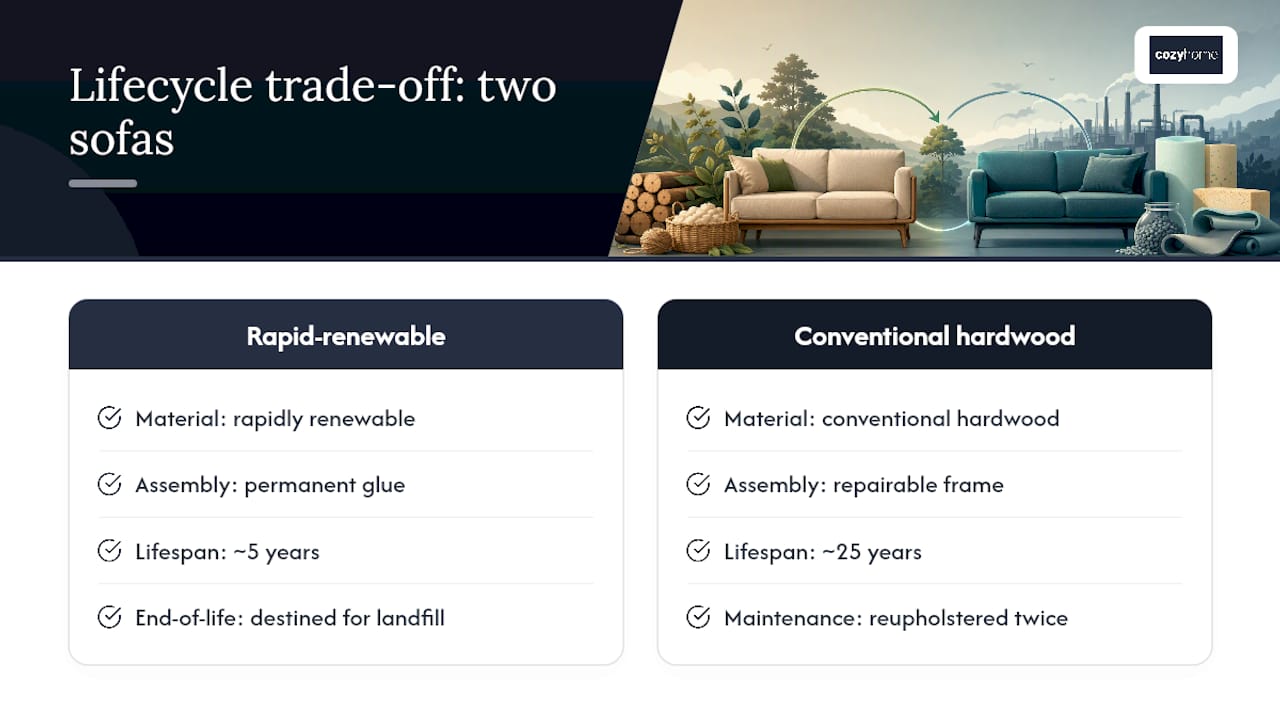
A sofa built from a rapidly renewable material but assembled with permanent glue and destined for landfill in five years may carry a heavier full lifecycle footprint than a well-built piece made from conventional hardwood that lasts twenty-five years and gets reupholstered twice along the way. This is why durability and repairability, covered earlier, aren’t a separate concern from material choice. They’re part of the same equation.
Transportation also factors into a full life cycle view, though it’s usually a smaller share of the total footprint than manufacturing and raw material extraction. A locally built piece cuts shipping distance, but a piece built to last three decades from imported certified wood can still outperform a locally sourced item that falls apart in four years. The math rewards longevity more often than it rewards proximity alone.
End-of-life is the phase most shoppers never think about until the piece is already worn out. A frame built with mechanical fasteners can be disassembled, repaired, or recycled in parts. One built with adhesive and staples usually can’t, which means the entire piece becomes waste at once instead of components that could have had a second life.
Emerging Materials Reshaping Furniture Manufacturing
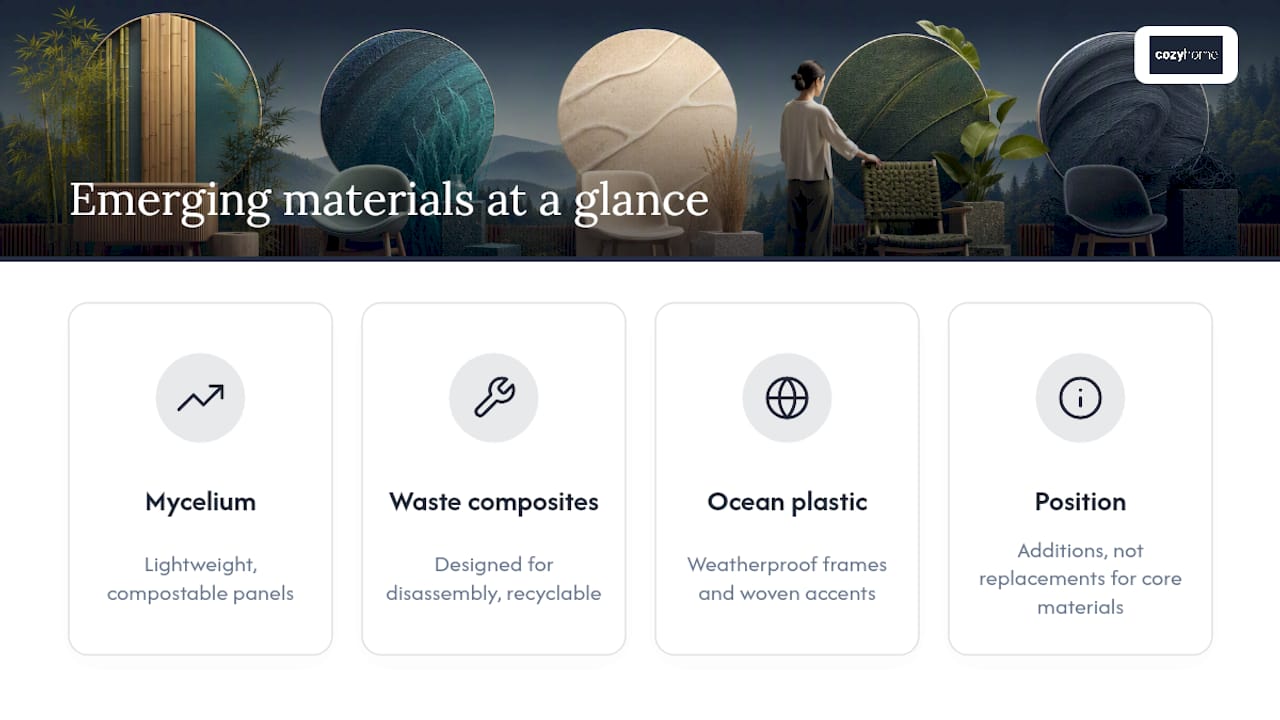
Mycelium is the material generating the most attention right now, and for good reason. Grown by feeding mushroom root structures agricultural waste in molds, it can be shaped into lightweight, compostable panels and packaging. Reporting from the World Economic Forum notes it’s still mostly experimental and paired with conventional materials rather than standing in as a full furniture material on its own, but the trajectory is worth watching.
Composite technologies built from waste fiber and binder systems, similar to Matek-style materials, represent a different kind of innovation: designing the disassembly into the product from day one, so panels can be separated and recycled rather than landfilled as a single fused unit. That “designed for disassembly” philosophy is likely to spread further as manufacturers face more pressure to document a product’s end-of-life plan, not just its origin story.
Recycled ocean plastic and reclaimed fishing net fiber are also finding their way into outdoor furniture lines, turning marine waste into weatherproof material for frames and woven accents. None of these newer materials are ready to replace certified wood, natural fiber textiles, or recycled metal as the backbone of a sustainable furniture purchase. They’re better understood as promising additions to a category that’s still mostly won by getting the fundamentals right: verified sourcing, low-toxicity construction, and a piece built to last.
Balancing Sustainability With Furniture That Lasts
The most sustainable piece of furniture is usually the one you don’t have to replace. Certifications and material lists matter, but repairable construction and honest sourcing documentation matter more over a piece’s full lifetime. That’s the standard worth holding every purchase to, custom or otherwise.
— Dean P.
Certifications to Verify Before You Buy
Check certificate numbers directly with these registries rather than trusting a badge alone.
- FSC US for forest management certification
- Rainforest Alliance for forestry and agricultural sourcing
- Cradle to Cradle Certified Product Standard for circular design
- PEFC for international forest certification
- Green America’s eco-friendly furniture guide for toxicity and flame retardant guidance
Sources
- FSC US
- Rainforest Alliance — What does Rainforest Alliance certified mean?
- Cradle to Cradle Certified™ Product Standard resources
- World Economic Forum — mycelium and sustainable materials
- Green America — How to find eco-friendly furniture
FAQ
What Are Some Eco-Friendly Building and Furniture Materials?
Bamboo, cork, reclaimed wood, FSC-certified hardwood, recycled metal, recycled plastic, hemp, natural latex, organic cotton, and mycelium composites all qualify as eco-friendly options depending on how they’re sourced and processed.
What Type of Furniture Is Most Sustainable?
Furniture built from responsibly sourced solid wood or reclaimed wood, assembled with mechanical fasteners instead of glue, and designed for repair or disassembly, tends to have the lowest lifetime environmental impact.
What Are the Most Eco-Friendly Materials for Furniture?
FSC-certified wood, reclaimed wood, bamboo, cork, recycled metal, and organic natural fibers like linen, hemp, and GOTS-certified cotton and wool rank among the most eco-friendly choices available today.
What Furniture Is Chemical-Free?
No furniture is entirely chemical-free, but pieces using natural latex, GOTS-certified wool batting, low-VOC or zero-VOC finishes, and OEKO-TEX certified fabrics minimize flame retardant chemicals and off-gassing compared to conventional options.
How Can I Tell If Furniture Is Genuinely Sustainable?
Ask for certificate numbers for FSC, GOTS, or OEKO-TEX and verify them on the certifier’s own registry, and request a product data sheet covering foam, finish, and adhesive before you buy.